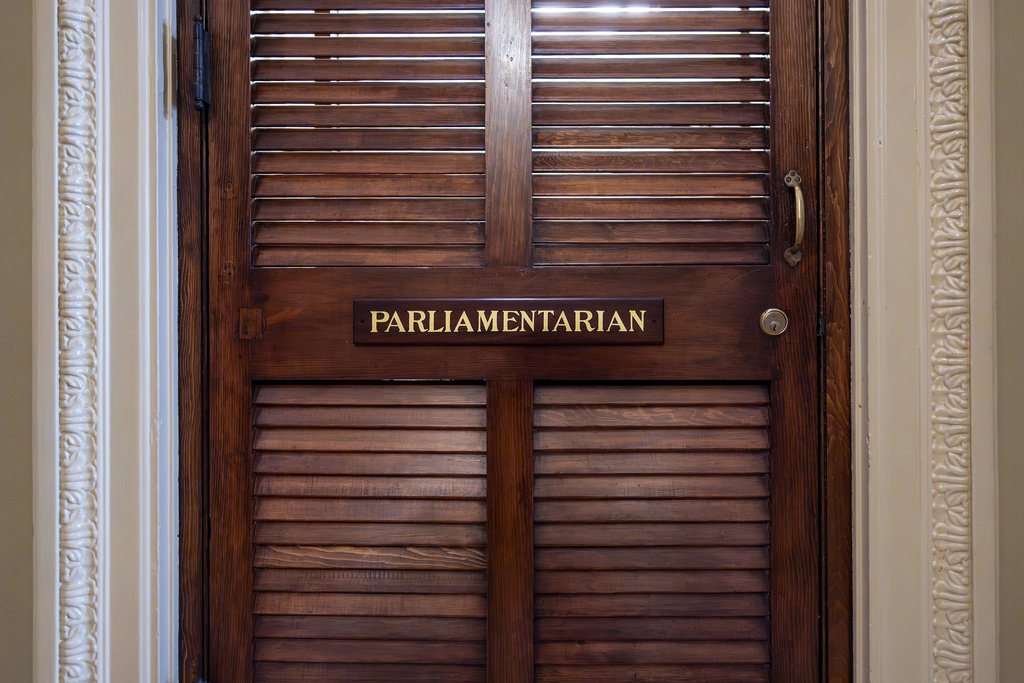
President Trump has recently called for the removal of Senate parliamentarian Elizabeth MacDonough, criticizing her interpretations of Senate rules and precedents. The parliamentarian, a nonpartisan position created in 1937, advises the presiding officer on procedural matters but does not make final rulings—that power rests with the vice president, president pro tempore, or the designated senator in the chair. Yet Trump’s frustration, particularly over the Byrd Rule, has reignited debate about the role of this little-known but crucial figure.
The immediate flashpoint is the Safeguard American Voter Eligibility (SAVE) Act, which Trump wants to advance through budget reconciliation—a fast-track process that shields legislation from filibusters. But the Byrd Rule, enshrined in the Congressional Budget Act, strictly limits what can be included in reconciliation bills to provisions with direct budgetary impact. MacDonough is widely expected to rule that key elements of the SAVE Act violate that standard.
G. William Hoagland, a former staff director for the Senate Budget Committee, argues that Trump’s attack on MacDonough misunderstands her role and risks undermining the Senate’s integrity. “The parliamentarian does not rule on questions posed to the chamber but advises,” he writes, noting that the presiding officer can accept or reject her advice. Still, her guidance carries weight because it is rooted in decades of precedent.
The Byrd Rule itself has a bipartisan pedigree. In 1981, Senate Majority Leader Howard Baker and Minority Leader Robert C. Byrd—the rule’s namesake—joined forces with Budget Committee leaders to restrict non-budgetary provisions in reconciliation bills. The amendment passed unanimously. Four years later, Majority Leader Bob Dole and Byrd codified the rule into law, defining six specific violations that render a provision extraneous, including lack of budget impact, incidental fiscal changes, and changes to Social Security.
Byrd himself later warned against using reconciliation to pass major policy shifts, such as the 2010 health care overhaul. He insisted that non-budgetary policies must undergo full Senate debate under regular order. Hoagland echoes that sentiment, cautioning that allowing the SAVE Act’s voting provisions into a budget bill would undermine the chamber’s deliberative purpose.
Beyond the Byrd Rule, Hoagland reminds readers of MacDonough’s heroism on January 6, 2021, when she and her staff swiftly removed Electoral College ballot boxes from the Capitol as rioters breached the building. “Had it not been for their quick action, the threat to our democracy that day would have been even deeper,” he writes.
MacDonough and her team should not be scapegoated for doing their jobs, Hoagland concludes. Rather, they deserve gratitude for upholding the procedural guardrails that allow the Senate to function—even when those guardrails frustrate a president’s agenda.
The debate comes as House Republicans advance a $95 billion budget blueprint that includes defense spending, farm aid, and voter ID provisions, signaling that reconciliation battles are far from over. Meanwhile, GOP leaders are already planning a fourth reconciliation package, as the third faces internal skepticism.