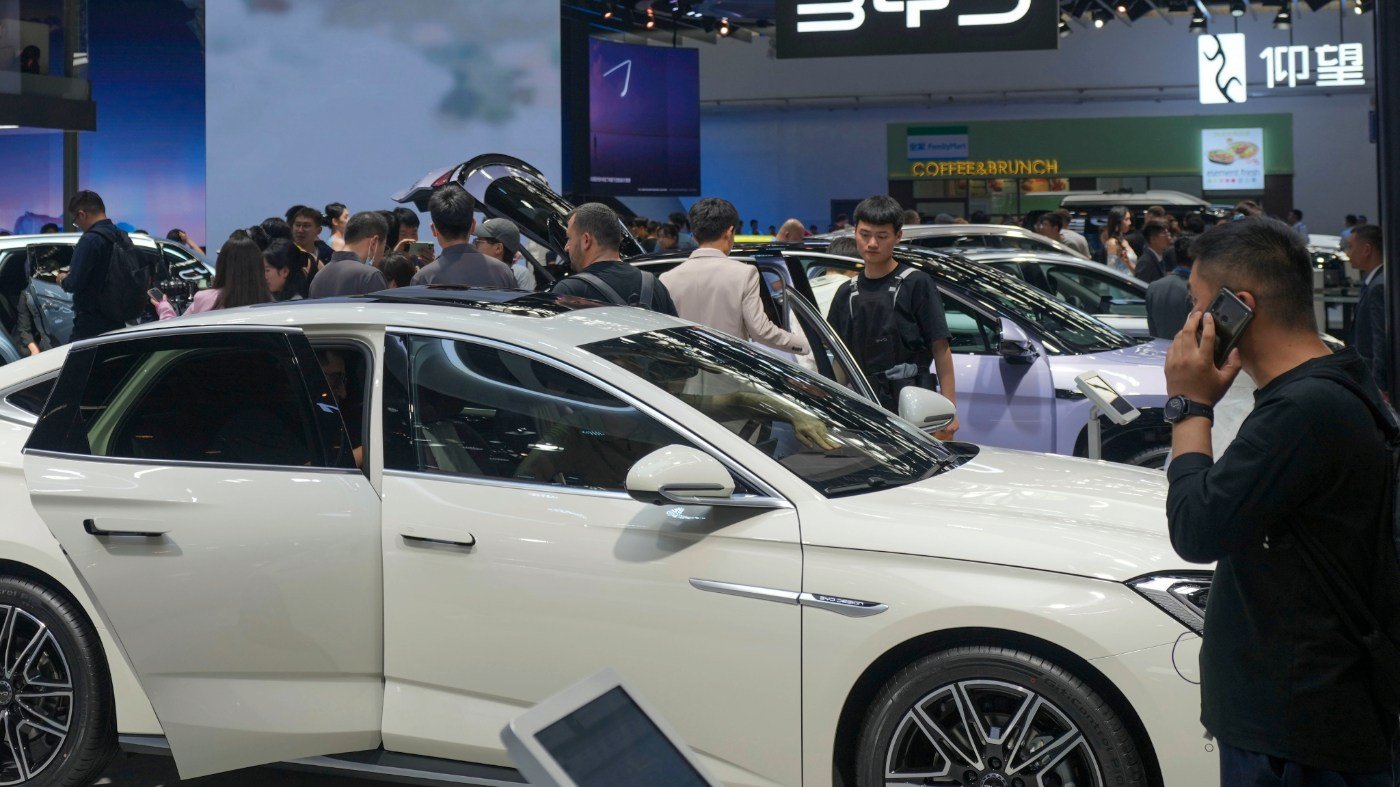
The Alliance for Automotive Innovation, a trade group representing major U.S. automakers, has formally requested that Congress enact a “permanent ban” on the sale, import, and manufacture of Chinese-made vehicles in the United States. In a letter sent Thursday to top congressional leaders, the group’s president, John Bozzella, argued that China’s automotive industry operates on a foundation of “unfair trade, subsidies, intellectual property theft and surveillance.”
The letter was addressed to Senate Majority Leader John Thune (R-S.D.), Senate Minority Leader Chuck Schumer (D-N.Y.), Speaker Mike Johnson (R-La.), and House Minority Leader Hakeem Jeffries (D-N.Y.). Bozzella pressed lawmakers to act before the 119th Congress adjourns in January, calling for a “permanent ban on the sale, import and manufacture of Chinese connected vehicles.”

“Right now, Chinese automakers are dumping subsidized vehicles with connected software and hardware around the world,” Bozzella wrote, pointing to China’s expanding presence in Europe, Australia, Southeast Asia, Mexico, and South America. “This hasn’t happened inside the U.S. yet, but given the scale and urgency of this threat, we urge you to enact a Chinese vehicle, software and hardware ban before adjourning this year and make this policy the law of the land.”
The Alliance for Automotive Innovation describes itself as representing the “entire” U.S. auto industry. Its request comes amid growing bipartisan concern in Washington over the national security implications of Chinese-made vehicles, which can collect data and be remotely controlled.
Lawmakers have already taken preliminary steps. In July, the Senate Commerce Committee advanced legislation that would bar companies with more than 15 percent Chinese ownership from selling vehicles in the U.S. That measure would have significant consequences for foreign automakers; for example, Mercedes-Benz would be unable to sell cars in the country because Chinese investors hold nearly 20 percent of its shares.
In the House, Reps. Debbie Dingell (D-Mich.) and John Moolenaar (R-Mich.) have introduced a companion bill, the “Connected Vehicle Security Act of 2026,” which has 72 additional co-sponsors from both parties. Bozzella acknowledged these efforts, writing that lawmakers “are determined to get the details of this policy right.”
“Enacting a permanent ban on Chinese vehicles and high-risk hardware and software in the 119th Congress will send a clear and bipartisan message that China’s strategy to dominate global automotive manufacturing will be met with a national security policy response from the American government,” he added.
The push comes as the Biden administration has also taken steps to restrict Chinese vehicle technology, including proposed rules on connected vehicle software. However, the industry’s call for a legislative ban would provide a more permanent solution, immune to executive branch changes. The issue is likely to remain a key point of contention as the 2026 midterm elections approach.
For more on related political developments, see public trust in government and the White House’s recent press engagement.