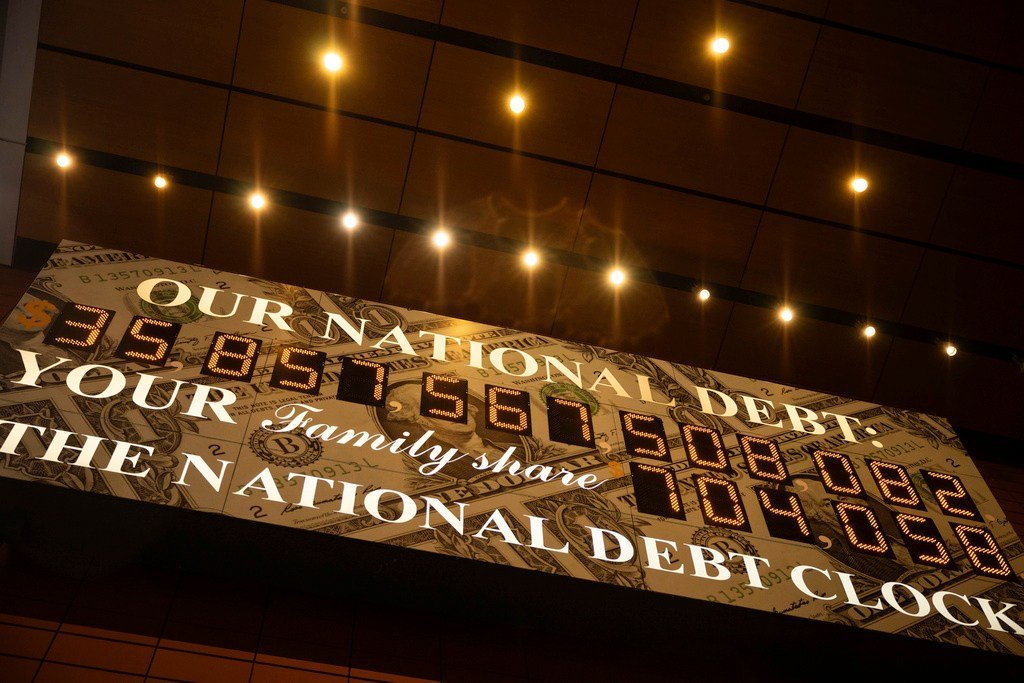
The U.S. national debt has crossed the $40 trillion mark, prompting the usual hand-wringing in Washington. But according to Peter J. Tanous, chairman emeritus at Lynx Investment Advisory, the standard prescriptions—cutting entitlements, trimming waste, closing loopholes—are nowhere near enough. The only realistic path forward, he argues, is a major new revenue source: a value-added tax.
Tanous, co-author of "The End of Prosperity," lays out the arithmetic that makes spending cuts a dead end. In fiscal 2026, Medicare alone will cost roughly $1 trillion; eliminating it entirely—a political non-starter—would close only about half of the current deficit. Social Security, at $1.7 trillion and growing, is even more untouchable. And if Congress zeroed out every agency typically labeled "waste"—the EPA, Education Department, State Department, foreign aid—that would trim just 13–14% of the budget. There is simply no spending-cut scenario that gets the job done.
The full budget picture is stark. The Congressional Budget Office projects total federal spending of about $7.7 trillion in fiscal 2026. Mandatory programs—Social Security, Medicare, Medicaid—account for 73% of that, or $5.6 trillion, and require no annual vote. Discretionary spending, which Congress actually controls, is roughly $2 trillion, split between defense ($900 billion) and everything else ($1.1 billion).
Then there's the interest bill. This year, the government will pay about $1.1 trillion just to service the debt. With debt held by the public now above $32 trillion—and a third of it, over $10 trillion, needing refinancing in the next 12 months—the cost is set to climb. The average interest rate on that debt is 3.3%, but current rates are 0.5 to 1.3 points higher. Each one-point rise costs the Treasury $300–$400 billion annually. Rolling over a third of the debt at today's rates adds roughly $100 billion to the interest tab before any new spending.
For Tanous, the solution is clear: a value-added tax, paired with sensible spending restraint. Every developed country except the U.S. already has a VAT. It taxes value added at each stage of production, and exempting essentials like food and clothing can soften its regressive edge. Yes, it raises prices, but as Tanous notes, "There is no version of closing a $40 trillion hole that doesn't."
The usual objection is that a VAT becomes a hidden revenue machine that Congress will endlessly expand. Tanous acknowledges that risk but argues it can be managed with safeguards, like requiring a supermajority to raise the rate. "The real choice isn't between a VAT and no new tax," he writes. "It's between a VAT we design carefully now and a forced, far more painful reckoning later."
What could it raise? The CBO scores a 5% VAT at $350 billion in 2027, rising to $440 billion by 2034 on a broad base. Tanous proposes a 10% rate, which the Tax Foundation estimates would cut the primary deficit by about $1.6 trillion a year conventionally—or $1.3 trillion after accounting for a modest drag on GDP. That's the only lever big enough to matter, especially compared to Europe's average standard VAT rate of 21%.
To address fairness, Tanous suggests exempting necessities and pairing the tax with a rebate for low-income households, similar to Canada's GST credit. "The time has come to face reality," he says. "Numbers don't lie. Do nothing, and we risk a financial and stock market crisis that would dwarf 2008–2009."
As the national debt tops $40 trillion, Washington's fiscal avoidance is deepening. Tanous's proposal is a sharp challenge to a political class that has so far shown little appetite for hard choices.