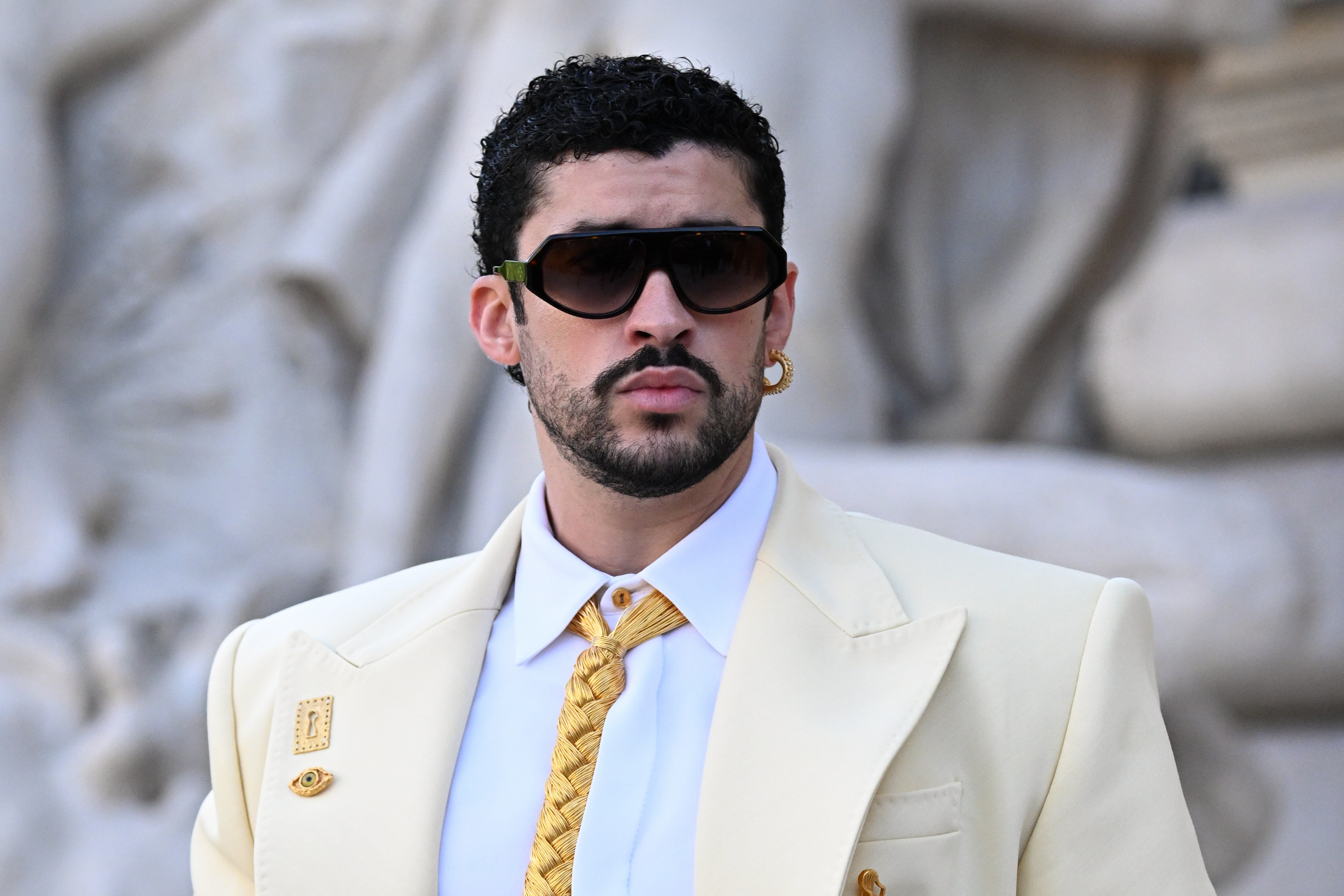
When Bad Bunny first encountered a viral TikTok track featuring an AI clone of his voice alongside fake verses from Daddy Yankee and Justin Bieber, he didn't laugh it off. He took to his WhatsApp channel and urged fans who enjoyed it to leave the group. That was months ago, and the problem has only escalated since.
As the 27th Annual Latin Grammy Awards nominees are announced during National Hispanic Heritage Month, the stakes for Latin artists have never been clearer. An investigation by The Atlantic this summer uncovered AI training datasets containing roughly 21.2 million tracks, including Bad Bunny's catalog, ingested without authorization or compensation. Universal Music Group and Sony Music are suing the AI platform Suno, having identified tens of thousands of their recordings inside its training data. Somewhere in those datasets lie the rhythms of reggaetón, the melodies of salsa, the voices of Latin trap—the raw material of the world's most streamed music, converted into fuel for machines.

The flood isn't confined to training data; it's in the catalogs. Deezer reports that nearly half of its daily music uploads are now AI-generated. Every day, synthetic tracks compete for the same playlists, royalties, and listener attention as human-made recordings. For Latin music—the most streamed genre family on the planet—that competition hits hardest.
The timing is consequential. In 2025, Latin music revenue in the U.S. crossed $1 billion for the first time, growing for a 10th straight year. Yet a study commissioned by the International Confederation of Societies of Authors and Composers warns that music creators could lose nearly one-quarter of their income to generative AI by 2028—a cumulative €10 billion. The community creating the planet's most in-demand sound stands to lose the most from the technology trained on it.
This echoes a painful history. Latin music has been undervalued before, during the era when "crossover" was the industry's highest compliment and Spanish-language records were treated as niche products even as they outsold English ones. Each time, the culture led, the business followed, and creators settled for whatever was offered. AI is the first technology that can separate a voice from its owner entirely. If the pattern repeats now, it won't be with a bad contract; it will be with no contract at all.
Two Paths Forward
Two futures are already arriving. In May, a bipartisan coalition in Congress reintroduced the NO FAKES Act, which would give every American the federal right to control AI replicas of their voice and likeness, with takedown procedures for unauthorized fakes. Meanwhile, Suno launched new models under licensed partnerships with Warner Music Group and BMG, with payment for participating artists—proof that AI companies can choose consent and compensation over scraping. The industry is deciding, right now, whether Latin music's AI era will be built on partnership or on taking.
Practical protection starts with unglamorous things: contracts that explicitly address AI training, metadata that travels with every recording, and collective muscle. Latin artists organized before to win fairer streaming economics, and they can organize around AI too. No single artist, no matter how large, can audit a 21-million-song dataset alone.
The fight cannot stop at the U.S. border. Latin music is a global repertoire, and an AI model trained in one country can clone a voice heard in every other country. American law, even a strong NO FAKES Act, protects only part of the picture. As lawmakers push for more AI oversight, the industry must recognize that international coordination is essential.
Every student who records a vocal track today should understand that the recording might one day train a model, and that the law and their contracts—not a terms-of-service they never read—should decide what happens next. This is why the timing of National Hispanic Heritage Month matters. We will spend September and October marveling at Latin music's global triumph: the billion-dollar revenues, the stadium tours, the chart records. But celebration without protection is just nostalgia with better lighting. The artists and communities who gave the world reggaetón, salsa, bachata and Latin trap deserve more than applause. They deserve to own their voices in an age of machines that can imitate them flawlessly.
Heritage, at its best, is not only what we remember—it is what we refuse to give away. AI has learned to sing in Spanish. The question National Hispanic Heritage Month should force us to answer is whether the people who taught it will get paid.
José Valentino Ruiz is an associate professor of music business and entrepreneurship at the University of Florida and an associate member of the AI for Health Institute at the UF College of Medicine. He is a multi-Latin Grammy Award-winning composer, producer, and recording engineer.