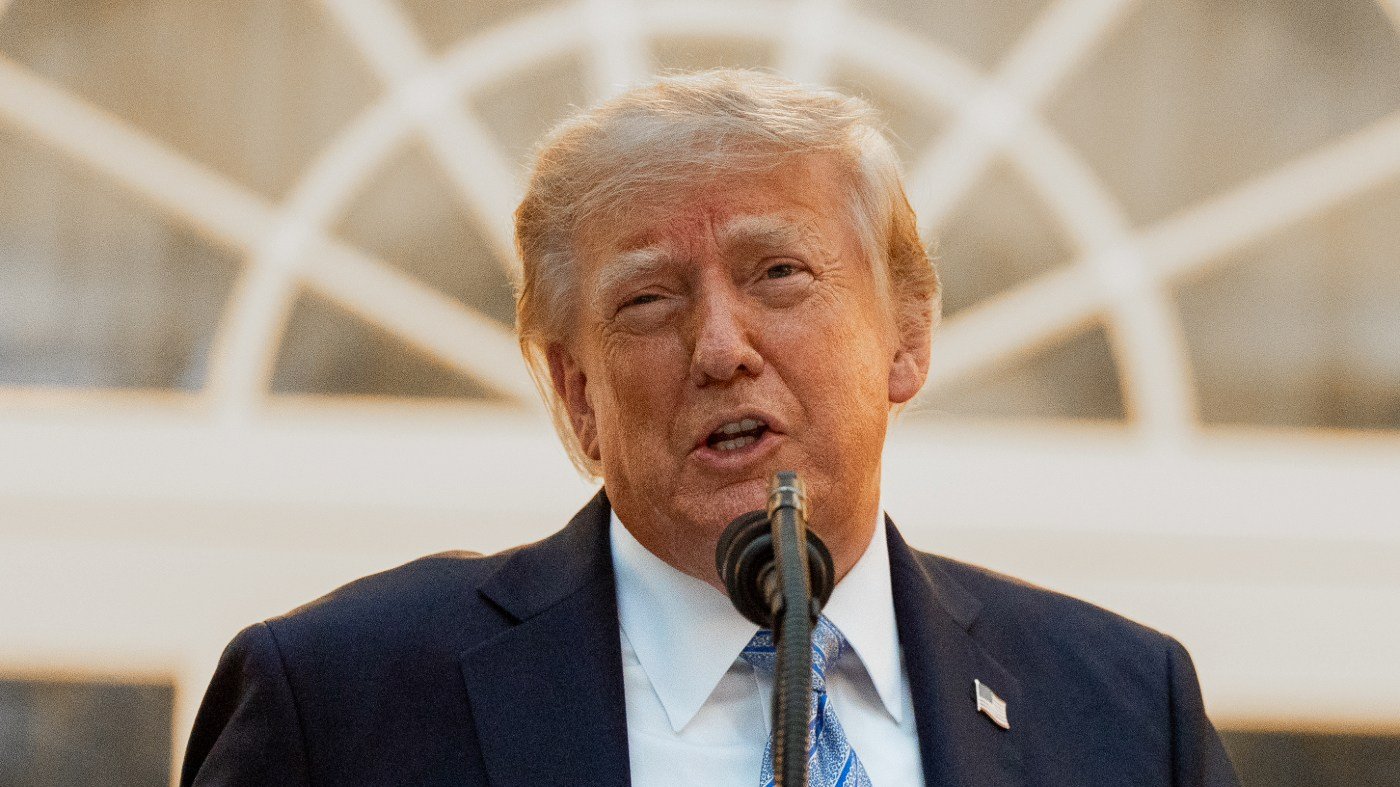
President Donald Trump on Sunday again raised the prospect of a devastating military strike against Iran, asking aloud, “if and when do I blow the entire nation up?” The remark, delivered during a private conversation, underscores the administration’s escalating rhetoric as it weighs options for Tehran.
Fox News correspondent Trey Yingst, who relayed the president’s comments, said Trump is in a “deciding mode” and that “very big things are going to be happening in the not so distant future.” According to Yingst, Trump described the available choices as “wiping Iran out, letting them rot economically or making a deal.” He then added: “My question is if and when do I blow the entire nation up? They better behave.”

The latest threat follows Trump’s Thursday remarks to Axios, in which he said he was weighing whether to “go in and annihilate them [the Iranian regime] or do I not,” adding that anything “could happen with me.” These comments come as the administration prepares for a high-stakes diplomatic week at the United Nations General Assembly, where Trump is expected to meet with six Persian Gulf leaders. The administration has also allowed a “core delegation” of Iranian officials, including President Masoud Pezeshkian and Foreign Minister Abbas Araghchi, to attend the high-level session.
This is not the first time Trump has threatened to obliterate Iran. In April, he warned that “a whole civilization will die” unless “maybe something revolutionarily wonderful can happen.” That threat, tied to a deadline, briefly pushed Tehran to the negotiating table and produced a short-lived ceasefire.
The ongoing U.S.-Israeli campaign against Iran has sent global energy prices soaring, with the national average for a gallon of gas hitting $4.48 on Sunday, according to AAA. Iran’s closure of the Strait of Hormuz, a critical chokepoint for oil shipments, has been a primary driver of the nearly seven-month price surge. Trump, however, has downplayed the pain at the pump, touting the low prices that preceded the Feb. 28 strikes.
“It’s a very inexpensive price to pay for what we’ve done. Remember that. It’s a little more. Frankly, even if it was a lot more,” Trump said at a rally for Republican Senate nominee Michael Whatley in Gastonia on Wednesday. “But that’s going to come tumbling down. That’s going to be like rocket ships in reverse.”
Republicans are now on the defensive as Democrats make the cost of living a central issue in the upcoming midterm elections. Senator Lisa Murkowski (R-Alaska) voiced frustration, noting that Alaskans are questioning the administration’s timeline. “As I’m talking to Alaskans, they’re saying, ‘Wait a minute, he said we were going to be in and out in a matter of weeks,'” she said last week. “And not only are we still there but this is what I am feeling in my community when it comes to the cost of the war. I’m not satisfied with where we are. Not at all.”
The administration’s aggressive posture has also drawn scrutiny over domestic security measures, including military upgrades to the D.C. arch amid heightened tensions. Meanwhile, Trump’s broader foreign policy moves, such as escalating tensions with Canadian Prime Minister Mark Carney ahead of the UNGA, signal a combative approach on multiple fronts.
As the administration weighs its next move, the international community watches closely. Trump’s latest rhetoric, while consistent with his past statements, raises the stakes for a region already on edge. With gas prices high and midterm elections looming, the political fallout of any decision on Iran is likely to be significant.