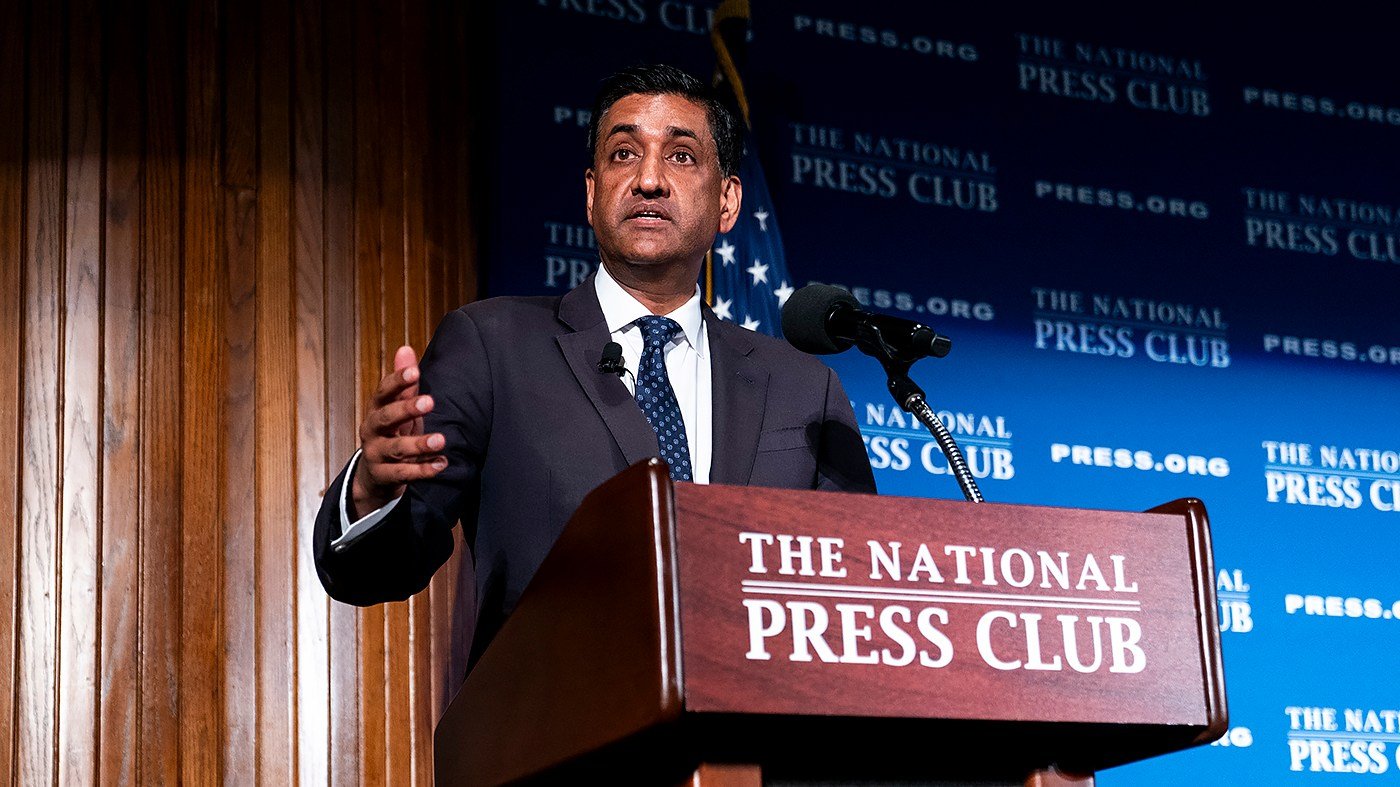
Rep. Ro Khanna (D-Calif.) on Sunday made the case for a new federal agency dedicated to regulating artificial intelligence, drawing a direct comparison to the Food and Drug Administration. Speaking on CBS News' "Face the Nation," Khanna argued that AI's rapid development demands institutional oversight, not just voluntary industry commitments.
"Well, we need to set up an AI agency like the FDA," Khanna told host Margaret Brennan. He also expressed uncertainty about the Trump administration's approach, saying, "I don't know what President Trump's vision is, I don't know if he's using AI in an offensive capability, which would give me a lot of pause."
Khanna invoked the warnings of Nobel laureate Geoffrey Hinton, often called the "Godfather of AI," to stress that regulation should mirror how the government handles nuclear energy, electricity, and aviation. "Have independent technical experts make sure AI is safe," he said, paraphrasing Hinton.
The California Democrat pushed back against tech executives who claim Washington is too ill-equipped to regulate complex technologies. "One of the things that really annoys me is when you have these tech CEOs out there saying, 'Oh, this is too complicated. People in Washington don't understand this.' Give me a break," he said. "We have regulated very complex things. We know we can appoint independent smart people from universities. This is not complicated."
Brennan noted that Congress has struggled to pass significant legislation lately, a point Khanna did not dispute but countered with urgency. He has already sent letters to Chinese AI firms like DeepSeek and Alibaba, urging them to slow development until guardrails are in place.
"Winning an AI war is like winning a nuclear war," Khanna warned. "It is catastrophic for civilization." He argued that both the loss of control and misuse of AI are grave dangers, and said Chinese companies have "taken no actions" to address either.
Khanna called for an "international agreement" with Chinese President Xi Jinping, including "basic standards that should include international monitoring" and checks at data centers. He acknowledged the need for verification, citing the Reagan-era principle of "trust and verify," and noted that Xi is expected to meet with President Trump at Joint Base Andrews on Wednesday for a state visit.
Bipartisan concern over AI's existential risks has been growing, particularly after a former researcher at Anthropic suggested the technology could threaten human life. Trump dismissed such warnings as a hoax but announced plans to create an "AI Force" and appoint an "AI czar," saying "Only High I.Q. individuals need to apply!" without offering specifics.
Critics, including former President Obama, have said the administration is not doing enough. Obama rejected the idea that the market alone will handle AI, pointing to existing regulations for airlines, drug companies, and food producers. He called "voluntary industry restraint" the "best we can do now" until the White House and Congress craft a more permanent solution.
As the political debate intensifies, Khanna's proposal adds to a growing chorus of lawmakers seeking to impose federal oversight on AI. The coming weeks could prove pivotal, especially with the upcoming Trump-Xi meeting and the administration's still-vague plans for an AI force.