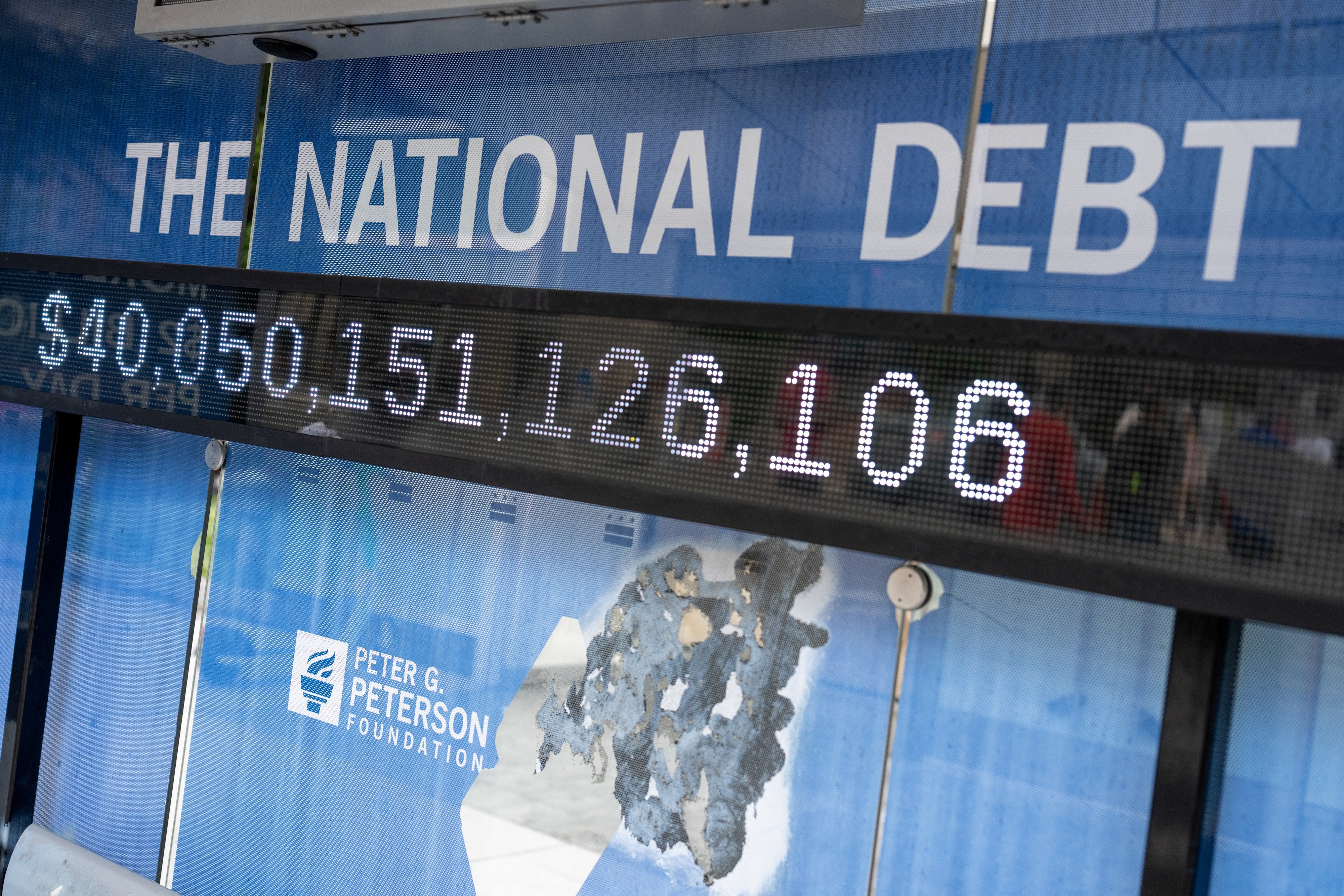
The United States has blown past a grim fiscal milestone: total national debt now exceeds $40 trillion. Publicly held debt—over $32 trillion—has surpassed the size of the entire U.S. economy, and annual interest payments on that debt have climbed above $1 trillion. Projections show public debt hitting 120 percent of GDP within a decade, with interest consuming more than $2 trillion of the federal budget each year.
These numbers ought to jolt policymakers in both parties out of complacency. Yet the Trump administration and Congress have largely shrugged. That indifference is a stark departure from earlier eras when Washington treated fiscal imbalance as a pressing national security and economic threat.
A history of dodging the hard choices
In 1987, during his first term in the House, former Rep. David Price (D-N.C.) was asked on PBS what surprised him most about Congress. His answer: the near-total obsession with the deficit and debt. That focus, he recalls, was a direct reaction to the fiscal excesses of the Reagan era—tax cuts and spending increases that his own budget director later called unprecedented.
Over the following decade, lawmakers forged three major bipartisan deals—in 1990, 1993, and 1997—that combined spending restraint with revenue increases. The 1990 agreement required President George H.W. Bush to break his “no new taxes” pledge, a move that cost him politically but helped stabilize the budget. The 1993 plan, pushed through by President Bill Clinton without a single Republican vote, mirrored that balance. And the 1997 accord, negotiated with a Republican Congress, paved the way for four consecutive budget surpluses and a $485 billion reduction in publicly held debt.
From surplus to crisis
The fiscal discipline unraveled during the George W. Bush years, thanks to sweeping tax cuts, post-9/11 security spending, and the 2007 recession. President Barack Obama tried to reverse course, appointing the Simpson-Bowles commission, which produced a comprehensive plan that ultimately failed to secure the required supermajority. Direct talks between Obama and House Speaker John Boehner collapsed, signaling that the grand-bargain era was over.
Price, who served on the Budget Committee and supported those earlier agreements, warns that today’s dangers are far more acute. “Both parties have adopted an ostrich policy,” he says, echoing Erskine Bowles, “refusing to deal with $2 trillion deficits as far as the eye can see.”
Interest costs are already crowding out priorities
At current deficit levels, the risk of crowding out private investment and pushing up interest rates is real. Interest payments on the national debt now exceed the entire annual defense budget, a fact that should alarm even the most hawkish budget watchers. The bond market, the one indicator the Trump administration seems to respect, is signaling that current trends are unsustainable.
Fiscal discipline isn’t a rival to the administration’s “abundance” and “affordability” agendas—it’s a necessary foundation. Without it, those promises ring hollow.
What must come next
Price argues that a new commission could help map the scope of the problem, but he’s skeptical that another grand bargain is politically feasible. Instead, he suggests incremental steps with clear benchmarks. At a minimum, Congress must address looming shortfalls in Medicare and Social Security—borrowing from general funds to cover those programs is not a viable long-term fix. A major tax overhaul is also overdue, as the current system fails to generate adequate revenue while widening inequality.
The Trump administration's $5,000 check promise to voters would only add to the fiscal hole, and Republicans face a brutal midterm hangover if they continue to ignore the problem. The House forecast is tightening, and voters are starting to notice which party takes fiscal responsibility seriously.
The time for head-in-the-sand politics is over. The bond market, the public, and the next generation all deserve better than another decade of denial.