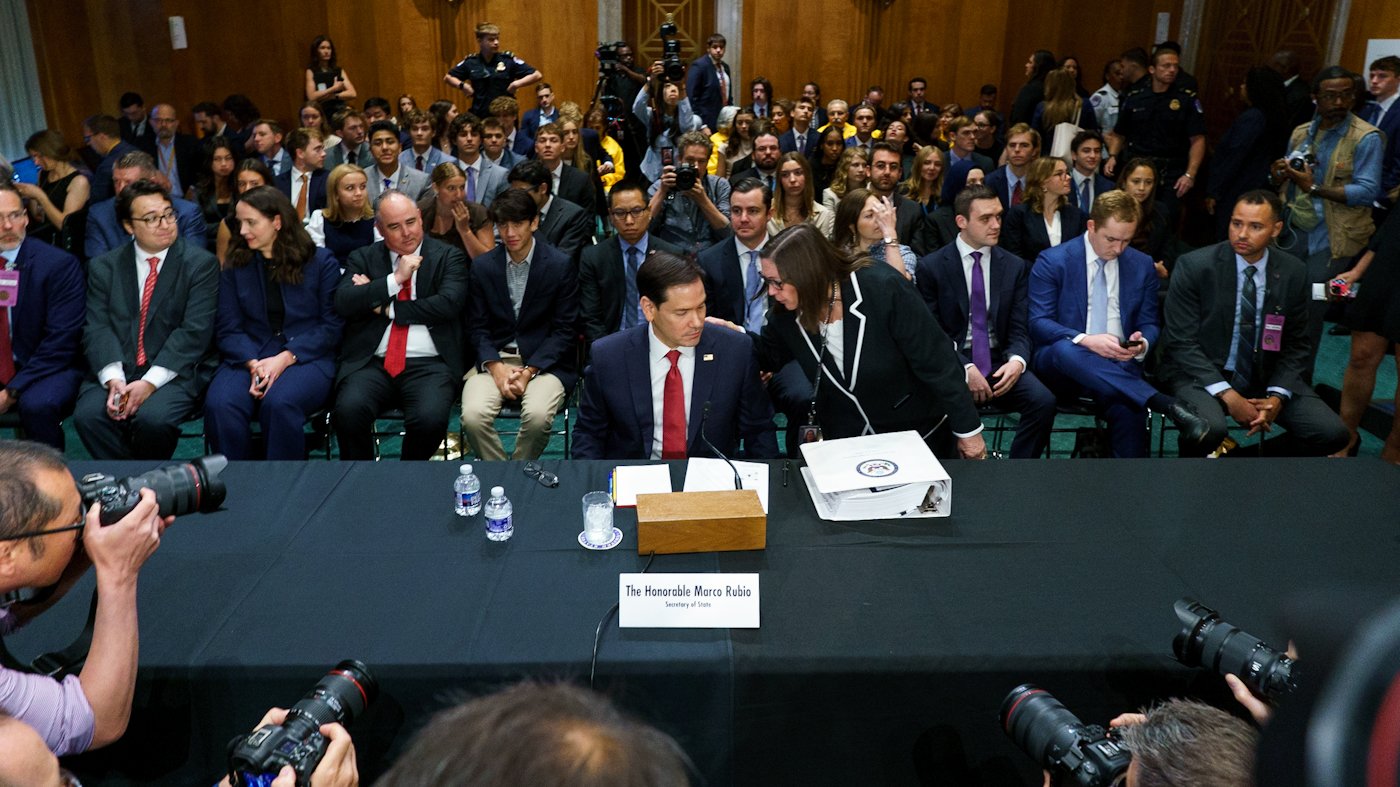
Secretary of State Marco Rubio is on Capitol Hill this week defending President Trump’s foreign affairs budget before House and Senate committees. What’s normally a routine debate over U.S. priorities has turned into a high-stakes confrontation over the administration’s radical reshaping of American diplomacy.
The proposed $35.51 billion spending plan represents a dramatic pullback from previous years. It cuts more than $4 billion from global health initiatives, another $4 billion from humanitarian aid, slashes contributions to international organizations like the United Nations by nearly 80 percent, and nearly eliminates funding for democracy promotion. If enacted, it would be roughly 30 percent less than what the government spent last year.

“Our budget reflects our national values,” said Rori Kramer, director of U.S. advocacy at American Jewish World Service. “This one signals a wholesale rejection of U.S. leadership on human rights, democracy, rule of law, and diplomacy.” Kramer argues the cuts show a preference for using American influence to suppress free speech and block democratic movements.
Congress now faces a critical test. Lawmakers must press Rubio on the real-world impact of these reductions. Over the past year, the administration dismantled the U.S. Agency for International Development, slashed the State Department’s Bureau of Democracy, Human Rights and Labor, and cut over $1 billion from pro-democracy programs. Rubio, meanwhile, has praised authoritarian leaders like El Salvador’s Nayib Bukele, who calls himself the “World’s Coolest Dictator,” while alienating traditional allies.
“Embracing a dictator anywhere means embracing dictators everywhere,” Kramer warned. The message has not been lost on autocrats abroad. In recent months, India passed a law undermining legal personhood, Senegal criminalized homosexuality, and the Dominican Republic launched mass immigration sweeps targeting Haitians and Dominicans of Haitian descent—even detaining women in hospitals after childbirth. Such actions once drew U.S. condemnation; now they go unchallenged.
The administration’s expansion of the Global Gag Rule compounds the damage. The policy now blocks virtually all foreign assistance from reaching those in need, weaponizing U.S. aid. Rubio should be asked how this protects lives or saves tax dollars.
The consequences are already visible: health clinics closing, human rights defenders losing critical funding, and marginalized groups facing increased violence. “The real-life consequences are cruel, devastating, and shortsighted,” Kramer said.
Despite evidence that humanitarian assistance and diplomacy advance U.S. national security, the administration remains determined to dismantle State Department programs based on fringe ideologies. Preventing conflict abroad is more effective and less expensive than responding to crises. Supporting civil society reduces instability, and diplomacy promotes goodwill, reducing the need for costly military interventions.
As Rubio testifies, Congress must not treat these hearings as business as usual. The nation cannot afford to abandon decades of support for human rights.
Rori Kramer is the director of U.S. advocacy at American Jewish World Service.