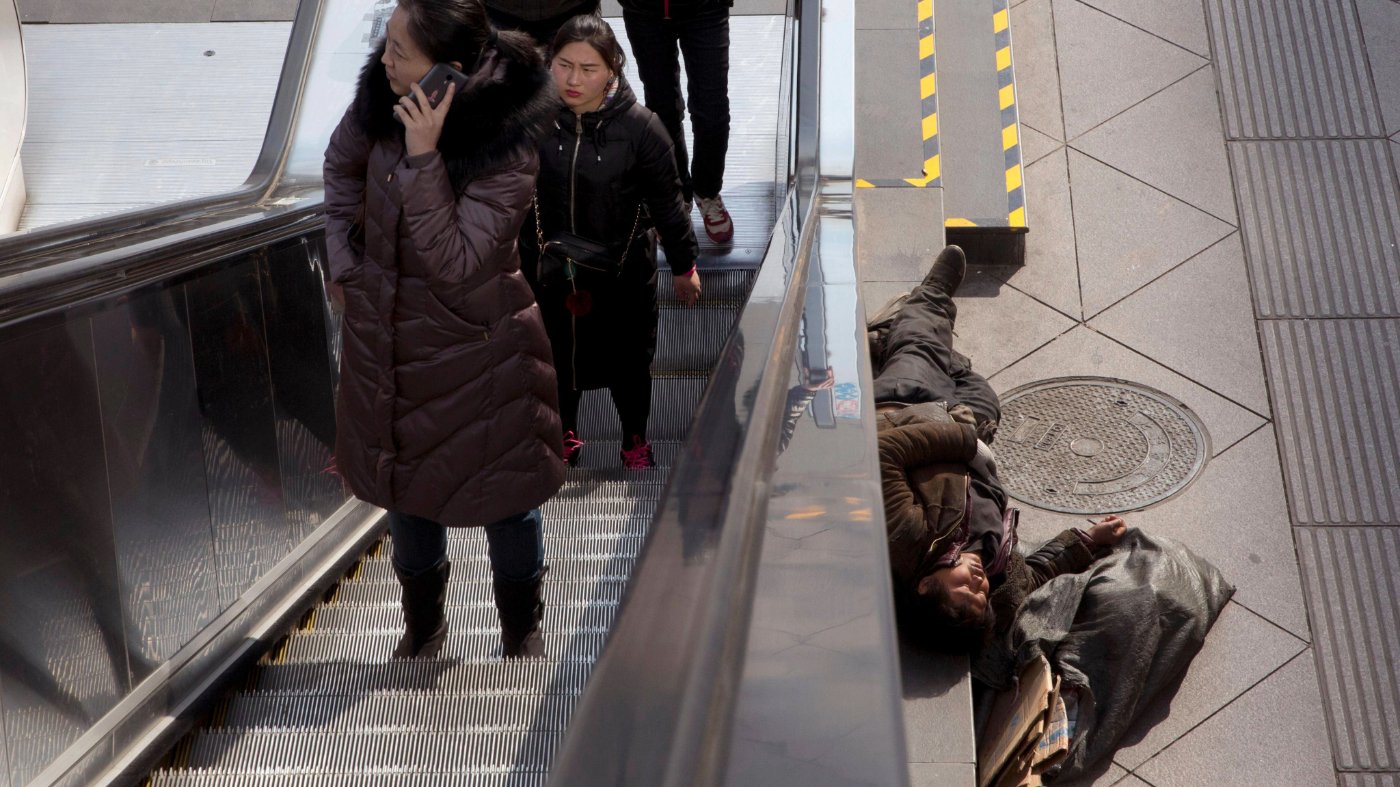
Beijing has quietly adopted a new official term for what it once called "homeless beggars": "dispersed persons." The linguistic shift signals a growing crisis that authorities may be struggling to contain. According to a report issued last year, approximately 47.5 million people in China are now homeless—a figure that, despite widely varying estimates, marks a fivefold increase over the pre-pandemic count in 2020. With the economy deteriorating further this year, the actual number on the streets is almost certainly higher.
The scale of the problem has stunned observers. "I was shocked by the statistics too," said Chen Lei, a cultural critic in Beijing. "I want to disbelieve it." Yet Chen conceded that he has personally witnessed more people sleeping rough, with online images showing individuals sprawled on sidewalks amid trash or lingering in public parks.
Demographics of the homeless are striking: a disproportionate share are young people, reflecting a labor market that has failed them. Official data shows youth unemployment climbing, and many jobless individuals are flocking to Communist Party–run service centers for free Wi-Fi, air conditioning, food, and water. In Shenzhen, one of China's wealthiest cities, nearly 3,000 young people visit such a center daily.
Analysts link the surge to a combination of post-pandemic economic strain and government policies that push automation, displacing workers. The high proportion of younger homeless is "closely tied to that labor market pressure," according to a UPI report. The trend is also seen as a symptom of broader societal breakdown, reminiscent of the dislocation caused by rapid industrialization in the early 1980s, but now compounded by a stagnant economy.
Some Chinese are choosing to flee entirely. The Biden administration witnessed an unprecedented surge of Chinese nationals crossing the U.S. southern border—many poor, but some middle-class, evidently desperate for a free society. However, for most, leaving is not an option. Street dwellers often carry low social credit scores, which restrict their access to bank accounts, train tickets, and coveted jobs, trapping them in homelessness.
Even those with high scores are disengaging. "The sad reality is that Chinese society is currently gripped by a profound, systemic malaise," said Charles Burton of the Sinopsis think tank, a former Canadian diplomat in Beijing. He pointed to cultural movements like "lying flat" and "letting it rot," which he describes as "forms of passive resistance against a system that has failed them economically and offers a bleak political future." Wealthier urbanites are reversing decades of migration by "retiring" to the countryside, a quiet rejection of modern Chinese life.
Burton criticizes the ruling elite's response: "Devoid of fresh, modern ideas, the Communist Party elite under Xi Jinping relies on a stolid ideology to prop up their uninspiring rule. They maintain power by tightening state control over every facet of public life, heavily censoring the media, ideologically constraining education, dictating popular culture." Piero Tozzi, senior director for China Policy at the American First Policy Institute, argues that Xi's governance model draws on "proto-totalitarian Legalism," which is "in the DNA of the Chinese Communist Party," aiming for "total societal control."
The human toll extends beyond homelessness. China's total fertility rate has plunged to an estimated 1.0, far below the 2.1 replacement level, threatening a population collapse later this century. Some demographers, like Yi Fuxian of the University of Wisconsin-Madison, predict China could shrink to a third of its current size by 2100. While declining fertility often accompanies economic development, China's pervasive gloom—as Burton describes—exacerbates the trend.
The regime's insistence on obedience clashes with a populace that, as Christopher Tibbs, a banker stationed in China in the 1990s, once observed, "There's a billion people who don't like following instructions." That tension is now playing out on the streets, where tens of millions are sleeping rough. As the government doubles down on control, the crisis deepens, leaving many to wonder if the system can hold.