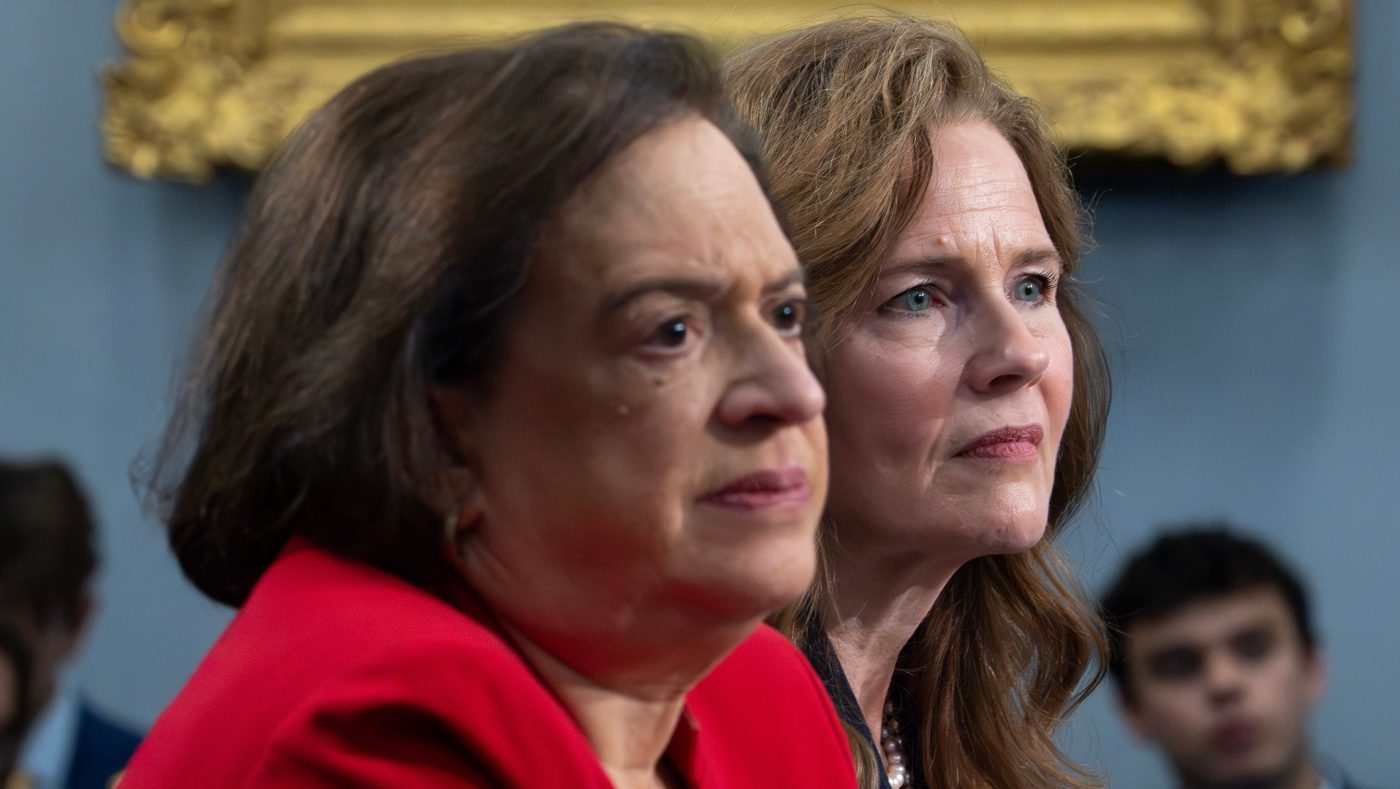
In a rare joint appearance before Congress on Tuesday, Supreme Court Justices Amy Coney Barrett and Elena Kagan made the case for a roughly $14 million increase in the court's security budget, citing a dramatic surge in threats against the judiciary. The hearing, held before House and Senate subcommittees, also touched on ethics enforcement and the shadow docket, though the justices largely avoided partisan traps.
Barrett's Vivid Account of Threats
Both justices underscored the growing danger faced by federal judges. Representative Rosa DeLauro (D-Conn.) noted 370 threats against federal judges as of July 1, a 31% year-over-year increase. Kagan, appointed by President Obama, recalled that when she joined the court in 2010, she drove herself to work and walked on the street—a stark contrast to today's reality. Barrett, a Trump appointee, offered a more personal account. She described being issued a bulletproof vest a few years ago after threats to her life, and the moment her then-12-year-old son saw it in her bedroom. 'I didn't expect that performing this service was going to put me in the position of explaining to my children what a bulletproof vest was and why I had to wear one,' Barrett told the House panel. She also recounted a recent swatting incident where a false report of gunshots led police to swarm her home, terrifying her teenage son.
Kagan's Implicit Jab at Trump
The hearing saw lawmakers from both parties test the justices with partisan statements, but only Kagan engaged directly on the issue of political intimidation. After Senator Jack Reed (D-R.I.) read President Trump's comments calling justices a 'disgrace' and accusing the court of 'ransacking' the country, Kagan responded without naming Trump. 'Whatever political figure says them, whatever party that political figure is a member of,' she began, before adding, 'When political figures of any stripe are trying to intimidate judges and justices to do things that they like rather than the things that they don't, that's where we really have crossed a line.' Her remarks echoed concerns about rising threats against the judiciary, a theme that dominated the session.
Ethics and Shadow Docket: Little Progress
Lawmakers pressed the justices on two contentious issues: the lack of an enforcement mechanism for the court's ethics code and the increased use of the shadow docket for expedited rulings. Senator Chris Van Hollen (D-Md.) warned that if the court doesn't act, Congress may legislate. But Barrett and Kagan resisted, expressing concern that any enforcement body could become a partisan weapon. On the shadow docket, Kagan acknowledged the court has improved in providing rudimentary explanations but told Senator Patty Murray (D-Wash.), 'I think we can still improve what we're doing.' The justices' reluctance underscores ongoing debates about independent ethics enforcement.
Avoiding Political Bait
Throughout the day, lawmakers tried to draw the justices into partisan squabbles. Representative Michael Cloud (R-Texas) complained about 'lawfare' against Trump, while Representative Steny Hoyer (D-Md.) warned of 'executive supremacy' under the current administration. Barrett and Kagan sidestepped these provocations, focusing on the budget and security. The unusual pairing of a conservative and liberal justice showcased their warm personal rapport, with both deferring to each other's points.
Kagan's Tribute to Graham
Before the House subcommittee, Kagan began by offering 'the entire Court's condolences' to the family of Senator Lindsey Graham (R-S.C.), who died suddenly at 71. Graham's cross-party vote had been pivotal in Kagan's confirmation, a moment she recalled in her testimony. The tribute highlighted the rare bipartisan moment in an otherwise tense hearing.