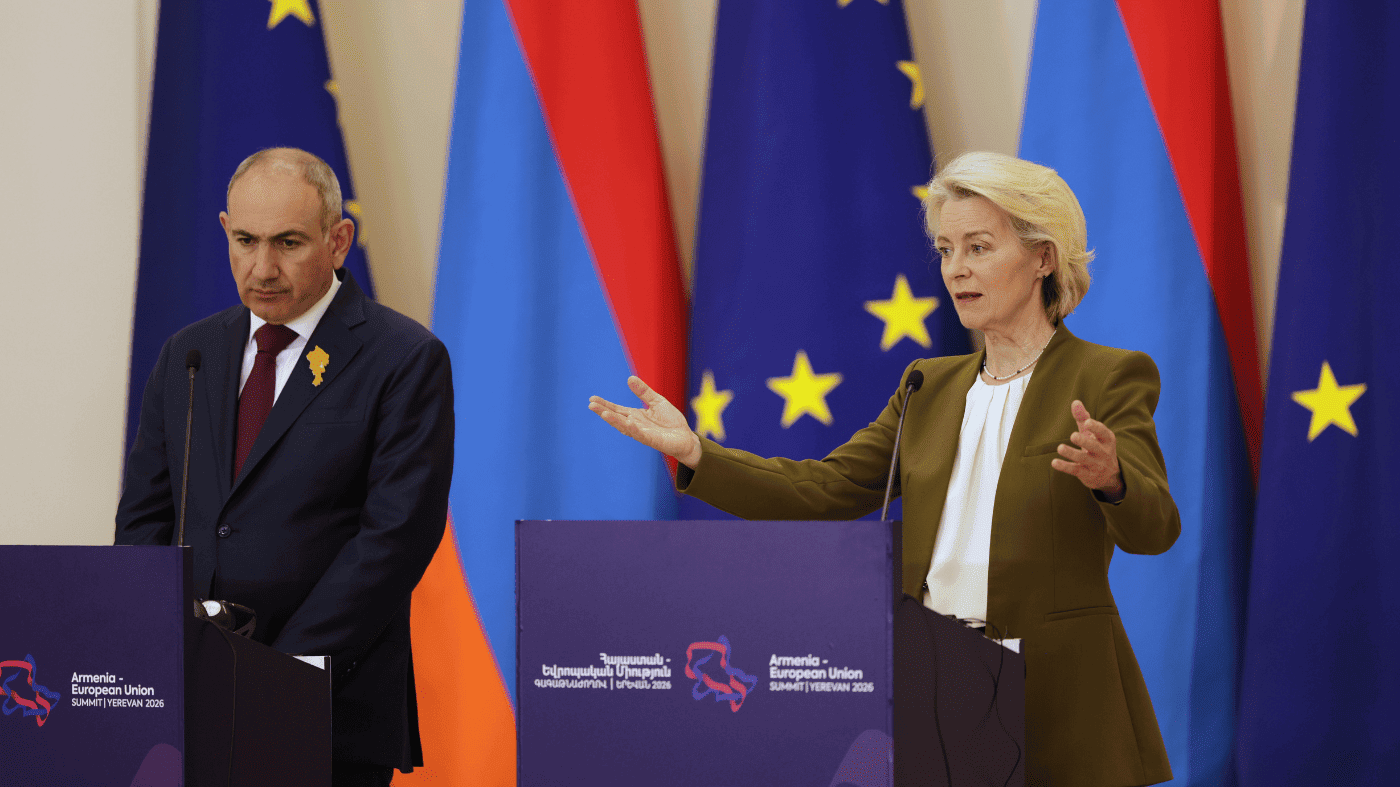
Armenia is preparing to formally apply for membership in the European Union, a move that would mark a dramatic departure from its decades-long alignment with Moscow. Prime Minister Nikol Pashinyan told parliament last month that the application would be submitted “in the near future,” drawing immediate warnings from the Kremlin.
Russia has long treated Armenia as a key partner in the former Soviet space, but the relationship has frayed following Azerbaijan’s 2023 takeover of Nagorno-Karabakh and the exodus of its ethnic Armenian population. The failure of Russian peacekeepers to protect the enclave shattered trust in Moscow’s security guarantees, prompting Yerevan to look westward.
Kremlin spokesman Dmitry Peskov responded to Pashinyan’s announcement by cautioning of “deep trade contradictions that will primarily harm Armenia.” Moscow and its Eurasian Economic Union partners have pressed Armenia to choose between the two blocs, with restrictions on Armenian exports to Russia already angering farmers. The warning is clear: Russia retains significant leverage to make the EU path painful.
Yet the shift is not merely a search for a new protector. Armenia’s tech sector is integrated into global markets, younger generations look to Europe and the United States for opportunities, and the diaspora—particularly in the U.S.—could become a conduit for capital and expertise. The West is increasingly where Armenians see their future.
Pashinyan’s EU bid is intertwined with the U.S.-brokered Trump Route for International Peace and Prosperity, or TRIPP, which envisions a 43-kilometer transit route across southern Armenia linking Azerbaijan, Nakhchivan, and Turkey. That corridor could eventually connect Central Asia with Europe, reducing regional dependence on Russia and Iran. After a major agreement in June, Pashinyan met senior U.S. officials last month to advance the project, with negotiations for a joint U.S.-Armenian development company nearing completion.
TRIPP and EU accession are two sides of the same geopolitical coin. Europe offers an institutional anchor; the U.S. provides strategic connectivity, investment, and technology, reinforced by a politically active Armenian American community. If these ties deepen, Armenia’s Western orientation could become entrenched in its economic and infrastructure realities, not just the preference of one leader.
Armenia is not simply swapping Moscow for Washington. It seeks relationships with China, India, Iran, and others. But diversification, for a country long dependent on a single protector, is itself a form of sovereignty. EU membership, however, would be a different order of magnitude—placing Armenia inside a Western political and economic system.
History offers a cautionary tale. After the Russian Empire collapsed in 1917, the First Republic of Armenia looked West, and Woodrow Wilson became a symbol of hope. But Western sympathy never translated into enforceable protection, and the republic was crushed between Turkish and Bolshevik forces in 1920. A century later, Armenians are taking another chance. The West has an opportunity to do it right this time.
As NATO allies brace for unpredictable Russian behavior, Armenia’s pivot carries broader implications. The coming months will test whether the West can back its rhetoric with concrete support, or whether Armenia’s westward turn will falter as it did a hundred years ago.