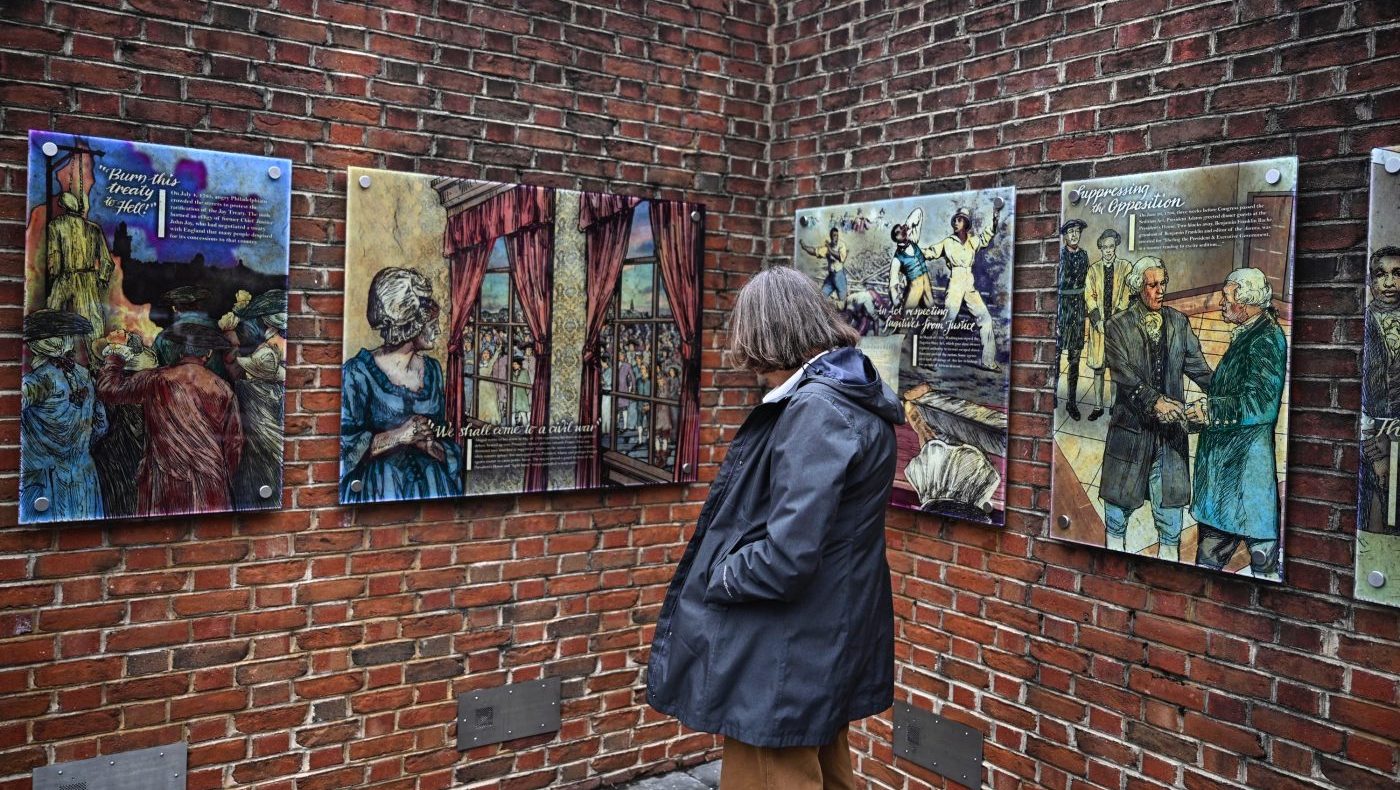
A federal appeals court on Thursday ruled that the Trump administration has the authority to remove and replace a slavery exhibit at the site of the nation's first executive residence in Philadelphia, overturning a lower court decision that had required the federal government to restore displays it had taken down earlier this year.
The three-judge panel of the 3rd Circuit Court of Appeals found that the district court lacked jurisdiction because the City of Philadelphia does not own the property in question—the President's House at Independence National Historical Park. The ruling vacated a February injunction that had blocked the Interior Department from damaging or altering items from the exhibit, which included panels, displays, and video content about nine individuals enslaved by George Washington.
“So the Court should not have considered the merits in its jurisdictional analysis,” wrote Judge Thomas Hardiman, a George W. Bush appointee. “And while the Court was ultimately correct to conclude that the City has standing, it did so on an incorrect (and premature) understanding of the relevant statutory and contractual agreements.” Hardiman was joined by Judge L. Felipe Restrepo, an Obama appointee, and Judge Peter Phipps, a Trump appointee.
The city of Philadelphia sued the Trump administration in January after slavery references were removed from the exhibit under an executive order directing Interior Secretary Doug Burgum to purge content that “inappropriately disparage Americans past or living” from all public monuments and memorials. The city argued that the federal government violated a 2006 cooperative agreement with the National Park Service that required mutual consent before altering the exhibit, which was designed to “illuminate the history” of the site where Presidents Washington and John Adams lived and worked, including the enslaved Africans kept there.
Hardiman noted that during oral arguments in April, the federal government said it had designed replacement panels and “stood ready to install them” if the temporary block were lifted. The National Park Service later posted images of the “new exhibits” on the park's website, which Hardiman described as “full of historical context.”
“They highlight the momentous events that took place in the President's House and the other sites at Independence National Historical Park,” Hardiman wrote. “They acknowledge the evil of slavery, including its injustices and hypocrisies, and, by telling the story of the nine slaves that Washington kept in the President's House, remind us of their essential humanity.”
The ruling comes amid broader debates over the Trump administration's approach to historical narratives at federal sites. Last week, a federal judge in Massachusetts ordered the administration to restore all displays and monuments removed from National Park sites over the past year as part of the same executive order. The Interior Department's response to the Philadelphia case was succinct: “Trust in Trump,” a spokesperson told The Hill. The city of Philadelphia did not immediately respond to a request for comment.
The case highlights ongoing tensions between local governments and the federal government over the interpretation of American history at national landmarks. The appeals court's decision effectively allows the administration to proceed with its replacement exhibit, which the court said acknowledges slavery's evils while focusing on the broader historical context of the President's House.