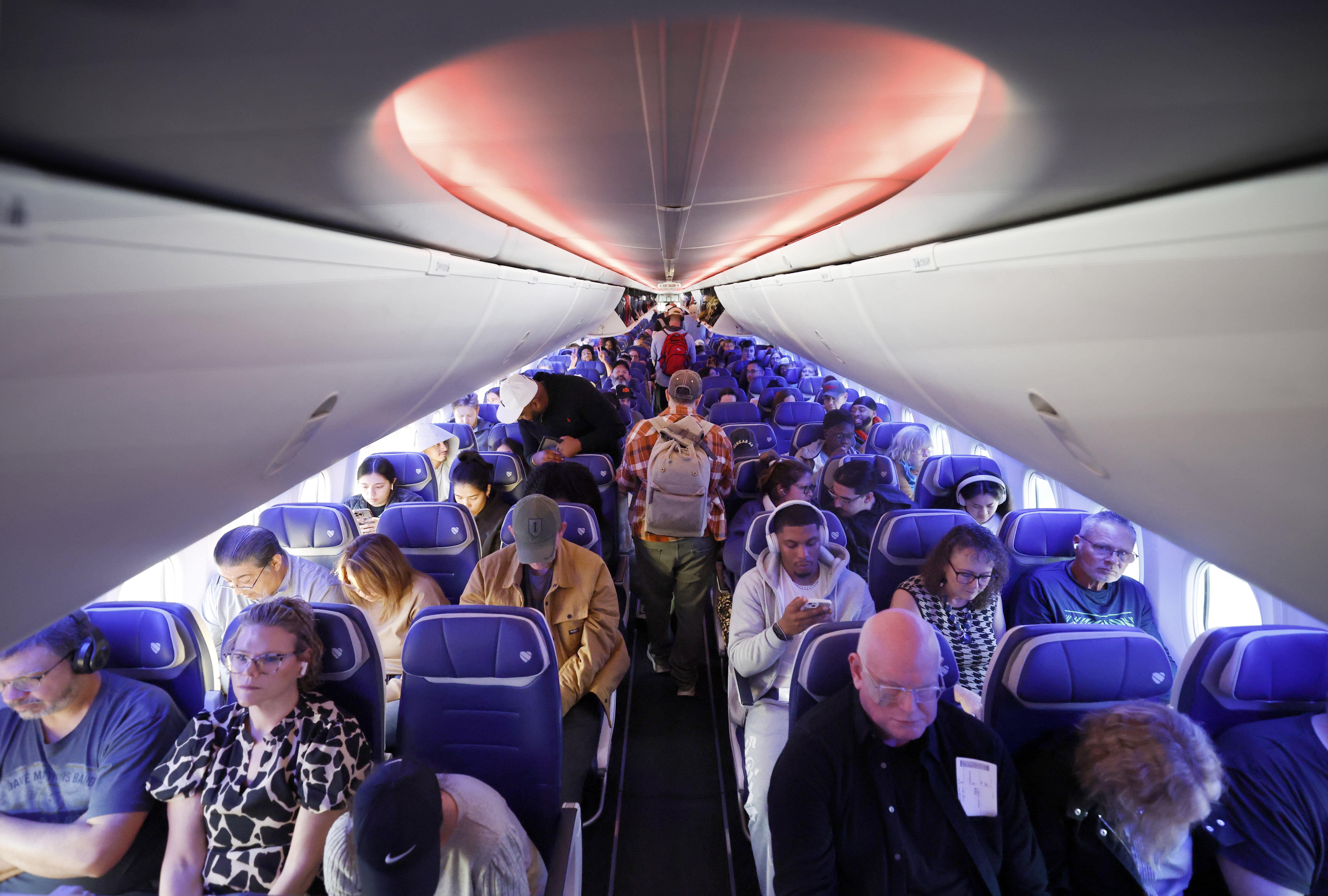
Southwest Airlines’ transition to assigned seating has hit turbulence, with passengers complaining they’re stuck in crowded rows at the back of the plane while empty seats sit just ahead. The shift, which took effect four months ago, replaced the airline’s iconic open-seating policy with a system that assigns seats based on payment or random assignment at check-in.
Travelers who decline to pay for a specific seat often end up in fully occupied rows near the rear, even when many seats are vacant. Viral videos and Reddit threads show flight attendants forcing passengers to return to their assigned seats, sparking debates about fairness and safety.
“I get that there’s assigned seating now, but we can’t move to empty seats either?” one Reddit user posted. “I’m on my fourth flight today and exhausted. I’m in a middle seat on a full row, but half the plane is empty. I moved seats and the flight attendant made me go back. WTF?”
This conflict isn’t unique to Southwest. Airlines have long managed seating based on weight and balance, a critical safety factor. Edgar Mora, a former pilot and chief aviation instructor at San Jose State University, explained that every flight’s center of gravity is triple-checked by dispatchers, loadmasters, and pilots before takeoff. “It’s checked by the dispatchers, it’s checked by loadmasters, it’s checked by the pilots. So it’s triple checked most of the time,” Mora said.
Where passengers sit directly affects the plane’s balance, along with cargo placement. An imbalanced center of gravity can prevent safe takeoff, and even small shifts—like a group moving seats—can be detected. “Any movement inside the cabin when the flight attendant’s going around with a little cart, we can feel it,” Mora said. “We even joke about it [in the cockpit] like, ‘Oh, somebody’s going to the bathroom.’”
For safety and fuel efficiency, airlines often place the center of gravity toward the rear, which explains why first-class seats are spread out forward and economy seating is denser in the back. This design means that assigning passengers to specific seats helps maintain balance, especially on less-than-full flights. Under Southwest’s old open seating, passengers naturally spread out, but the new system requires stricter control.
“We don’t notice it as passengers because when the airplane’s usually full, it’s obviously balanced,” Mora added. He noted that under the old policy, passengers on a two-thirds-full flight would likely spread out evenly, balancing the plane naturally.
Sean Cudahy, senior aviation reporter at The Points Guy, sees this as a learning curve for both customers and crew. “I think that what you’re seeing basically is both customers and flight attendants kind of getting used to this new normal,” he said. Both Cudahy and Mora advise passengers to ask a flight attendant before moving seats to avoid conflicts.
A Southwest spokesperson told Nexstar that weight and balance is most critical during takeoff, which is why passengers must stay in assigned seats before departure. The spokesperson said such conflicts are uncommon “and we continue refining our policies to best serve our Customers.”
While the frustration is understandable, the underlying reasons are rooted in aviation safety—not airline indifference. For passengers hoping to escape a middle seat, a polite request to a flight attendant might yield a solution, but don’t expect to freely roam the cabin.