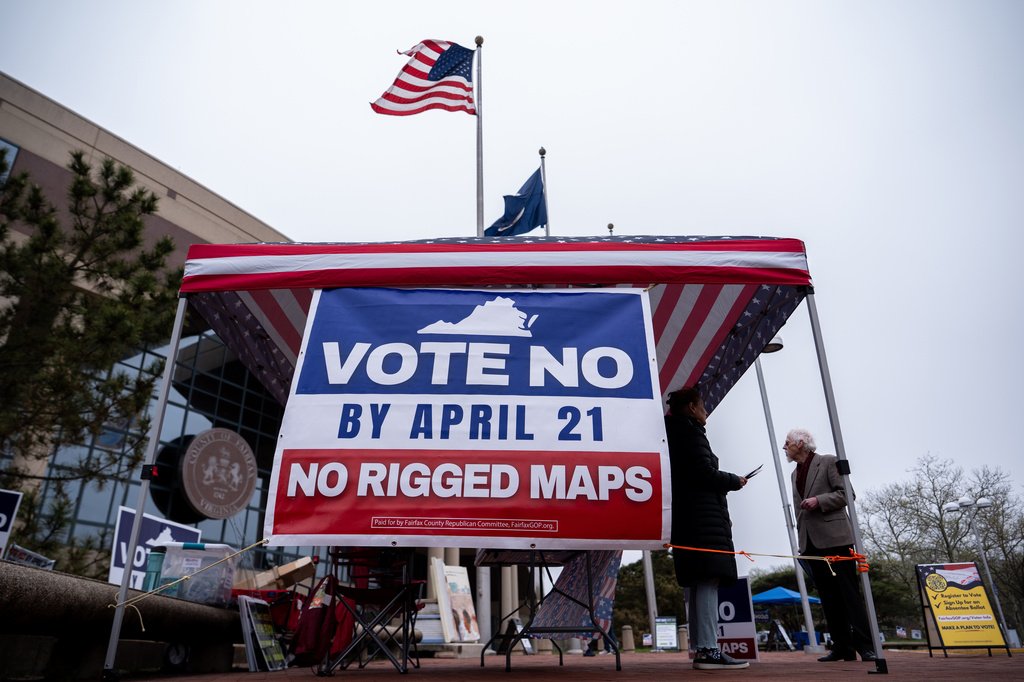
Amendment Would Bypass Independent Commission, Grant Power to Legislature
On April 21, Virginia voters will cast ballots on a proposed state constitutional amendment that would fundamentally alter how congressional districts are drawn. The measure would authorize the General Assembly to discard maps created by Virginia's independent redistricting commission and draft its own congressional boundaries. Proponents argue this is necessary to "restore fairness" in elections, framing it as a corrective to partisan gerrymandering in other states.
The national stakes are immense. With the U.S. House of Representatives narrowly divided, the redrawing of even a handful of seats in Virginia could determine which party controls the chamber after the fall elections. This places Virginia at the center of a growing, ad-hoc national redistricting conflict. The norm of redrawing maps only once per decade is eroding, with six states having already created new congressional districts following the 2024 elections and six others currently considering changes, often in response to political pressure or actions taken elsewhere.

The "Fairness" Debate and a Partisan Chain Reaction
The amendment's logic is controversial: it posits that "bad" gerrymandering in other states must be countered with "good" gerrymandering in Virginia to level the national playing field. Democratic leaders in the state, who support the amendment, see it as a cure for a systemic illness. However, critics contend the prescription is worse than the disease, arguing that responding to gerrymandering with more gerrymandering ignites a destructive chain reaction that ultimately weakens voter influence.
As detailed in our coverage of the GOP's long-term strategy for seizing control of state redistricting processes, these battles are increasingly premeditated and nationalized. The effort faces practical and philosophical hurdles. There is no consensus on what constitutes a "level" national playing field, and attempting to calibrate it through a patchwork of state-level gerrymanders is a blunt and imprecise instrument, likely to further corrode public trust.
Opponents draw a clear line: gerrymandering is gerrymandering, whether labeled good or bad. Unnecessary, irregular redistricting subverts democratic principles by letting politicians choose their voters. As former Arkansas legislator and Cato Institute senior legal fellow Dan Greenberg argues, paraphrasing Chief Justice John Roberts, "the way to end gerrymandered districts is to end the gerrymandering of districts."
A Warning from Indiana and the Risk to Virginia Voters
Some states have resisted entering this fray. Last year, Indiana Republican lawmakers, including State Senator Spencer Deery, refused a directive from former President Donald Trump to produce a mid-cycle Republican gerrymander. Deery stated his opposition was driven by principle, not in conflict with it. Virginia, critics urge, should follow this example and refuse to join a "race to the bottom."
The amendment poses a direct risk to Virginians. As U.S. Representative Don Beyer (D-Va.) conceded, the measure "seems unfair in Virginia" but is framed as "totally fair for America." This admission underscores how the amendment sacrifices local electoral integrity for perceived national partisan advantage. Voters have no inherent interest in lopsided, partisan maps; their shared interest is in neutral rules that produce authentic electoral outcomes. Adopting rules biased toward a current majority is a gamble, as political fortunes inevitably change.
The political climate surrounding this vote is tense, occurring as Governor Spanberger's approval ratings have suffered amid contentious policy fights. The decision comes down to whether Virginia will escalate a national partisan arms race or attempt to halt its spread. The core question for voters is whether attempting to cure bad gerrymandering with more gerrymandering can ever produce a healthy democracy.