House of Commons Speaker Sir Lindsay Hoyle arrived in Washington this week, landing just as the United Kingdom cycled through yet another prime minister. “We’re overachieving on prime ministers,” he joked during an interview at the British ambassador’s residence, comparing the rapid turnover to London buses: “They all come at once.” The UK has now had five prime ministers in four years, a stark contrast to the four over roughly a decade under his predecessor.
Despite the domestic turbulence, Hoyle stressed the resilience of the transatlantic alliance. “Prime ministers may come, prime ministers may go, but the one thing that remains is the special relationship,” he said. His visit, built around the 250th anniversary of American independence, follows a state visit by King Charles III that Hoyle admitted set an impossibly high bar. “With the bar set so high, mine will be so low,” he quipped, adding that the King’s trip underscored the relationship’s durability.
However, the term “special relationship” has faced scrutiny. In April, British Ambassador Sir Christian Turner said the only country with such a bond with the U.S. is “probably Israel.” The UK Foreign Office later dismissed those remarks as private and informal, insisting they did not reflect government policy.
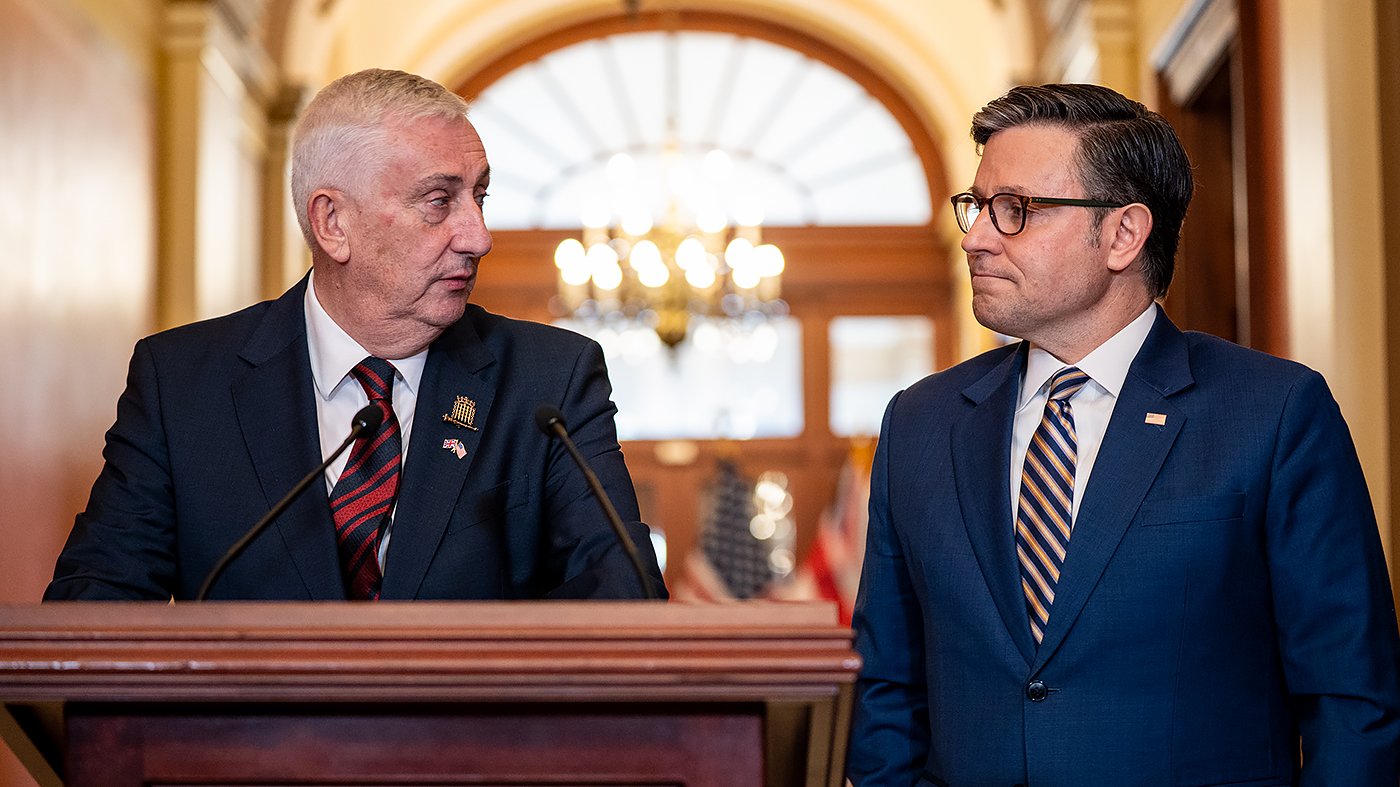
Hoyle’s trip reciprocates a visit by U.S. Speaker Mike Johnson (R-La.) to the House of Commons earlier this year. “This is a game over two legs,” Hoyle said. His Washington schedule includes a speech to the British American Business Group, a visit to Arlington National Cemetery, and a stop at George Washington’s Mount Vernon estate.
A key difference between the two speakers: Hoyle gave up his Labour Party membership when elected to the chair, a practice that often surprises American lawmakers. “You’re appointed by all the different political parties, and therefore the rules are you give up your political membership,” he explained. “If you can’t accept the rules, don’t apply for the job.” He argued the arrangement gives him more freedom. “The handcuffs are off,” he said. “I can be more open, more honest on my personal views because I don’t have a political party view.”
That impartiality limits how forcefully he can challenge a prime minister who dodges questions in the Commons. “The moment I pull the prime minister up, I politicize myself,” Hoyle said. “It’s certainly not for me to make sure—I hate to say it, sometimes they don’t know the answer.”
The visit also comes amid renewed focus on lawmaker safety in the UK following the murder of right-wing politician Ann Widdecombe. Hoyle traced the security overhaul to the 2016 murder of Labour MP Jo Cox and the 2021 killing of Conservative MP Sir David Amess, both attacks outside Parliament in their constituencies. Asked about a Reform UK proposal to spend billions more on protective measures, Hoyle questioned its feasibility. “There has to be a reality of what you can deliver,” he said, adding that the UK lacks enough armed police for round-the-clock protection for every MP and peer. “We haven’t got the capability of enough armed police to deliver at that scale.”
On lessons from the U.S., Hoyle pointed to the Jan. 6, 2021, Capitol riot and a 2018 knife attack near the British Parliament as evidence that no country has solved the problem. “Nobody has the ultimate… magic key that can protect all of us,” he said. “What we’ve got to do is share the best of knowledge between all of the democratic institutions.”
New British Prime Minister Andy Burnham has signaled openness to moving away from the first-past-the-post voting system. Hoyle expressed skepticism, saying the decision rests with the House of Commons. “It is for the House of Commons to decide,” he said, adding that his personal preference has “always been first past the post” but that “while a prime minister may have a vision—it will be the House that makes the final decision.”
When asked what he hoped to leave with Johnson and other U.S. lawmakers, Hoyle returned to the 250th anniversary. He described the U.S. and UK as “a family—not by marriage, but by history”—one that will have disagreements but remains bound by shared democratic commitments at a time when democratic governance is under strain globally. “We’ve seen a world that’s shrinking. Democracy has been shrinking,” Hoyle said. “We’ve got to push back and show the world that democracy is the way forward, not through dictatorships.”
For more on the shifting global landscape, see how central banks are adapting to geopolitical and demographic shifts. Meanwhile, the GOP lawmaker’s call for unconditional surrender from Iran underscores the political risks in foreign policy.