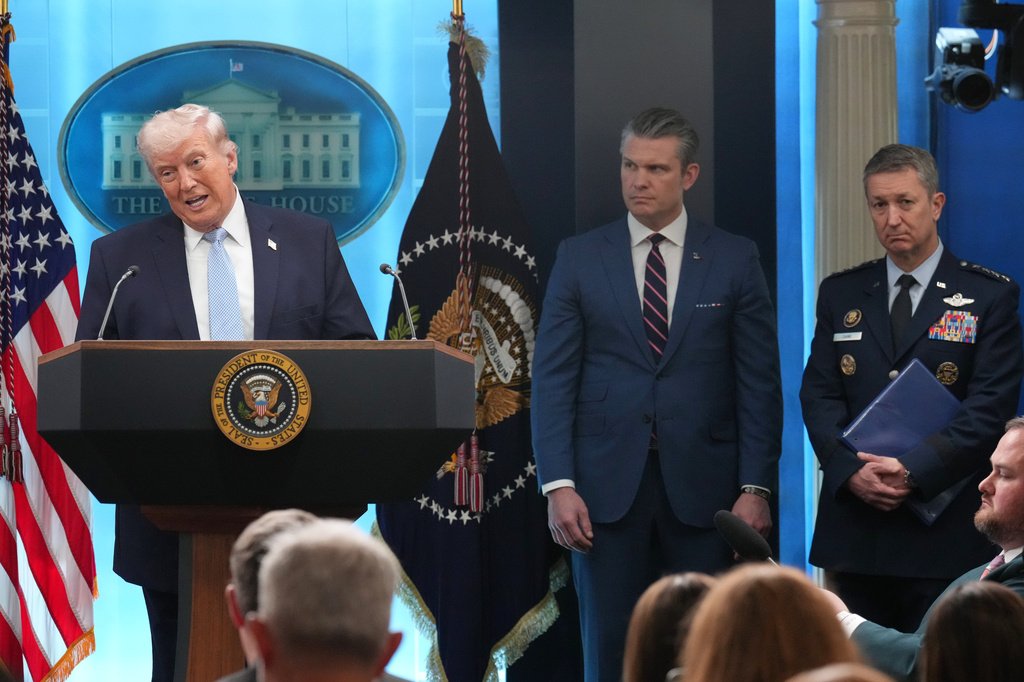
Every time President Trump makes a factual claim—whether at a podium, on the tarmac, or in the Oval Office—the White House press corps should respond with two straightforward questions: “How do you know that?” and “What does that mean?” This simple protocol, applied consistently, could transform how the administration’s statements are covered.
Shouted questions and next-day fact-checks have failed to hold Trump accountable. These two queries, used as a standing routine, would make evasion visible in real time and render “fake news” an insufficient reply. They are not hostile; they are epistemic. They demand the speaker identify a briefing, an agency, a document, or a study that can be verified before the motorcade leaves the driveway.
Consider the record of the past 10 weeks. In his February 2026 State of the Union, Trump claimed $18 trillion in new investment had flowed into the U.S. since he resumed office. His own White House website cited $9.7 trillion—a figure inflated by vague “bilateral trade” pledges. He later asserted that an accused killer of a Ukrainian refugee in North Carolina had entered through “open borders,” though available evidence indicates the suspect is an American citizen. He also claimed Somali residents of Minnesota had “pillaged an estimated $19 billion,” a figure with no identifiable source or methodology. Each of these statements would have collapsed under “How do you know that?”
The second question polices definitions. When Trump says he “ended” wars that were never formally declared, or that Washington is “now one of the safest” cities despite contrary crime data, “What does that mean?” forces him to clarify. A president who cannot define his own assertion cannot defend it. This is not a gotcha; it is the minimum standard of adult conversation and professional journalism.
We have seen the consequences when these questions are not asked. In 2020, Trump told reporters Seoul had 38 million residents—roughly four times the actual figure—then instructed the press to stop asking “snarky” questions. The number stood unchallenged because no one pressed for a source. That vacuum is now routine, widened by the administration’s deliberate narrowing of press access, such as the Pentagon’s demand that reporters pre-clear stories and the exclusion of the Associated Press for refusing to rename the Gulf of Mexico.
A two-question protocol, used by every outlet in the room, would do three things: put Trump on the record or expose the absence of a record, make definitional vagueness uncomfortable rather than convenient, and restore a shared expectation that factual assertions come with provenance. Critics say Trump will simply call questioners enemies—and he will. But the coverage then changes. “The president did not identify a source” is a more honest lead than “The president claimed.” “The president did not define the term” is more honest than “The president said.”
The press corps is not obligated to convert every dodge into a declarative sentence. Evasion, reported as evasion, is journalism. As the country moves through its 250th anniversary year, the First Amendment’s protection of a free press remains a barrier against government, not a guarantee that government will tell the truth. The discipline must come from inside the room. Two questions; every time; no exceptions. Let the answers, or their absence, speak clearly.
This approach aligns with broader concerns about press freedom. For instance, the FBI probed a NYT reporter over an article on Kash Patel's girlfriend, raising alarms about government overreach. Similarly, the Trump administration's spring purge saw five top officials exit in six weeks, further eroding accountability. These developments underscore the need for a vigilant press corps.