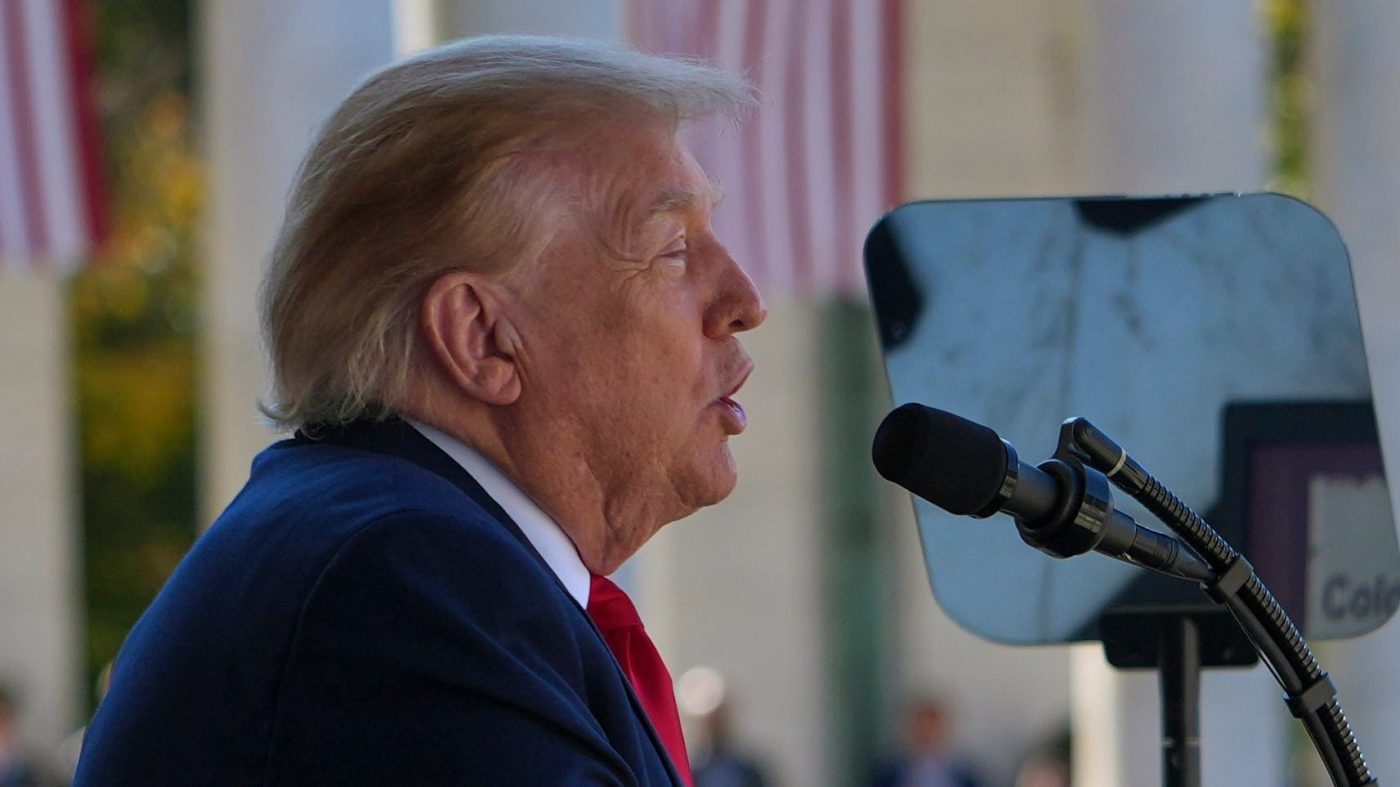
President Trump on Thursday seized on reports of a new migrant caravan forming in southern Mexico, framing it as a direct consequence of the Republican Party's losses in last week's midterm elections. In a post on Truth Social, the president claimed that "huge caravans are forming and beginning their illegal march through Mexico," and suggested the movement was emboldened by the Democratic victories.
According to a Chiapas state government source cited by Reuters, roughly 1,500 people, including families with young children, departed the city of Tapachula near the Guatemalan border on Tuesday. Many of the migrants, hailing from Central America, told Reuters that the Democratic gains in the midterms had raised their hopes for a more permissive U.S. immigration policy.

"There might be a light at the end of the tunnel, a way for us to get in," said Cesar Sandoval, a 47-year-old Nicaraguan migrant who was deported from the U.S. months ago. "We believe the Democrats will help us ... with God's help." Others, like Honduran migrant Billy Noe Martinez, who survived the 2010 massacre of 72 migrants in Tamaulipas, expressed hope that Mexican President Claudia Sheinbaum would show compassion and "allow us to move forward."
Trump's post also carried a pointed warning to Mexico, stating that the country's government must stop the caravan or face an immediate doubling of tariffs on Mexican goods. "MEXICO, THE GOVERNOR OF TEXAS, THE VERY LIBERAL NEW GOVERNOR OF TEXAS, OUR GREAT BORDER PATROL, & ICE, HAVE BEEN SO INFORMED," he wrote. "There will be no leniency!"
The president has a history of using migrant caravans as a political rallying cry, particularly around midterm elections. In 2018, he made unsubstantiated claims that Democrats were behind a caravan and that it included Middle Eastern migrants and terrorists, later admitting to a reporter that there was "no proof of anything." This time, his messaging comes in the wake of a midterm cycle that saw the GOP lose control of the House, and after Trump himself conceded that his administration's deportation crackdown may have been "too tough" and contributed to the losses.
The political dynamics are further complicated by the recent appointment of Stephen Miller, a longtime immigration hard-liner, as White House chief of staff, replacing Susie Wiles. Miller's elevation signals that the administration is doubling down on its restrictive immigration stance, even as some Republicans, like Erick Erickson, warn that the party must break from Trump or face a 2028 rout. Meanwhile, Mick Mulvaney has suggested that Trump's grip on congressional Republicans is slipping after the midterm losses.
The new caravan also echoes a broader pattern of migration surges that have tested U.S.-Mexico relations. Trump's tariff threats against Mexico are not new, but they come at a delicate moment, as the Biden administration has been negotiating with Mexico on migration enforcement. The president's rhetoric, however, suggests he is in no mood for compromise.
For the migrants themselves, the journey north remains perilous. Many are fleeing violence, poverty, and political instability in their home countries. The caravan's goal, according to Reuters, is to reach Mexico City, where they hope to receive federal assistance and protection from detention at the U.S. border. Whether they will be allowed to proceed remains uncertain, but Trump's latest statements make clear that the political battle over immigration is far from over.