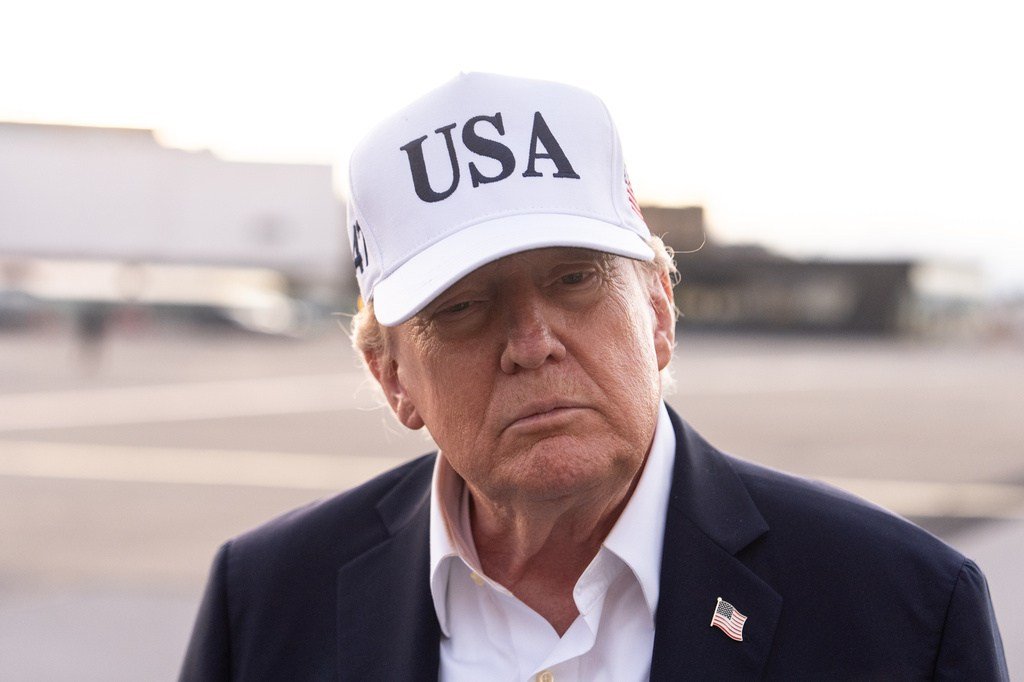
President Trump doubled down on his hands-off approach to artificial intelligence on Monday, declaring that the only safeguard the technology requires is his own leadership, while lashing out at industry executives and lawmakers who have called for stricter oversight.
In a series of posts on Truth Social, Trump wrote that "the only control or 'guardrails' that AI needs is a STRONG AND SMART (High IQ!) PRESIDENT," adding that his administration has already prevented AI "people" from doing "bad, or potentially bad, 'things.'" He asserted that existing criminal and regulatory powers over tech companies are sufficient, and accused critics of pushing a "SICK conspiracy" against AI and data centers that only benefits China.
The president's remarks come as bipartisan concerns over AI's risks—ranging from job displacement to existential threats—continue to mount. Trump has repeatedly dismissed such worries, arguing that the United States must win the AI race against Beijing at all costs. "Whoever wins AI wins," he said over the weekend, reiterating his belief that American dominance in the field is non-negotiable.
Trump specifically named Anthropic CEO Dario Amodei as an example of someone who has done "bad," accusing him of now "pretending to be a 'perfect little angel.'" Amodei, whose company is a leading AI safety research firm, recently published a blog post urging the industry to slow down model development to allow for third-party evaluations and safety alignment. "Pacing does not mean halting model training or technical progress," Amodei wrote, "but ensuring companies take adequate time to align and safeguard their models."
The president's attack on Amodei follows China's rebuke of the Anthropic CEO's call for restrictions, highlighting the geopolitical stakes in the AI debate. Trump and his allies argue that any slowdown would cede ground to Beijing, but critics contend that rushing development without guardrails could lead to catastrophic outcomes.
Senate Democratic Leader Charles Schumer (N.Y.) on Monday demanded a classified briefing for senators on AI dangers, reflecting growing unease even among lawmakers who typically support technological innovation. Both parties have also raised alarms about the environmental and infrastructure impacts of AI data centers, which Trump has staunchly defended as essential to national competitiveness.
Trump's latest comments are part of a broader pattern of dismissing AI skeptics as "conspiracy theorists, treasonists, traitors, and leakers," a warning he issued directly to those who question his approach. His administration has so far resisted calls for new regulations, preferring to rely on existing laws and executive oversight.
Political analysts note that Trump's stance on AI could become a flashpoint in the upcoming midterm elections, with some Republicans already tying their electoral fortunes to the president's agenda. However, public opinion polls suggest that voters are increasingly worried about AI's societal impact, and Schumer's request for a briefing indicates that even some Republicans may be open to more scrutiny.
As the debate intensifies, Trump shows no signs of backing down. "We already have tremendous CRIMINAL and REGULATORY power over these companies!" he wrote, adding that the U.S. is "leading China, and all others, and will continue to do so." Whether his confidence is justified remains an open question, but for now, the president is betting that his personal authority is sufficient to steer AI safely into the future.