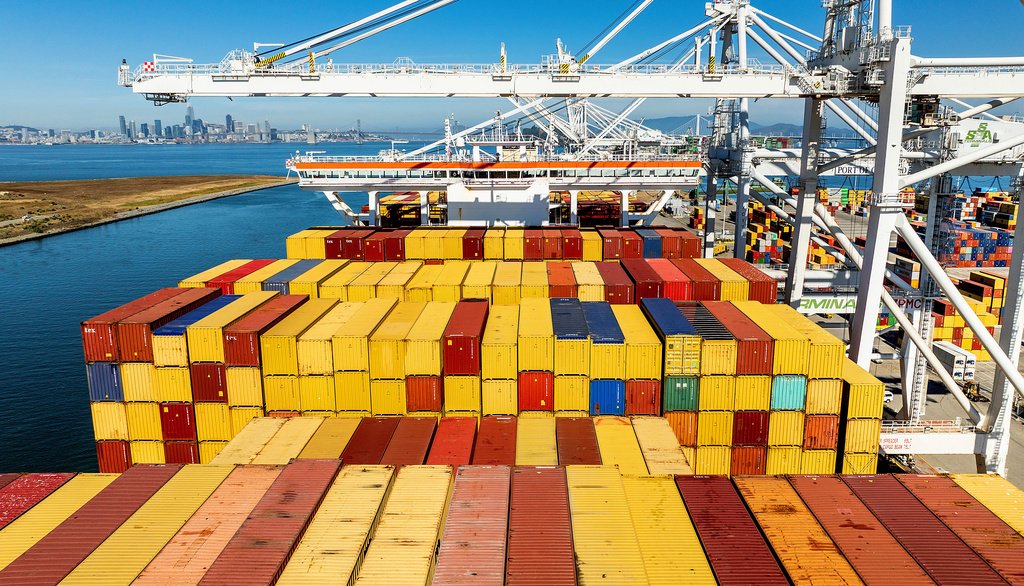
President Trump’s latest push to impose new tariffs on dozens of nations comes after a Supreme Court defeat, but the policy that was supposed to remake American trade has delivered none of its promised benefits. Instead, evidence mounts that the tariffs are a political and economic liability—alienating allies, raising costs for U.S. firms, and frustrating consumers who blame them for higher prices.
The president has repeatedly claimed that foreign countries pay the tariffs. But the reality is that American importers and households bear the cost. An executive order signed on Inauguration Day directed agencies to explore creating an “External Revenue Service” to collect tariff revenue from abroad. In his inaugural address, Trump said, “Instead of taxing our citizens to enrich other countries, we will tariff and tax foreign countries to enrich our citizens.” Yet the Reason Foundation has calculated that his tariffs represent the largest tax increase on Americans since 1993.
Corporate disclosures underscore the burden. Ford Motor Company announced in February that it paid roughly $2 billion in tariffs in 2025 and expects another $2 billion in 2026. General Motors similarly paid about $2 billion last year. During a recent trip to Michigan, Trump said, “It’s amazing what tariffs are doing for GM.” The data suggests he meant “doing to GM.” More than a thousand companies—including FedEx, Costco, and Revlon—have sued at the U.S. Court of International Trade to reclaim a share of the $133 billion they’ve paid in tariffs. USA Today reported in June that “Corporate America stands to receive billions in tariff refunds from the U.S. government.” Trump has even warned firms against seeking refunds, saying, “If they don’t do that, I’ll remember them.” That comment inadvertently confirms that U.S. businesses and consumers are footing the bill.
Trade Deficit and Manufacturing: Promises Broken
Trump’s long-standing obsession with the trade deficit—which one economist dubbed “trade deficit derangement syndrome”—has not translated into progress. The U.S. trade deficit in goods stood at $1.2 trillion in 2024, Biden’s last full year. In 2025, under Trump’s tariffs, it rose to $1.23 trillion, the highest on record for any president. Economists generally view the deficit as a non-issue, comparing it to a household’s imbalance with a local store, but Trump has made it a centerpiece of his agenda.
Manufacturing job growth was another core promise. After an initial pandemic slump, manufacturing employment peaked in early 2023 and has since declined. In January 2025, there were about 12.67 million manufacturing jobs; by June 2025, that number had fallen to 12.6 million. The anticipated manufacturing renaissance has simply not materialized.
Revenue Shortfall and Political Fallout
Trump also claimed tariffs would generate trillions and possibly replace the income tax. In reality, tariffs—now at their highest level since the early 1930s—brought in between $130 billion and $160 billion last year. The 2025 federal deficit was $1.78 trillion, and the 2026 deficit is projected near $2 trillion. Tariff revenue covers roughly a tenth of that shortfall, a fraction of the government’s $7 trillion in spending.
The political cost is mounting. CNN reports that 63 percent of Americans oppose the new tariffs. Voters widely believe tariffs have driven up prices on necessities. If a Democrat had pursued such policies, Republicans would be outraged. Instead, most remain silent—a stance that could prove costly. Trump won’t be on the ballot in November, but Republicans will, and they may face the consequences of his tariff failures.
As legal challenges from two dozen Democratic states move forward, the administration’s tariff policy appears increasingly indefensible. The evidence is clear: tariffs have failed to achieve their stated goals, and the burden falls squarely on American businesses and families. For Republicans, the question is whether they will continue to back a policy that is both economically damaging and politically unpopular.