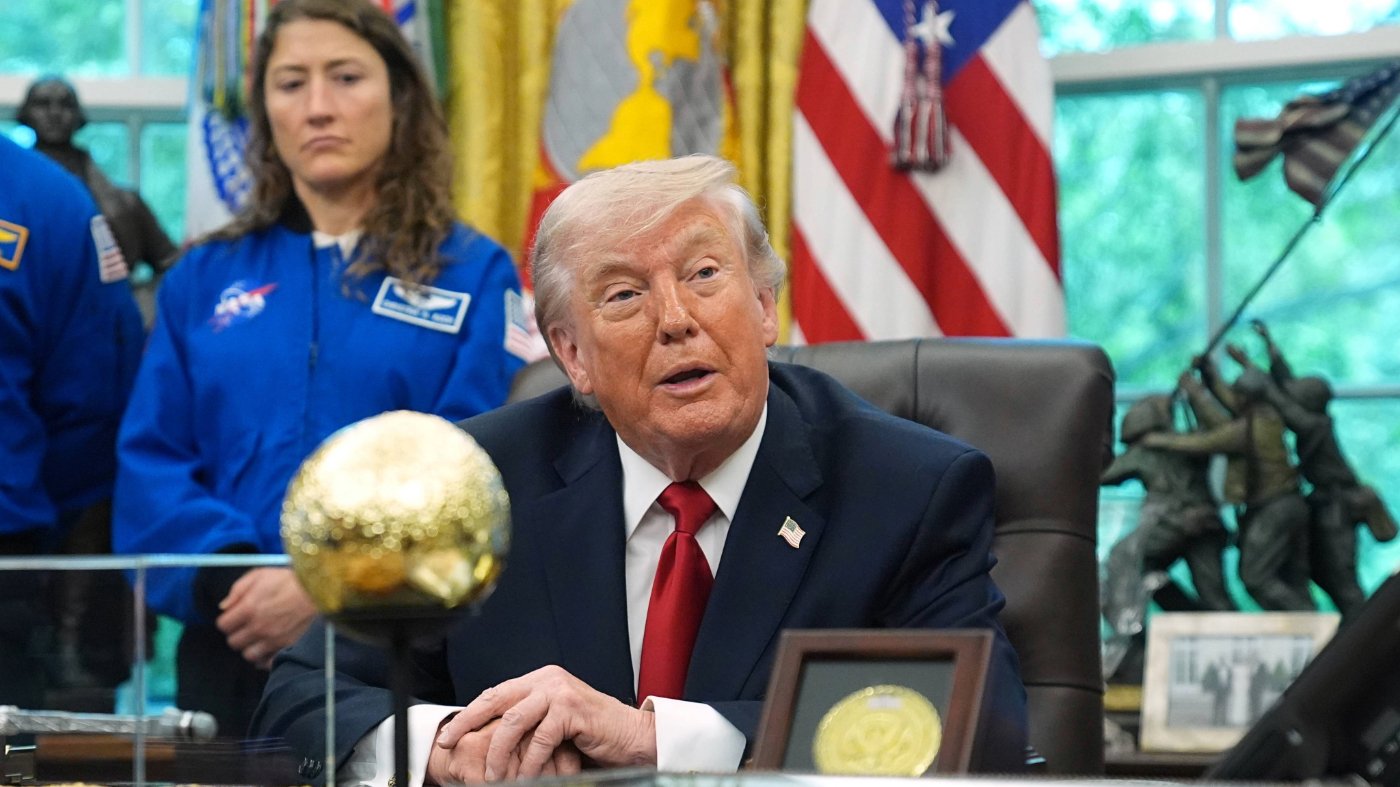
As the Artemis II crew soared toward the moon, the White House released a proposed budget that would cut NASA’s overall funding by 23%—and slash science, aeronautics, and education accounts by 47%. The timing could hardly have been worse. The first crewed lunar mission in over 50 years turned astronauts Reid Wiseman, Victor Glover, Christina Koch, and Jeremy Hansen into instant celebrities, fueling public demand for more space investment, not less.
White House vs. Congress on NASA Funding
This is the second year in a row the Trump administration has proposed deep cuts to NASA. Last year, Congress flatly rejected them, and the pattern appears to be repeating. NASA Administrator Jared Isaacman—confirmed after the budget was drafted—was dispatched to defend the proposal before the House Science Committee. He argued that some cuts target duplicate programs, especially in education, and that commercializing certain Earth science and space science missions could free up money for flagship projects only NASA can handle.

Isaacman pointed to the Nancy Grace Roman Space Telescope, set to launch in September on a Falcon Heavy, and the Dragonfly drone mission to Saturn’s moon Titan as examples of high-priority missions preserved in the budget. NASA is also planning a nuclear-propelled Mars probe to test faster interplanetary travel. The administrator’s own track record—financing two private space missions—lent credibility to his claims of fiscal efficiency. But committee members listened politely, then largely ignored him. As one observer noted, what Isaacman said was irrelevant; the cuts would be restored.
And they were. Both House and Senate appropriators moved to reverse the reductions, signaling that Congress intends to protect NASA from the White House’s austerity drive.
The Deficit Dilemma
The administration’s push to cut NASA comes amid a grim fiscal picture. The national debt is approaching $40 trillion. The 2025 deficit hit $1.78 trillion, and the 2026 shortfall is projected at $1.9 trillion. With deficits spiraling, the White House argues that lower-priority programs must be trimmed. Isaacman, they say, is the right person to manage those cuts with minimal pain.
But the political calculus is unforgiving. The Planetary Society, led by Bill Nye, launched a “Save NASA Science” campaign on Capitol Hill. Even Sen. Ted Cruz (R-Texas), chair of the Commerce Committee, invoked the Chinese space threat to argue against the cuts. “Artemis is the answer to China,” he said, implying that Earth observation satellites and planetary probes are also vital to national security. The administration’s attempt to find savings at NASA now looks like a political liability, especially as it also pursues the biggest military buildup since the 1980s.
A Glimmer of Reform?
Robert Zimmerman, who runs the blog “Behind the Black,” supports cutting what he calls pork at NASA. But he offers a possible silver lining: Congress, while restoring the money, might give Isaacman more discretion over how to spend it. Lawmakers often micromanage agencies through the power of the purse—the Space Launch System, plagued by delays and cost overruns, is a prime example. Rarely do they hand over a pot of money with broad guidelines and let the executive branch decide.
If NASA becomes an exception, Isaacman could prove the model works. Under broad direction, he might invest funds in ways that yield tangible returns. That could spark a new way of doing business across the federal government. Or, as one skeptic put it, “pigs might fly to the moon.”
For now, the Trump administration faces a familiar wall: every government account has its defenders, even waste, fraud, and abuse. With Congress unwilling to touch NASA and the military demanding more, the White House will have to look elsewhere to tame the deficit. Good luck.