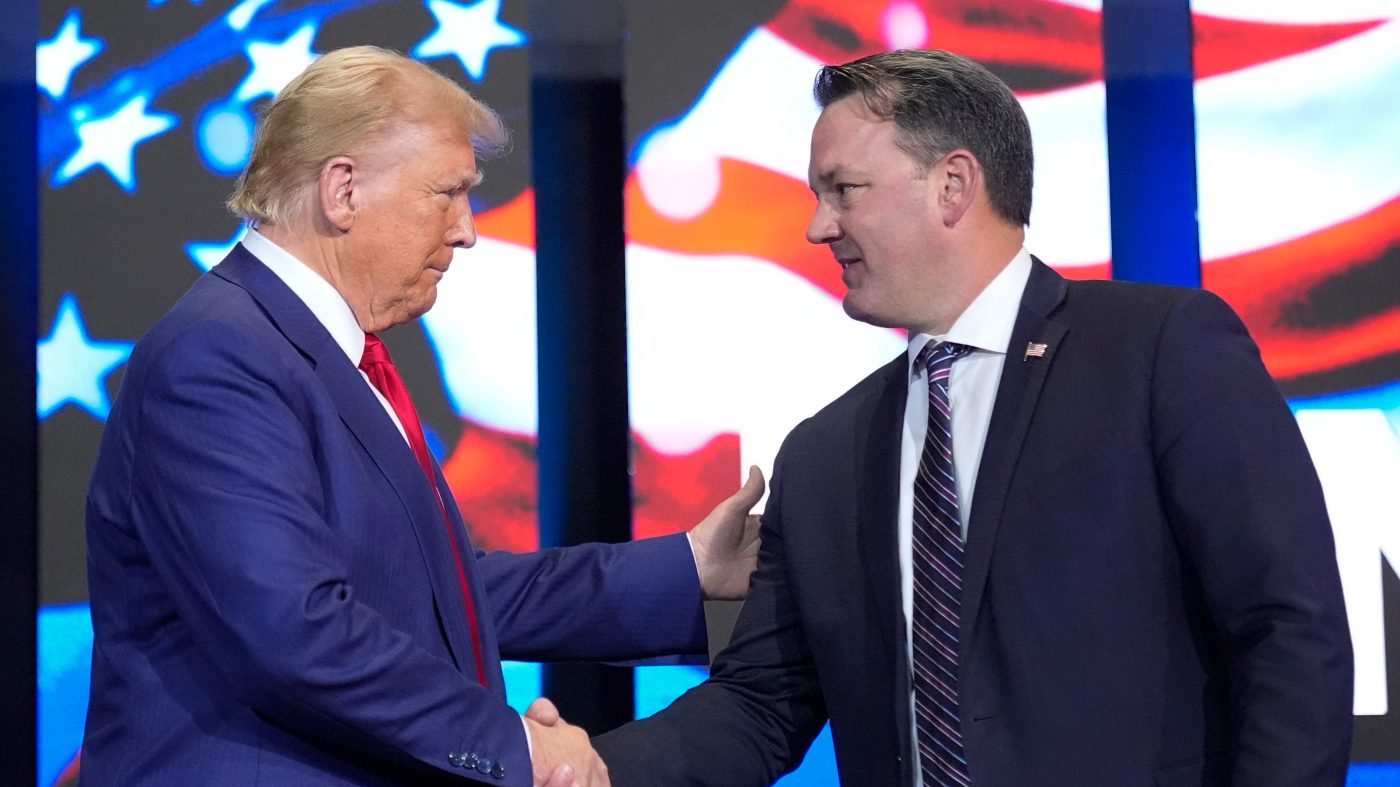
President Donald Trump's influence in Republican primaries faced a significant test Tuesday night, yielding a mixed verdict. In Georgia, healthcare executive and billionaire Rick Jackson defeated Trump's preferred candidate, Lt. Gov. Burt Jones, in the GOP gubernatorial runoff. Jackson’s victory, by a single-digit margin, marks the second time this cycle that a Trump-backed gubernatorial candidate has lost a primary. The first was earlier this month in Iowa, where Rep. Randy Feenstra fell to businessman Zach Lahn.
Despite this setback, Trump notched several wins elsewhere. His last-minute endorsement of Rep. Mike Collins in the Georgia Senate GOP runoff paid off, as Collins easily defeated former college football coach Derek Dooley, who had the backing of Gov. Brian Kemp. Collins will now challenge Democratic Sen. Jon Ossoff in one of the most closely watched Senate races this fall. Collins has aligned himself closely with Trump, touting his work on the Laken Riley Act, the first piece of legislation Trump signed in his second term, which allows federal officials to detain undocumented immigrants accused or convicted of certain crimes.
In Alabama, Trump-backed Rep. Barry Moore won the GOP runoff for the Senate seat vacated by Tommy Tuberville, despite some polls showing a tight race. Moore defeated former Navy SEAL Jared Hudson, who had criticized Moore’s Washington ties. The race also highlighted the growing influence of the cryptocurrency industry, as a super PAC tied to Fairshake spent nearly $10 million on ads supporting Moore, who owns crypto assets. Meanwhile, in Oklahoma, Rep. Kevin Hern, another Trump endorsee, secured the GOP primary for the Senate seat left open by Markwayne Mullin.
The Georgia governor’s race was particularly notable for the divergence from Trump’s wishes. Jackson, a political newcomer, poured tens of millions of dollars into his campaign, transforming from a little-known donor into a Republican frontrunner. He won endorsements from Sens. Ted Cruz and Rick Scott, as well as state Attorney General Chris Carr. Carr and Secretary of State Brad Raffensperger, both of whom resisted Trump’s efforts to overturn the 2020 election, finished with just over a quarter of the vote in the initial primary. Jones, by contrast, signed documents falsely claiming Trump won Georgia in 2020. This contrast may have pushed some Carr and Raffensperger voters toward Jackson, an outsider.
In the Georgia Senate race, the Trump-Kemp divide was on full display. Collins, backed by Trump, beat Dooley, who aligned with Kemp’s brand of conservatism. Dooley presented himself as a political outsider aiming to shake up Washington, but it wasn’t enough to overcome Trump’s endorsement. Collins will now face Ossoff, widely seen as the most vulnerable Senate Democrat this cycle, in a race that could determine control of the chamber.
In Oklahoma, former state Sen. Mike Mazzei, who secured a Trump endorsement, made it into a runoff for governor, placing a narrow second behind state Attorney General Gentner Drummond. The runoff is set for later this summer. Meanwhile, in Alabama, Moore’s win is another boost for Trump, but also for the crypto industry, which invested heavily in his campaign. The race underscores how outside money is reshaping primary contests.
Overall, Tuesday’s results show that while Trump remains a dominant force in Republican politics, his endorsements are not always decisive. The Georgia governor’s race, in particular, suggests that well-funded outsiders and local dynamics can still trump presidential preferences. The coming months will test whether Trump can maintain his grip on the party as the general election approaches.