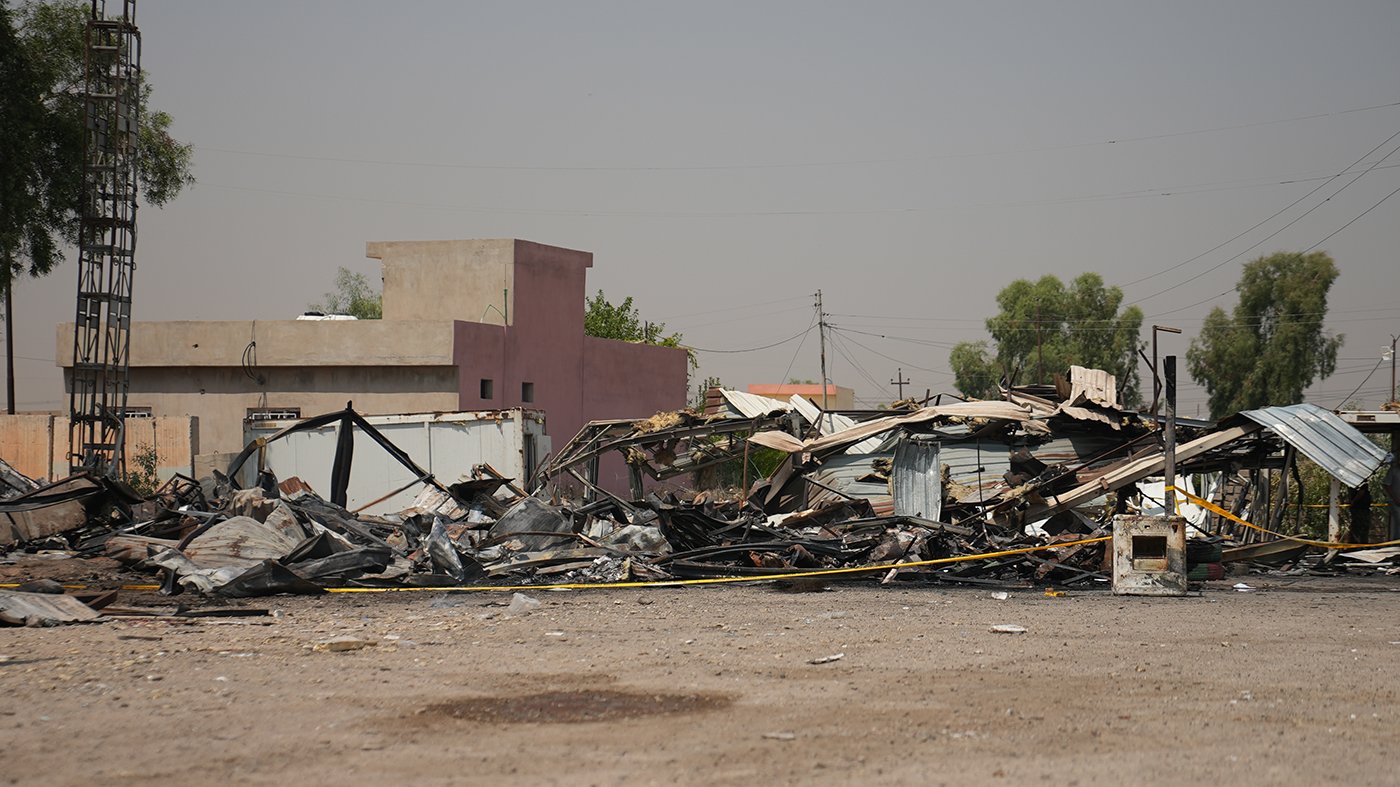
The conflict between the United States and Iran is intensifying across the Middle East, raising the specter of a broader regional war that could entangle key U.S. allies. Egyptian authorities reported Thursday that a drone ignited a blaze on two gas vessels at the port of Damietta the previous day. Although no group has claimed responsibility, the incident has amplified worries that the fighting, which began with U.S.-Israeli operations five months ago, is now spreading beyond the initial battlegrounds.
The Damietta attack comes as the U.S. conducts retaliatory strikes against Iran for missile attacks on American forces in Jordan earlier this week. Simultaneously, Saudi Arabia joined U.S. forces in launching joint airstrikes on Iranian-backed militias in Iraq, a response to drone strikes on the Saudi Aramco oil facility at Abqaiq. These coordinated actions underscore a widening front, with the Egyptian port incident highlighting the vulnerability of the Suez Canal—a vital chokepoint for global trade linking the Red Sea and the Mediterranean.
Tehran has blamed Israel for the tanker strike, while also praising Egypt as an “important friend and partner.” Iranian Foreign Minister Abass Araghchi took to social media to warn of “Israeli plots and false-flag operations,” stating, “The threat is clear, mutual and fearful of Muslim solidarity.” Military analysts, however, expressed skepticism about Iran’s capacity to sustain such attacks at scale, and questioned the strategic logic of antagonizing Egypt’s formidable military.
Retired Army Lt. Gen. Sean MacFarland noted that Iran’s ability to conduct a prolonged campaign against strategic targets remains unproven, comparing the drone strike to Iran’s earlier missile attack on Diego Garcia, the joint U.S.-U.K. base in the Indian Ocean. That attack missed its mark but demonstrated Iran’s extended reach. Jason Campbell, a senior fellow at the Middle East Institute, characterized the recent strikes as an “uptick” in a conflict that has been regional since its inception in March. He suggested Iran may be trying to constrain U.S. military options in Israel, as Washington appears to be staging for another round of strikes.
MacFarland questioned the wisdom of Iran provoking Egypt, noting, “Why would you want to draw them into the conflict too? It doesn’t make a lot of sense. But sometimes these things don’t make sense—it made no sense for Germany to declare war on the United States after Pearl Harbor.” In response to the escalation, President Trump vowed on Wednesday to “beat the f--- s---” out of Iran, reflecting the administration’s hardline stance.
The escalating conflict has put political pressure on Trump, with a recent AP-NORC poll indicating that 64% of Americans believe the war is “not worth fighting,” while only 33% support it. Israel, which initiated Operation Epic Fury with the U.S. in late February, has so far remained on the sidelines but has pledged retaliation if Iran launches new attacks on its territory.
In the lead-up to the latest strikes, the U.S. signaled preparations for a large-scale air campaign, deploying special operations forces, additional fighter jets including F-15s and F-35s, and sending 150 extra medical personnel to Landstuhl Regional Medical Center in Germany. The State Department also issued multiple travel warnings for Americans abroad, citing increased threats to diplomatic facilities. Campbell interpreted these moves as signs that the U.S. was preparing to expand its target set, and that Iran, seeing the buildup, wanted to disrupt Washington’s preferred timeline.
Will Walldorf, a professor at Wake Forest University and senior fellow at Defense Priorities, argued that Iran’s attacks on U.S. outposts are meant to signal its refusal to accept peace terms it deems unfavorable. “After rejecting the most recent peace terms put forward by Oman, its attacks on Jordan and Egypt are meant to send this signal,” Walldorf said. “It is playing a dangerous game of chicken with Trump, hoping that he will eventually see that force is pointless and that talks are the best path forward.”
Meanwhile, Saudi Arabia hosted a meeting of representatives from 43 countries on Thursday, in an apparent effort to coordinate a response to the growing instability, as the region braces for further escalation.