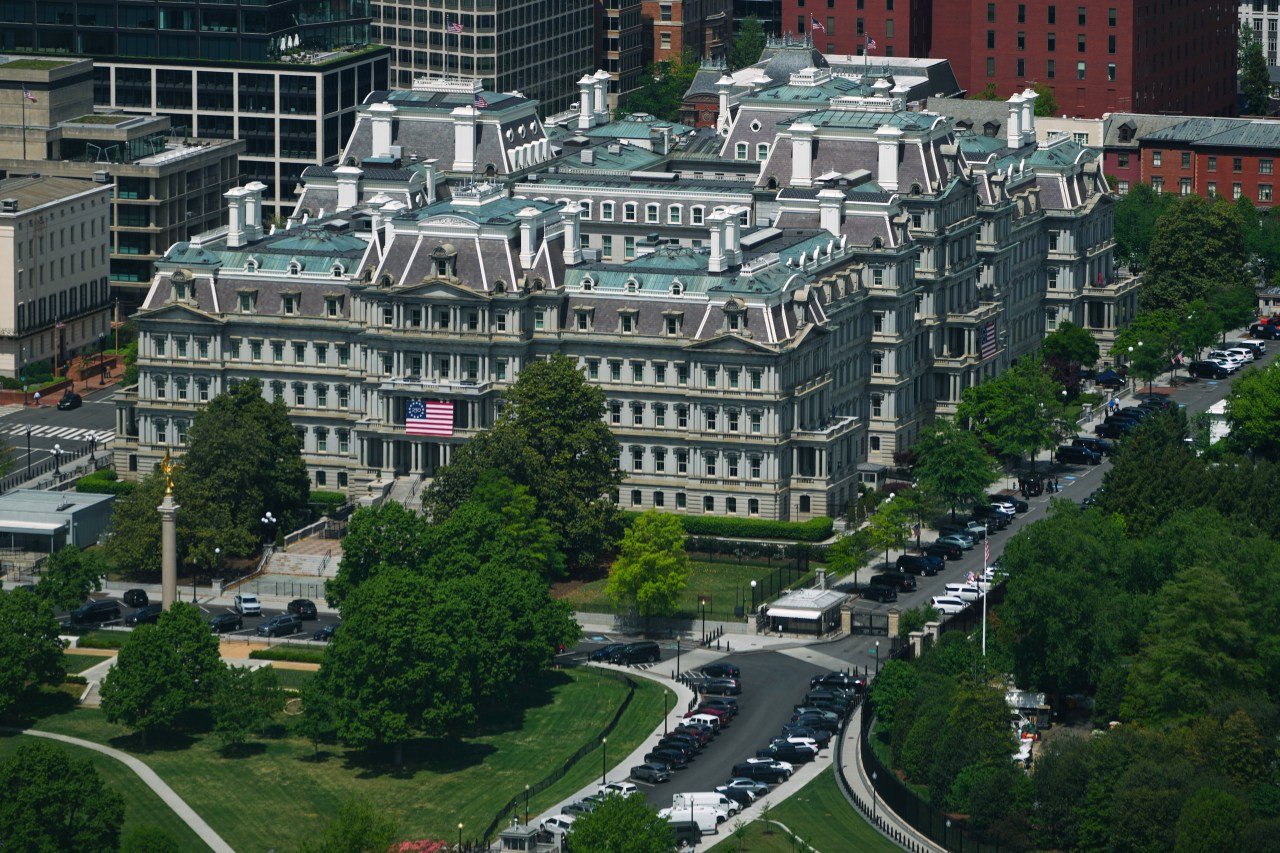
President Donald Trump's ambition to give the Eisenhower Executive Office Building a fresh coat of white paint is now pegged at a minimum cost of $7.5 million for taxpayers, according to a White House official involved in the project. The proposal, which targets a 19th-century National Historic Landmark adjacent to the White House, was presented to the National Capital Planning Commission (NCPC) on Thursday by Ryan Erb, the construction operations and facilities manager in the White House Office of Administration.
The NCPC did not greenlight the project during its monthly meeting. Instead, commissioners directed the White House to supply additional details at a later date, including specifics on the paint type and alternative approaches to enhance the building's appearance without painting it. This delay marks a setback for Trump's broader effort to what he describes as beautifying Washington, D.C., which has already included razing the East Wing for a 1,000-person ballroom and renovating Lafayette Park.
“President Trump continues to beautify the White House and our Nation’s Capital and is giving it the glory it deserves — something everyone should celebrate,” White House spokesperson Davis Ingle said in a statement after the meeting. However, the plan has ignited opposition from preservationists, architects, and historians, who warn that painting granite could trap moisture and cause long-term deterioration. Priya Jain of the Society of Architectural Historians argued that “painting the granite facade of the building white will adversely and permanently alter this important landmark, and should be rejected.”
The White House has floated two options: painting the entire gray granite exterior white, or leaving the granite base unpainted while covering the rest. Officials prefer the full-paint approach. Trump himself has derided the building's current color, calling it a “really bad color” last year. Erb told commissioners that the paint, a silicate variety, is being tested on granite samples from a Maine quarry, as no testing can be done on the Eisenhower Building itself, which opened in 1888 after 17 years of construction. “The initial data was encouraging for this process,” he said, though he acknowledged that the samples are new stone, not aged like the historic structure.
The National Trust for Historic Preservation has weighed in, stating that the building's “subtle and rich colors” are central to its historic significance and that the proposal fails to protect those features. The nonprofit has already sued over the White House ballroom project. More than 2,000 public comments submitted to the NCPC overwhelmingly opposed the paint job, criticizing the cost as a waste of taxpayer dollars and warning that a white Eisenhower Building would disrupt the visual balance along Pennsylvania Avenue and overshadow the White House. Some commenters suggested landscaping or lighting improvements as alternatives.
The NCPC, chaired by top Trump aide Will Scharf, approved staff comments that require the White House to present more information, including alternatives to painting. A separate federal agency, the U.S. Commission of Fine Arts, is also reviewing the proposal and has asked for additional data on paint testing before any vote. A lawsuit challenging the paint job is pending in federal court.
This is not the first time Trump's renovation projects have sparked controversy. His administration has pursued a series of changes to the White House and its surroundings, from the East Wing ballroom to the blue coating of the Lincoln Memorial Reflecting Pool. Critics argue these efforts reflect a broader pattern of prioritizing aesthetics over preservation and fiscal prudence, even as Iran war costs soar and other pressing issues demand attention.
For now, the Eisenhower Building's fate remains uncertain. The White House says it will use funds already allocated for maintenance, but the preliminary $7.5 million estimate could rise as testing continues. Erb stressed that “we can't rush that process,” but with preservationists and legal challenges mounting, the path forward is anything but clear.