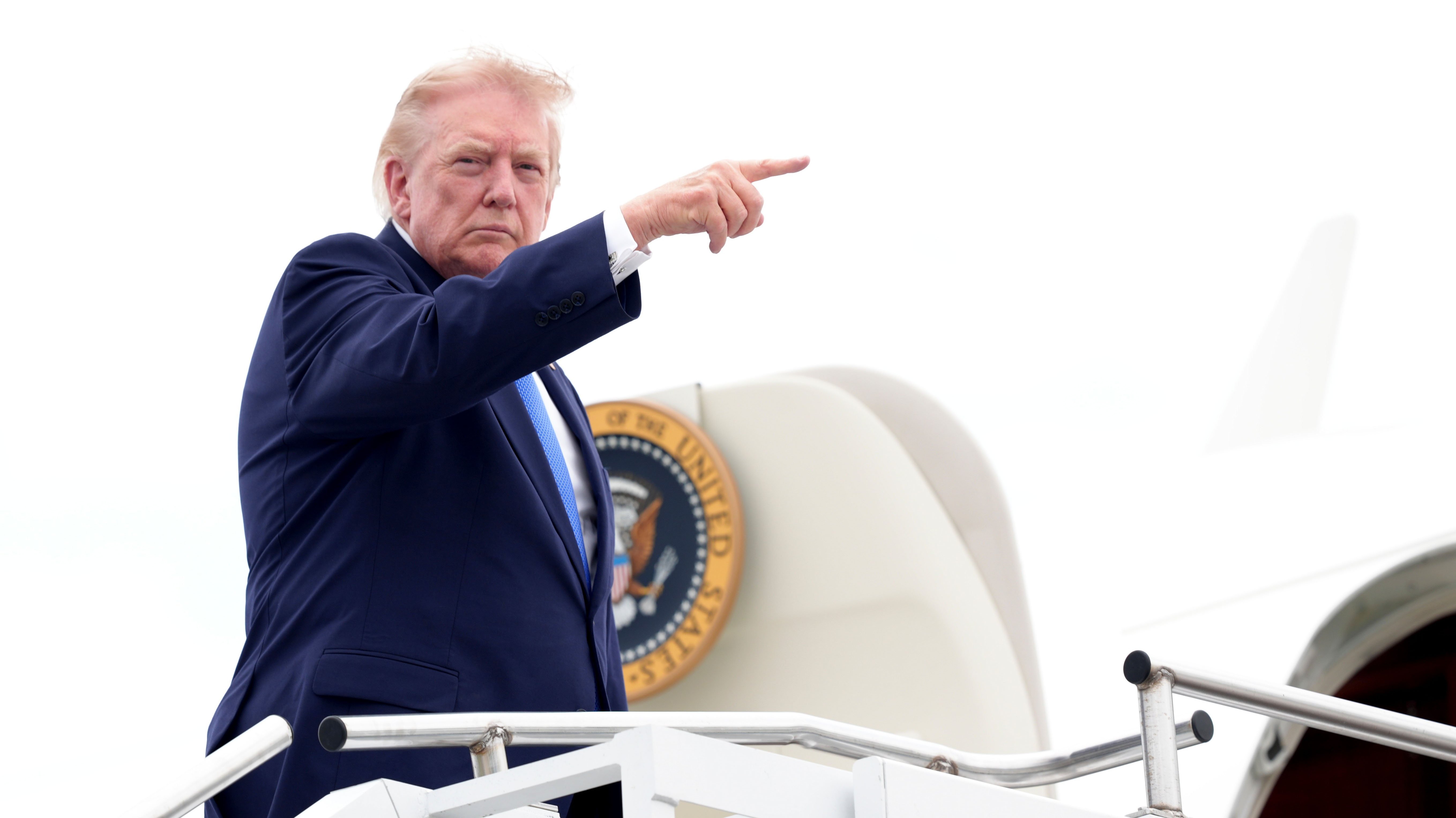
President Trump on Tuesday confirmed that the Secret Service and the military orchestrated his clandestine switch from Air Force One to a separate military aircraft during his July return from the NATO Summit in Turkey, citing a specific threat from Iran. “It’s up to the Secret Service and the military. They wanted me to go on a different flight from a different plane. I do what they say,” Trump told reporters, deflecting personal responsibility for the operation that left the White House press corps uninformed and, as they later learned, potentially in harm’s way.
The incident, first reported by The Washington Post on Monday, revealed that Trump was whisked off the presidential jet via an airport catering truck and onto a separate military plane while flying near Iranian airspace. Journalists aboard Air Force One were told to lower their window shades without explanation, and were led to believe the president was still on board. Trump reportedly told one reporter, “If I go, you go,” a chilling reference to the perceived danger from Tehran amid escalating tensions in the region.
“I think there was a threat. I didn’t ask too much about it. I get a lot of threats,” Trump said on Monday, downplaying the gravity of the situation. But longtime White House correspondents have expressed astonishment at the secrecy, noting that such a move is highly unusual and potentially dangerous for those left behind. The catering truck evacuation is a stark departure from standard practice, where the press pool is typically kept apprised of the president’s whereabouts for both logistical and safety reasons.
This is not the first time a president has dodged a security risk by abandoning Air Force One. In 2000, President Bill Clinton flew on an unmarked aircraft from India to Islamabad, Pakistan, to avoid potential attacks from Islamic terrorist networks, and most reporters on Air Force One were not informed of his absence. However, the White House later told USA Today’s Susan Page about the switch in an off-the-record conversation, a transparency that Trump’s team has not matched.
Critics argue that the failure to inform the press even after the threat had passed is unacceptable. White House correspondent S.V. Dáte said “everyone aboard the real 747 AF1 — crew, guests, press pool — was considered expendable.” Former Republican Rep. Adam Kinzinger (R-Ill.) echoed that outrage, writing on X: “Trump put his staff and press at risk to save his own hide. The fact that the right is trying to push this as a ‘cool cloak and dagger’ thing is so insane. It’s a cult.” He added, “This shows Iran is stronger than he said, his plane is worse than he said, and he doesn’t care about his people. Sorry. It’s true.”
The episode raises fresh questions about the administration’s handling of security threats and its relationship with the media. While Trump has repeatedly clashed with the press, this incident goes beyond rhetoric, placing journalists in a position where they could have been targeted without their knowledge. The administration’s broader approach to transparency has been a point of contention, and this latest revelation is likely to intensify scrutiny.
As the story unfolds, the Secret Service has not publicly commented on the specific threat that prompted the unusual maneuver. Trump’s own comments suggest he was briefed but chose not to delve into details, a stance that may do little to assuage concerns among those who were unwittingly placed in harm’s way. The president’s recent foreign policy moves have been marked by bold claims, but this incident underscores the real-world consequences of his decisions on the ground.
For now, the press corps is left to digest a disturbing reality: that in the name of presidential security, they were treated as expendable, and that the full story only emerged after a media investigation, not through official channels. The episode is a stark reminder of the delicate balance between security and accountability, and it remains to be seen whether the administration will offer a fuller explanation or simply move on.