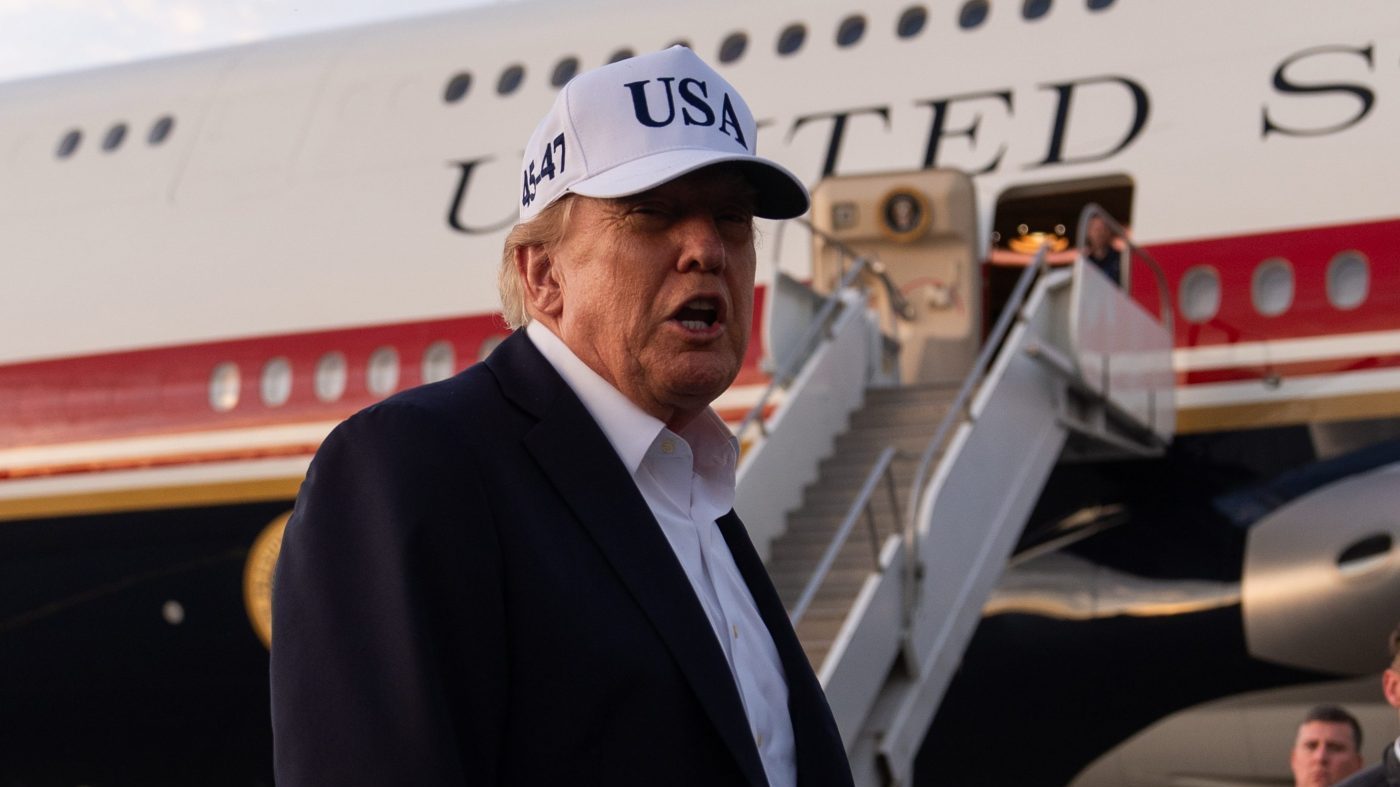
President Trump on Sunday rejected suggestions that he is minimizing the dangers of artificial intelligence, responding to a reporter's question aboard Air Force One with a firm denial. The exchange came after a weekend of high-profile calls from tech industry leaders to slow the pace of AI development to allow for safety measures.
"No, I'm not downplaying," Trump said, interrupting the reporter. "But it's going to be more good than bad, by a lot."
Earlier in the day, while attending a golf tournament in Ireland, Trump was asked about the possibility of slowing AI development or increasing regulation. He framed the issue in terms of global competition, particularly with China, and stressed the importance of maintaining American dominance in the field.
"Well, I'll say this: we're leading China in AI. We're the most sophisticated country in the world, and frankly, I want to keep it that way because whoever wins AI wins," the president said. He added that while guardrails could be put in place, he believed many of the concerns raised were overblown. "And we can put guardrails, we can do this and that, but, I think you have a lot of negative forces that are bringing it up that shouldn't be bringing it up, and they're bringing up things that won't happen," he said.
His comments come as a growing number of industry figures and lawmakers call for more caution. On Saturday, Anthropic CEO Dario Amodei published a blog post arguing that AI development must be slowed to allow time for necessary safety precautions. He was joined by OpenAI CEO Sam Altman and billionaire Elon Musk.
"We must slow the pace at which we improve the capabilities of AI models," Amodei wrote. "Progress will still seem fast, and we must make wise use of the time we gain." Amodei recommended that AI companies adopt a "pacing" framework, which does not mean halting development but ensuring adequate time for alignment and third-party evaluation.
"To be clear, pacing does not mean halting model training or technical progress, but ensuring companies take adequate time to align and safeguard their models, and for third party evaluators to confirm this," he continued. "Our pacing framework is an attempt to further strengthen our commitment to safety and encourage a race to the top."
The debate is intensifying on Capitol Hill, where lawmakers from both parties are pressing for more briefings and oversight of the emerging technology. Some, however, like House Speaker Mike Johnson (R-La.), have urged restraint and cautioned against panic.
Earlier this month, a group of current and former Anthropic researchers issued a stark warning, suggesting that the AI they are developing could pose an existential threat to humanity. That report has added urgency to calls for stronger safeguards, but the president has remained focused on the competitive advantage, a stance that aligns with his broader dismissal of AI extinction fears in favor of the race with China.
The administration's position has drawn criticism from some Democrats, who argue that the president is not taking the risks seriously enough, while Republicans in Congress have been divided on how to approach AI regulation, with some echoing the president's emphasis on innovation and others calling for more oversight.