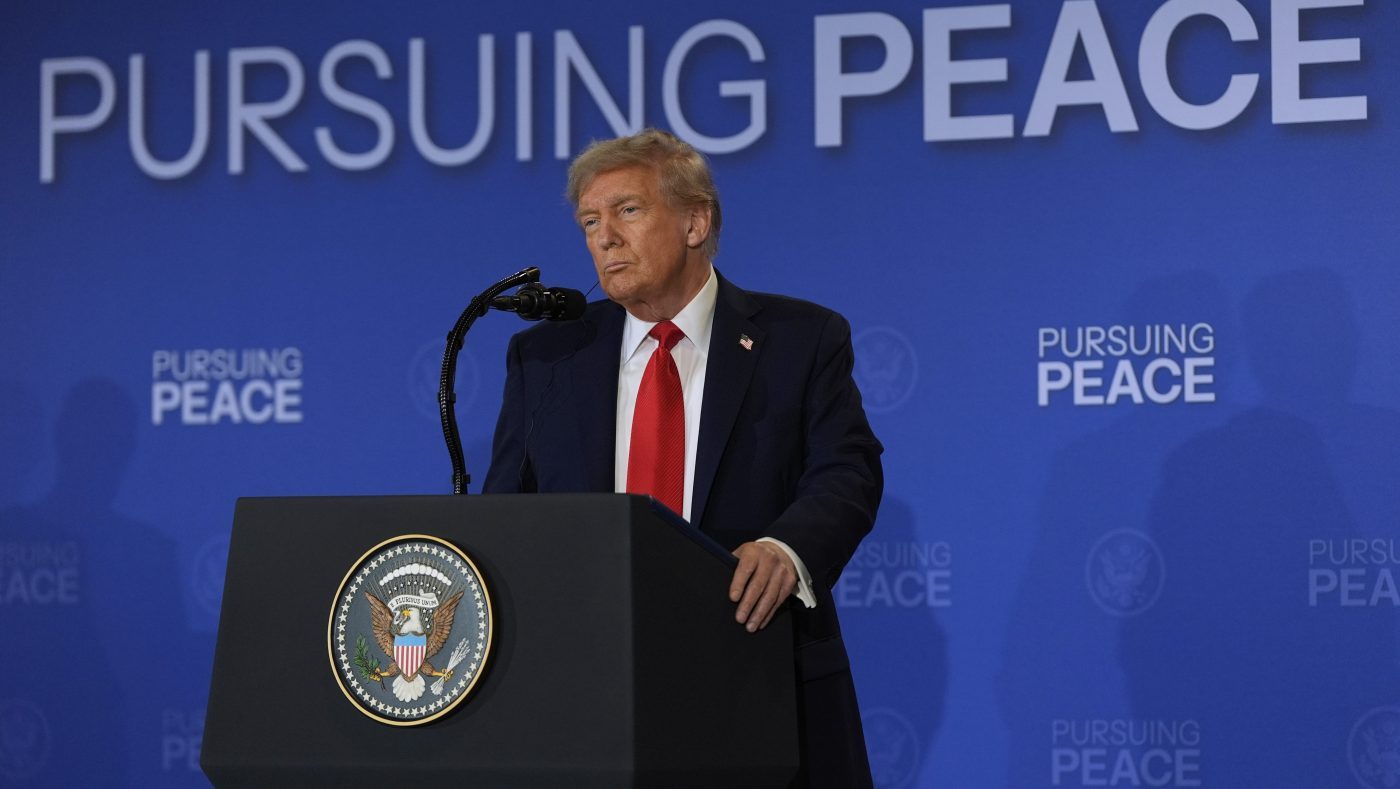
President Trump said Thursday that the United States will not launch military strikes against Iran before the November midterm elections, asserting that his administration is engaged in "productive discussions" with the Islamic Republic. The announcement comes amid reports that the White House had requested strike options from the Pentagon, and as oil prices surged on the possibility of an imminent attack.
In a post on Truth Social, Trump wrote: "I want to make it clear to everybody that, while Iran is in very bad condition, both Economically and Militarily, and while the Blockade will remain in full force and effect, with Oil flowing in Record Numbers of Barrels through the Hormuz Strait (22 Million Barrels, last night alone, with not one barrel coming from, or going to, Iran!), we will not be attacking Iran at any time prior to the Midterm Elections to be held in the United States on November 3rd." He added emphatically: "IRAN WILL NOT HAVE A NUCLEAR WEAPON."

The president's statement follows a report from The Atlantic that the White House had asked the Pentagon to develop a range of military options against Iranian targets that could be executed before the elections. A White House official told The Hill that "the Commander-in-Chief has all options available at any time," and that "the United States is in a very strong position with control of the Strait of Hormuz and the Iranian economy collapsing." The official further warned: "Iran has been decimated, and things will go one of two ways; the easy way or the hard way. President Trump holds all the cards and will do whatever is best for the United States."
Diplomatic efforts between Washington and Tehran have stalled as the conflict has entered its seventh month. Iran's economy is under severe strain from the Trump administration's continued economic pressure campaign and a naval blockade in the Arabian Sea. Nevertheless, Iranian forces have persisted in attacking commercial tankers navigating the Strait of Hormuz, further disrupting global energy exports.
The debate over potential strikes comes as the US military has significantly reinforced its presence in the region under US Central Command (CENTCOM). The Pentagon has deployed over 4,000 Marines and sailors aboard three warships, led by the USS Makin Island, a Wasp-class amphibious assault ship. Additionally, the USS Theodore Roosevelt, a Nimitz-class aircraft carrier, is en route to the Middle East to relieve the USS George Washington.
The prospect of pre-election military action has already rattled energy markets. On Thursday, Brent crude climbed to $104.60 per barrel, while West Texas Intermediate (WTI) jumped 3.91 percent to $92.19 per barrel. Analysts attribute the spike to heightened fears of an armed confrontation that could disrupt oil flows through the strategic waterway.
Trump's pledge not to strike before the midterms may provide some short-term relief, but the underlying tensions remain. The administration's continued military buildup and the president's hardline rhetoric suggest that the option of using force against Iran is very much on the table after the elections. As the midterm campaign intensifies, the White House is walking a tightrope between projecting strength and avoiding a new conflict that could unsettle voters.
With the midterms approaching, the political calculus is delicate. Trump's decision to publicly rule out an immediate strike appears aimed at easing concerns about an election-eve war, even as his administration keeps all options open. Whether "productive discussions" with Iran will yield a diplomatic breakthrough remains uncertain, but for now, the president has drawn a clear line: no attack before November 3rd.