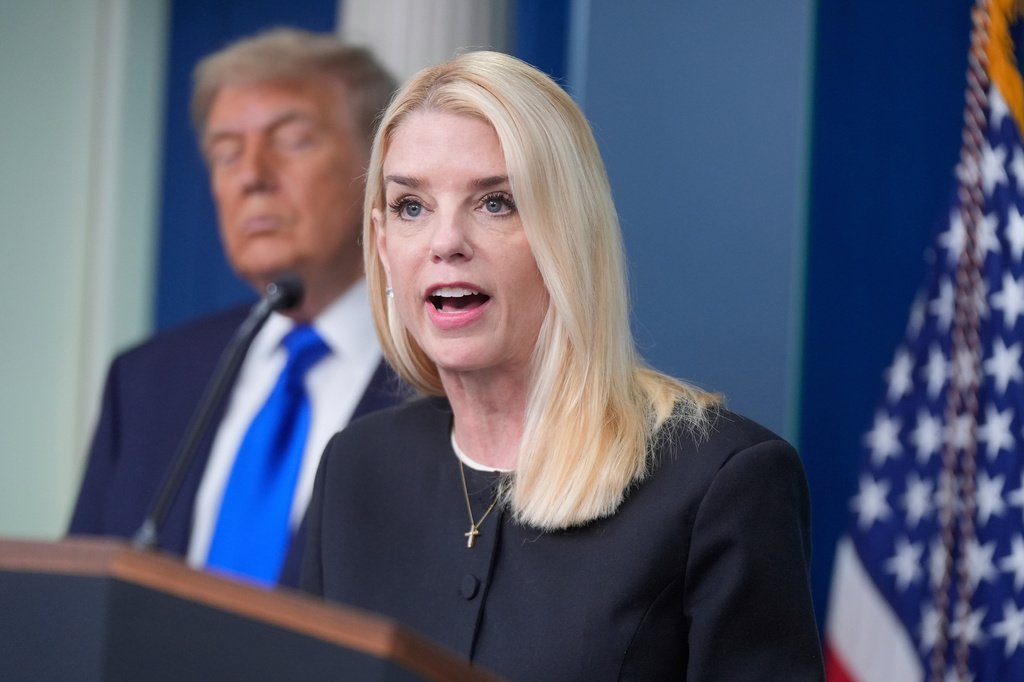
President Trump has dismissed Attorney General Pam Bondi, according to sources familiar with the matter, marking another high-profile departure driven by the President's dissatisfaction with the Justice Department's refusal to function as a political weapon. The firing centers on Bondi's alleged failures to launch prosecutions against Trump's adversaries and to control the fallout from the Jeffrey Epstein scandal.
A Pattern of Political Demands
This move echoes the 2018 firing of Attorney General Jeff Sessions, who was also removed for resisting pressure to direct the department's resources for partisan ends. Trump has consistently treated the agency as an extension of his personal legal and political interests, rejecting the traditional norm of an independent attorney general who represents the United States and administers justice without regard to party.

Despite her efforts to align herself with the President—including purging career lawyers deemed disloyal and lavishing him with public praise—Bondi ultimately fell short of Trump's expectations. She was reportedly tasked with securing criminal convictions against figures like former FBI Director James Comey and New York Attorney General Letitia James, despite an apparent lack of evidence for charges. As a former prosecutor noted, such cases would be nearly impossible to win without factual foundations, highlighting the unrealistic nature of the demands.
Operational Shifts and Erosion
Under Bondi's brief tenure, the Justice Department underwent significant operational changes that critics argue have weakened its core functions. More than 23,000 criminal cases were reportedly dropped to refocus resources on immigration enforcement, a key Trump priority. Simultaneously, FBI Director Kash Patel reassigned thousands of agents to similar duties while dismissing those who had worked on investigations into Trump. This exodus of experienced personnel has raised alarms about the nation's capacity to combat terrorism and other serious crimes.
Bondi also could not fulfill Trump's directive to derail congressional investigations into the Epstein case or prevent the release of files that repeatedly mention the President. Furthermore, she was unable to substantiate Trump's false claims of winning the 2020 election, another persistent demand placed on the department that has consumed taxpayer resources.
An Acting Replacement with Deep Ties
Trump has appointed Deputy Attorney General Todd Blanche as acting attorney general. Blanche previously served as Trump's personal defense attorney in multiple criminal cases, a background that intensifies concerns about the erosion of the department's independence. It remains unclear whether Blanche will be nominated for the permanent role. His upcoming agenda includes outlining the administration's fraud crackdown strategy, a move being closely watched for its political undertones.
The appointment has drawn immediate comparisons to figures like Roy Cohn, the ruthless attorney who served both Senator Joseph McCarthy and Trump himself. Senate confirmation of any nominee will now become a critical test of whether legislators are willing to check the President's influence over law enforcement. As one commentator noted, if Republicans wish to prevent a future Democratic president from similarly politicizing the department, they must act now to restore its traditional nonpartisan mission.
Broader Implications for Governance
This episode occurs against a backdrop of escalating confrontations in Trump's second term, including a public feud with commentator Tucker Carlson over Iran policy and scathing internal critiques from former allies like Chris Christie. The firing underscores a governing philosophy where loyalty is paramount and institutional independence is viewed as obstruction.
The fundamental question for senators, as one observer put it, is whether they will work to restore the Justice Department as "America’s most respected and professional law enforcement agency" or allow it to become a permanently politicized tool. The principle at stake is foundational: democracies administer justice fairly, while dictatorships weaponize it.