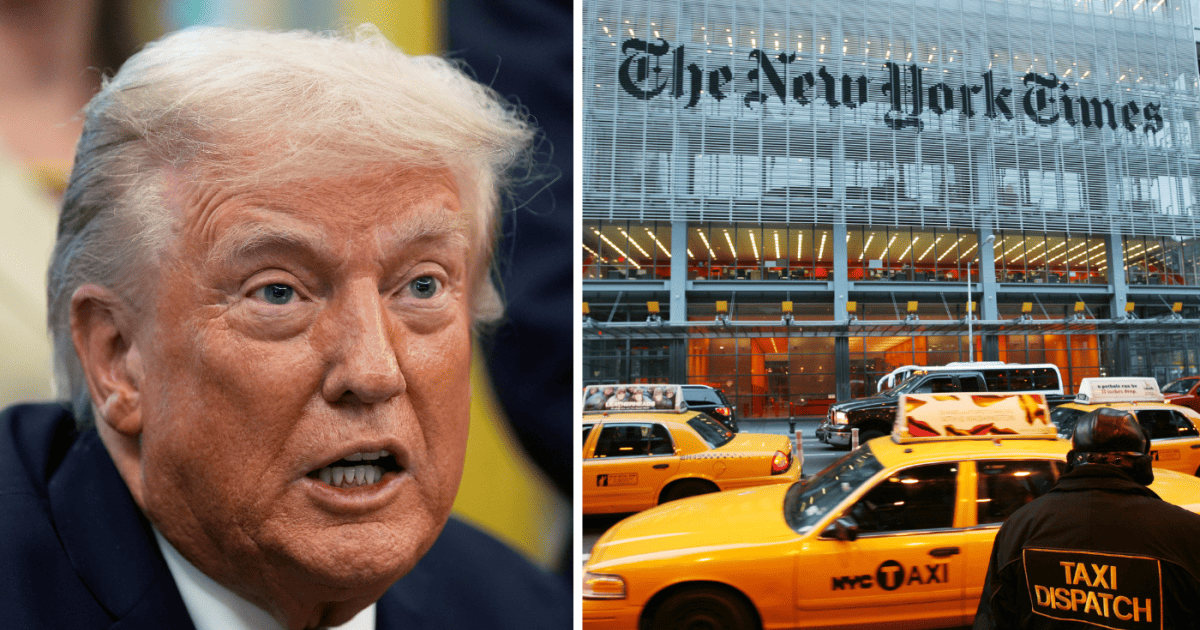
President Donald Trump renewed his assault on the New York Times over the weekend, excoriating the newspaper for an analysis that concluded the U.S.-Iran conflict has achieved little in nearly four months. In a series of posts on Truth Social, Trump labeled the reporting as "TREASONOUS" and pledged to incorporate the article into his existing lawsuit against the company.
The president took aim at the Times' headline, which read: "What Changed After Almost 4 Months of War? Analysts Say Not Much." Trump countered with a litany of claimed victories, asserting that Iran's military capacity has been decimated. "Their Military is DONE, their Navy is GONE, their Air Force is GONE, their Launching Pads, Missiles, Drones and Manufacturing of same, is almost GONE," he wrote, also citing the removal of Iranian leaders, soaring inflation at 250%, and a broken economy. He further highlighted that the Strait of Hormuz remains open and that U.S. stock markets and employment are at record highs.
The president's broadside comes amid heightened tensions, with Iran threatening to close the Strait of Hormuz as conflict escalates between Israel and Hezbollah in Lebanon. The New York Times article, penned by journalist Neil MacFarquhar, notes this development and suggests that Iran's emboldened posture throughout the war has created a stalemate, undermining prospects for negotiations. MacFarquhar writes that despite repeated U.S. strikes, Iran's capacity to "retaliate and inflict damage" has been viewed by analysts as a victory, a characterization Trump vehemently rejects.
In a separate post, Trump amplified a screenshot of Senator Lindsey Graham (R-S.C.) criticizing the Times for downplaying the administration's military achievements. Graham's intervention underscores the political pressure on the White House to demonstrate decisive results in a conflict that has drawn comparisons to previous protracted engagements in the Middle East.
This is not the first time Trump has clashed with the New York Times; he has repeatedly targeted the outlet and other media organizations throughout his presidency. The lawsuit referenced by Trump is part of a broader pattern of legal and rhetorical attacks on press coverage he deems unfavorable. Critics argue such moves threaten press freedom, while supporters see them as necessary pushback against biased reporting.
Strategic Stalemate or Decisive Victory?
The dispute highlights a fundamental divide over how to measure success in the Iran war. Administration officials point to the degradation of Iranian military assets and the reopening of key shipping lanes as evidence of progress. However, independent analysts and some lawmakers question whether the conflict has achieved its broader strategic objectives, including deterring Iranian proxies in the region. The question of whether the war has actually weakened Iran's long-term influence remains a point of contention, especially as nuclear talks between the U.S. and Iran resume in Switzerland.
Meanwhile, the economic toll of the conflict is becoming more apparent, with fertilizer costs surging 40% amid the war, threatening to drive up global food prices. This adds a layer of domestic political vulnerability for Trump, who has staked his reelection on economic performance.
The president's latest broadside also comes as former Defense Secretary Mark Esper has questioned the quality of advice Trump receives, warning of gaps in constitutional loyalty among his inner circle. Such internal critiques may fuel perceptions of a disjointed war strategy.
As the conflict drags on, the White House faces mounting pressure to articulate a clear endgame. Trump's aggressive response to the Times suggests he will continue to frame the war as a success story, even as analysts and some allies urge a more nuanced assessment. Whether this messaging resonates with voters remains to be seen, but for now, the president is doubling down on his narrative of decisive victory.