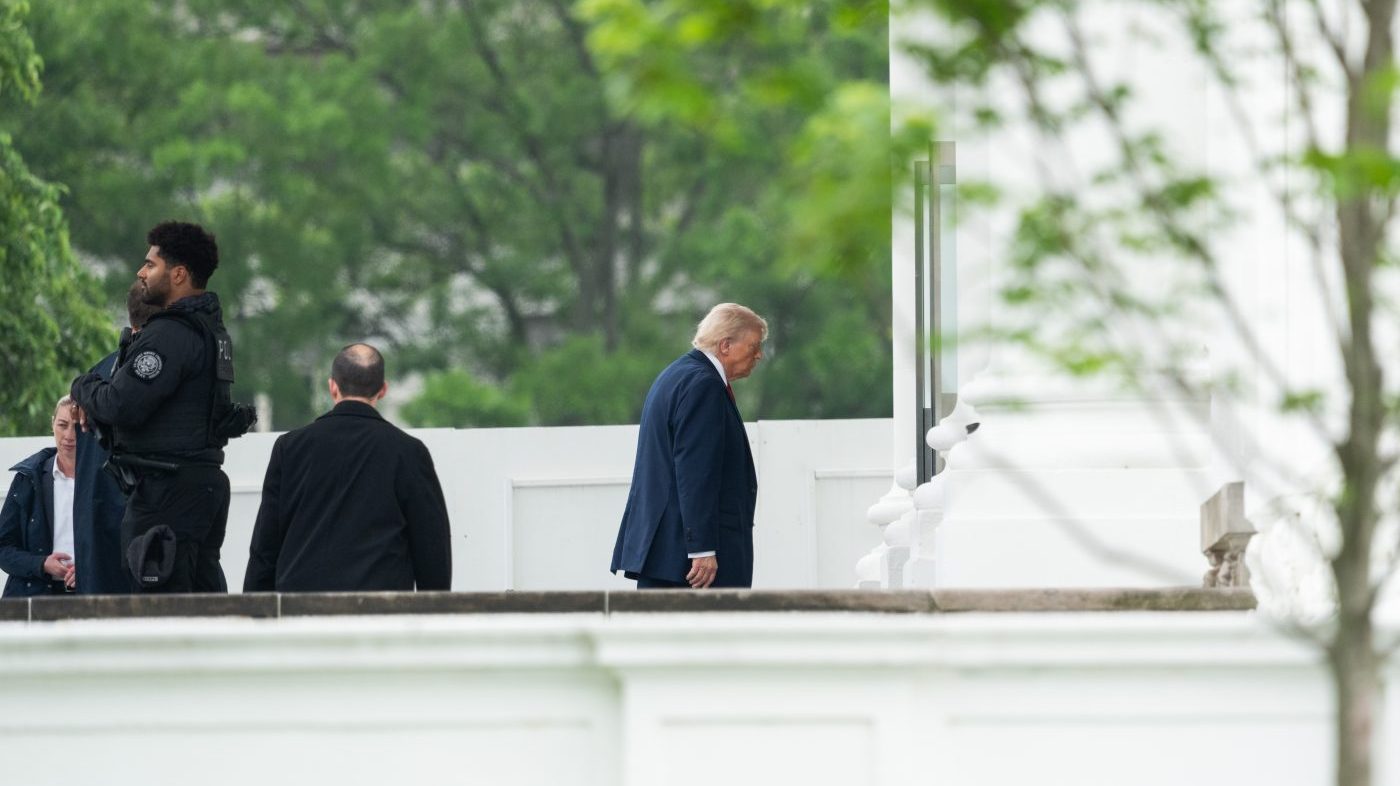
President Donald Trump laid out two potential paths for dealing with Iran’s enriched uranium stockpile on Monday, signaling that the fate of the material could be a key component of any peace agreement currently being negotiated between Washington and Tehran.
In a post on Truth Social, Trump wrote that the “Enriched Uranium (Nuclear Dust!)” would either be “immediately turned over to the United States to be brought home and destroyed” or, alternatively, “destroyed in place or, at another acceptable location, with the Atomic Energy Commission, or its equivalent, being witness to this process and event.” The president’s phrasing echoed his earlier references to Iran’s nuclear material as “nuclear dust,” a nontechnical term that has become a hallmark of his administration’s messaging on the issue.
The announcement comes as U.S. and Iranian negotiators make progress in Qatar toward a deal that would end the ongoing conflict and gradually reopen the strategic Strait of Hormuz. The uranium stockpile has long been a sticking point in talks, with Washington insisting Tehran dismantle its nuclear program entirely. Trump’s latest proposal appears to offer Iran a choice: hand over the material for destruction abroad, or allow it to be neutralized under international supervision on Iranian soil.
House Speaker Mike Johnson (R-La.) reinforced the administration’s stance during an appearance on “Fox & Friends Weekend” on Sunday, saying, “We’ll take care of the nuclear dust. We’ll get the Strait of Hormuz reopened, which will be great for gas prices here and stability around the world, and that’s why all the regional allies are following U.S. leadership under President Trump.” Johnson’s comments underscore the political stakes for Republicans, who see the talks as a chance to deliver a tangible foreign policy win ahead of the 2028 election cycle.
Trump has consistently argued that Iran must never be allowed to develop a nuclear weapon, a position that led him to withdraw from the 2015 Joint Comprehensive Plan of Action (JCPOA) in 2018. He has criticized the Obama-era deal for failing to permanently restrict Tehran’s enriched uranium stockpile. The current negotiations, however, take place against a backdrop of military action: U.S. forces struck Iranian nuclear facilities in March, targeting the Ardakan yellowcake production plant in Yazd and the Shahid Khondab Heavy Water Complex in Arak, according to state media. Trump claimed those facilities were “obliterated” during initial U.S. and Israeli attacks last June.
Despite Trump’s focus on the uranium issue, Iranian officials maintain that the fate of their nuclear material is not part of the current talks. Foreign Ministry spokesperson Esmaeil Baqaei told the Associated Press on Monday that “the focus of the negotiations is on ending the war and at this stage,” suggesting Tehran is unwilling to discuss broader nuclear concessions until a ceasefire is secured. Iranian President Masoud Pezeshkian reiterated on state television Sunday that his country is ready “to assure the world that we are not after a nuclear weapon,” a claim Iranian officials have made repeatedly while insisting the program is for peaceful purposes.
The negotiations have drawn both praise and skepticism from within Trump’s own party. The Wall Street Journal editorial board recently warned that a deal could amount to an “economic bailout” of the Iranian regime, while Senator Lindsey Graham (R-S.C.) has backed Trump’s push to expand the Abraham Accords as part of the broader diplomatic effort.
As talks continue, the question of who will oversee the destruction of Iran’s enriched uranium—and whether Tehran will ultimately agree to any such arrangement—remains unresolved. For now, Trump’s proposal offers a clear binary choice, but the road to a final agreement is still fraught with obstacles.