President Trump on Wednesday asserted that North Korea is armed with “57 very powerful nuclear weapons,” using the figure to justify his ongoing engagement with Pyongyang and to criticize past U.S. policy toward the isolated regime.
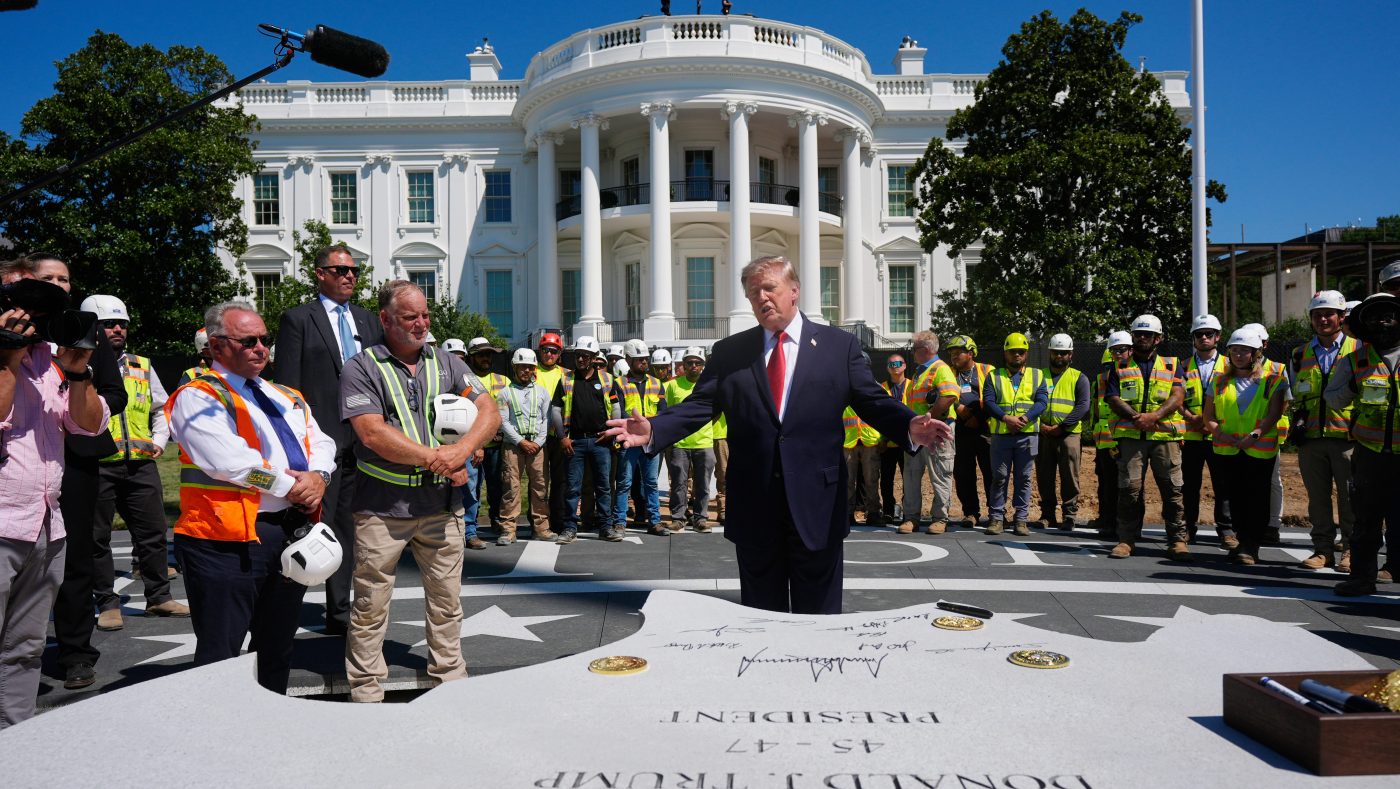
Speaking at a White House event, Trump said, “The fact that I get along with him, that’s a good thing, not a bad thing. He has 57 very powerful nuclear weapons.” He was referring to North Korean leader Kim Jong Un, with whom he has maintained a personal rapport.

The president added that the weapons buildup should never have been allowed to happen, but that his relationship with Kim is an asset. “Should’ve never allowed it to happen. They should’ve never allowed it, if I were president, I wouldn’t have allowed it. But he’s got them. I get along with him very well,” Trump said.
His remarks come days after he publicly complained about the cost and messaging of annual U.S.-South Korea military exercises. In a Truth Social post on Sunday, Trump said he had instructed Defense Secretary Pete Hegseth to “substantially reduce” those drills, arguing they are expensive and send a “totally inappropriate and hostile” signal to a country that has been “unthreatening and respectful” during his tenure.
Trump also referenced South Korea’s refusal to join U.S. military operations in Iran, writing that he recently asked the South Korean president to participate in the “Denuclearization of the Islamic Republic of Iran” and was met with a “No thanks!” He framed that response as further justification for scaling back joint exercises.
The U.S.-South Korea drills are long-standing, large-scale defense maneuvers held in the spring and summer to bolster the alliance and readiness against regional threats. Critics of the exercises have long argued they provoke North Korea, while supporters say they are essential for deterrence.
Trump’s latest comments align with his previous praise of Kim and his willingness to engage directly with the North Korean leader. During his first term, he held three summits with Kim and became the first sitting U.S. president to step onto North Korean soil, though talks on denuclearization ultimately stalled.
The president’s assertion about North Korea’s arsenal—and his defense of his personal diplomacy—comes amid broader questions about his approach to international relations, particularly his rocky relationship with traditional allies and his willingness to break with established foreign policy norms.
Analysts note that North Korea’s nuclear capabilities have grown significantly under Kim, with multiple tests of intercontinental ballistic missiles and a declared hydrogen bomb. The exact number of warheads remains a matter of intelligence debate, but most estimates range from 30 to 60.
Trump’s comments also drew attention to his controversial dealings with foreign leaders and his tendency to prioritize personal relationships over institutional ties. His administration has yet to provide a detailed strategy for addressing North Korea’s advancing weapons program.
The White House did not immediately clarify the source of the “57” figure or whether it reflects new intelligence. The president’s remarks are likely to reignite debate over the effectiveness of his engagement strategy and the future of the U.S.-South Korea alliance.