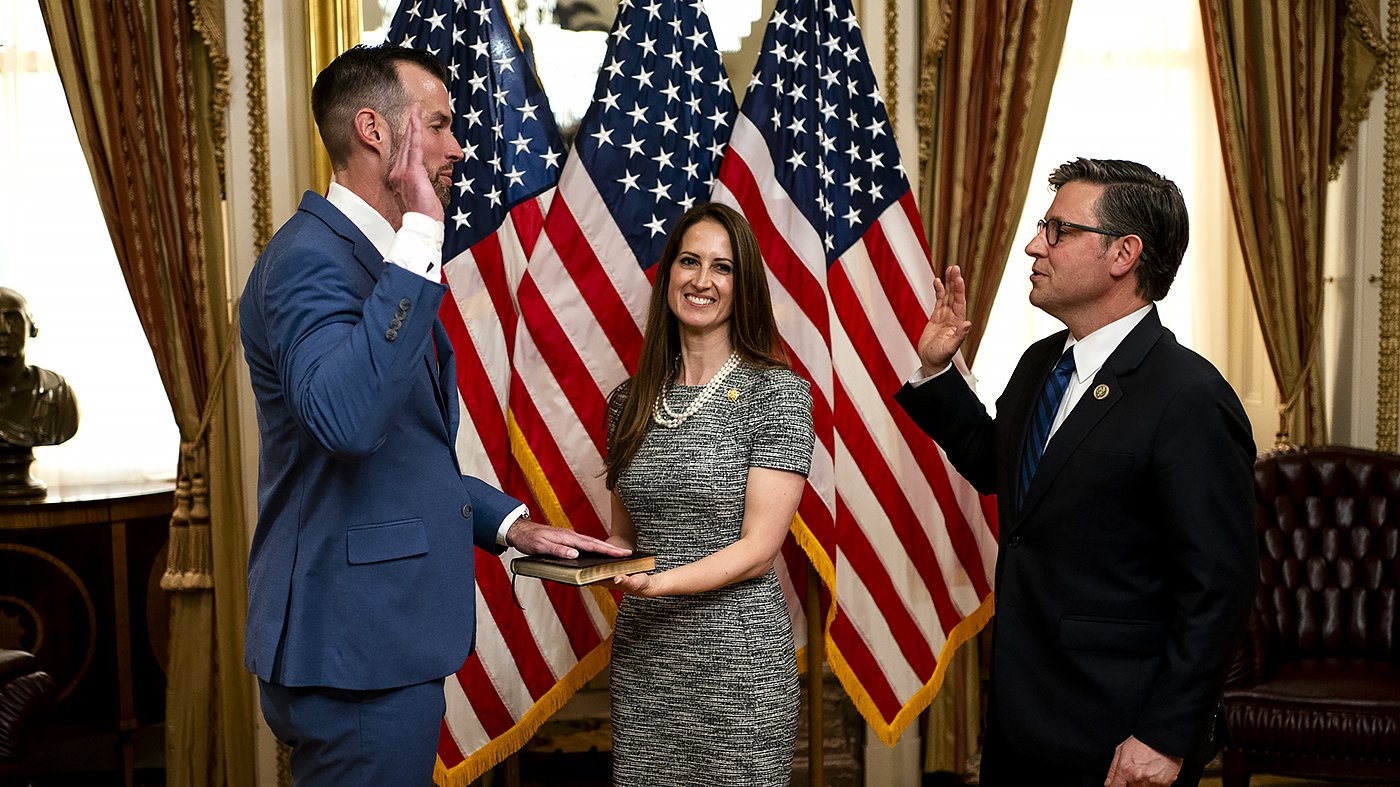
Republican Clay Fuller formally took his seat in the House of Representatives on Tuesday, sworn in to complete the term of former Rep. Marjorie Taylor Greene. Fuller's arrival provides a critical vote for the GOP's narrow governing margin as the party seeks to advance President Trump's priorities in the final months of the congressional session.
Bolstering the GOP Majority
Fuller's entry into Congress comes after a special election victory in Georgia's 14th Congressional District. He will serve the remaining months of Greene's unexpired term, a period during which every vote is crucial for Republican leadership. The party holds one of the slimmest House majorities in modern history, making Fuller's presence immediately significant for procedural votes and legislative initiatives aligned with the Trump administration.

During his swearing-in ceremony, Fuller struck a dual tone, pledging aggressive advocacy for his conservative base while extending an olive branch across the aisle. "You were sent a warrior to Congress, and I can't wait to fight for you each and every day," Fuller declared. He added, "To my Democratic colleagues. I look forward to working with each and every one of you, and so thank you, Mr. Speaker, I'm ready to get to work here."
Bipartisan Signals and Local Focus
Rep. Sanford Bishop, the Democratic dean of Georgia's congressional delegation, responded positively to Fuller's overture. Bishop expressed hope that the two could find a "way to work together across the aisle, even as we have our diverse interests, particularly when subjects impact the people of the great state of Georgia." This focus on state-specific issues, especially concerning rural communities, suggests potential areas for limited cooperation despite the deeply polarized environment.
Fuller's ascension follows a notable political rupture. He received a direct endorsement from President Trump to replace Greene, who has emerged as a vocal critic of the president during his second term. This dynamic underscores the ongoing fractures within the Republican conference over foreign and domestic policy, where Greene has publicly broken with Trump on issues like Iran.
Background and Political Pedigree
The new congressman brings a resume that includes military and legal service. He previously served as a Judge Advocate General (JAG) Corps officer and as the district attorney for Georgia's Lookout Mountain Judicial Circuit, a position he resigned to run for the House seat. His political credentials were burnished by a stint as a White House fellow during the first Trump administration, cementing his ties to the current political establishment.
Fuller's entry into Congress occurs amid a tense legislative calendar. The GOP majority is tasked with funding the government and supporting White House initiatives while navigating internal dissent. His reliable vote is seen as a bolster for Trump's agenda, contrasting with his predecessor's recent rebellious stance. Greene has not only questioned Trump's approach to Iran but has also publicly criticized specific White House policy promotions as out of touch with economic realities.
The political landscape Fuller enters is defined by its fragility. With majorities often hanging on a single vote, leadership from both parties is forced into delicate negotiations. Fuller's willingness to signal bipartisanship on Georgia-centric matters may provide a narrow path for must-pass legislation, even as he is expected to be a steadfast vote on core party-line issues. His immediate impact will be felt in committee assignments and on the House floor, where the balance of power remains exceptionally tight.
As the 118th Congress moves toward its conclusion, the focus will be on whether Fuller's professed pragmatism translates into actual legislative maneuvering or remains rhetorical. His tenure, though brief, will be a test of whether a Trump-endorsed freshman can navigate the competing demands of a hardened base and the practical necessities of governing with a microscopic majority.