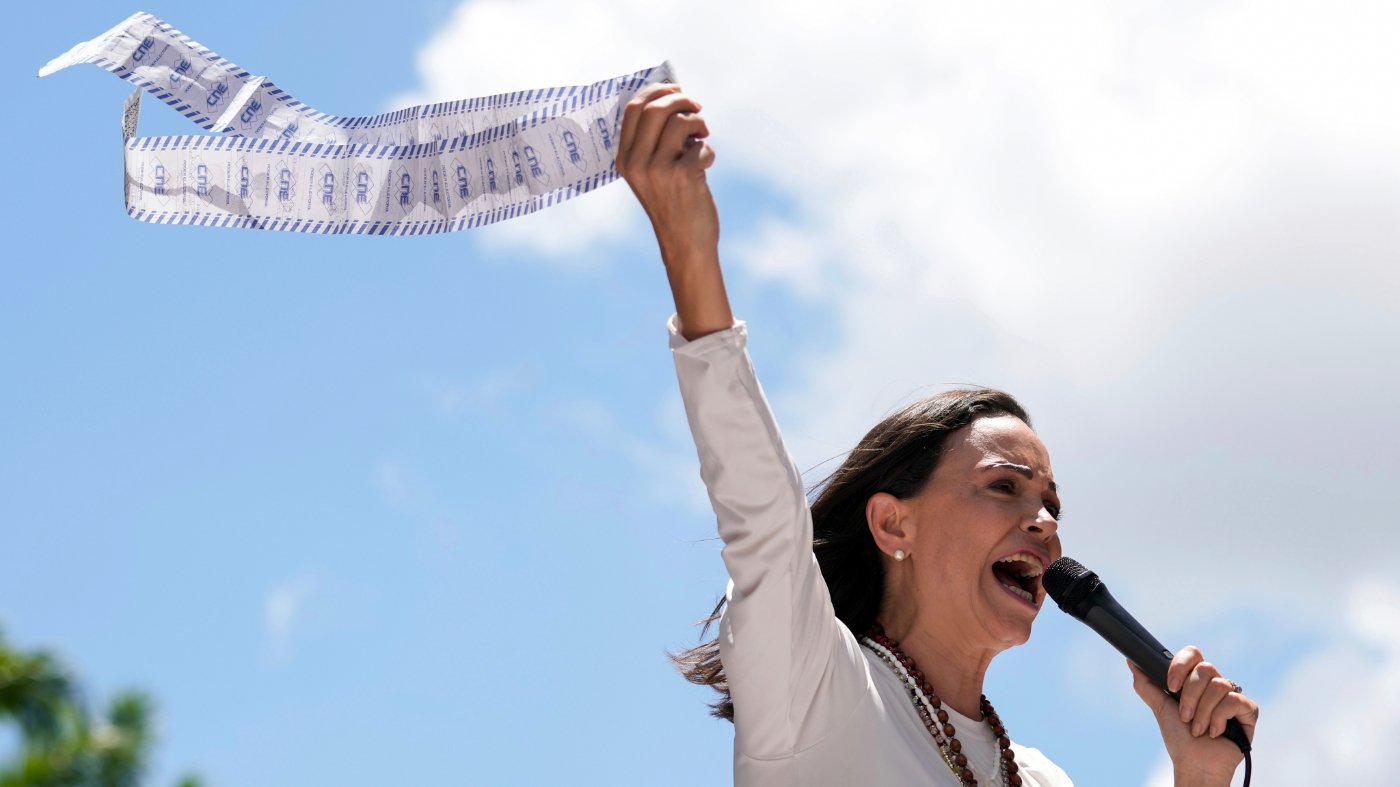
The abrupt mid-air termination of Maria Corina Machado's flight back to Venezuela earlier this month has laid bare a sharp divide between the Trump administration's lofty talk on democracy and its bare-knuckled realpolitik. Secretary of State Marco Rubio had painted a vision of U.S.-led stabilization for the earthquake-stricken nation, but the decision to ground Machado's jet—turning it around over North Carolina—suggests a far different calculus in Washington.
Machado, Venezuela's most prominent opposition figure, had hoped to return to lead relief efforts after the devastating earthquake. Her inner circle believed the trip had tacit U.S. approval, but instead, the administration ordered the plane to abort its journey, leaving her blindsided. The move echoes the darkest days of the Iraq occupation, where grand promises of democracy-building gave way to a scramble for oil. In both cases, critics argue, the U.S. used a battered population's suffering to justify intervention, only to abandon its moral commitments when economic interests took priority.
In Iraq, at least, elections were eventually held and democratic institutions began to take shape. But in Venezuela, many within the U.S.-Venezuela transition team say the Trump administration never intended to rebuild democratic institutions. After the Jan. 3 abduction of Nicolás Maduro, Venezuelans—including Machado, who had gifted her Nobel Peace Prize medal to Trump—pinned their hopes on U.S. support. In neighboring Colombia, where I spend much of the year, there was a palpable expectation that the epicenter of narco-politics would finally be dismantled.
Yet a January poll by Venezuelan firm Meganalisis, reported by NPR, found 90% of Venezuelans backed Maduro's ouster, but 94% did not want the U.S. to lead the post-Maduro transition. They were right to be skeptical. Rubio's three-phase plan for stabilization, recovery, and transition, along with promises to include Machado in negotiations, has proven to be empty rhetoric. The U.S. has squandered a singular, time-sensitive opportunity.
Rather than using its leverage to demand the release of political prisoners, rebuild institutions, or support the opposition's transition plans, Washington's main achievement appears to be seizing control of Venezuela's oil industry. According to former U.S. diplomat Brian Naranjo, of the $8 billion moved to U.S. control, only $300 million was pledged for earthquake relief. Phil Gunson of the International Crisis Group described the U.S. response as “anything from totally non-existent to, at best, completely inadequate.” One observer called the relationship that of a “client-state,” where Washington controls the oil revenue that funds the government.
The Venezuelan regime's response to the earthquake has been equally damning. The interim government of Delcy Rodríguez—a longtime Chavist insider with no legal claim to the presidency and a history of human rights abuses—blocked at least 65 news sites and turned back international rescue teams. Thousands remain missing, but only a fraction of the death toll has been reported. Grieving families have been forced to dig through rubble themselves.
Trump has publicly praised Rodríguez, declaring in March that she was “doing a great job.” But former Ambassador to Venezuela James Story warned that the U.S. has merely “cut the head off one part of the hydra,” leaving the rest of the regime in power. Eric Farnsworth of the Center for Strategic and International Studies told me that Rodríguez “enjoys no greater legitimacy than Maduro and is widely reviled.” He stressed that Edmundo González and Machado, who won elections that Maduro himself oversaw, must be given the chance to lead.
Trump's betrayal of Venezuela marks a dark turn in U.S. foreign policy. The international community must demand that Washington allow Venezuela's democratic parties to elect their own leaders, replacing those illegally appointed by the Maduro regime. At stake is not only the future of U.S. relations with Latin America's democratic movements but the risk of entrenching authoritarian rule. As former Trump lawyer Ty Cobb once likened the president to a “2-year-old” over election denial, the administration's approach to Venezuela suggests a similar disregard for democratic norms.