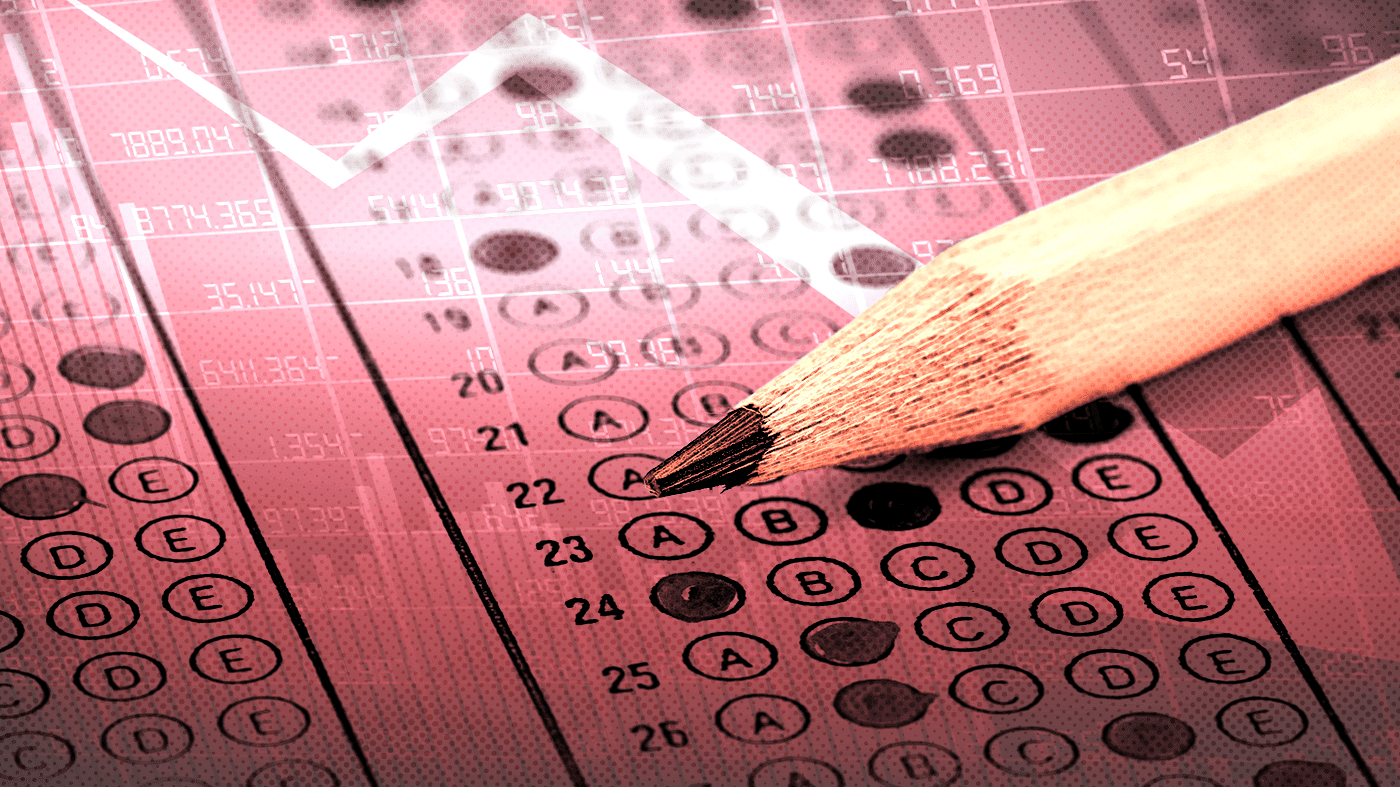
The pandemic's toll on America's youth is painfully obvious, but a new report from Stanford University's Educational Opportunity Project suggests the damage runs far deeper than a temporary setback. After a slight rebound in 2024, 2025 scores have slumped again, indicating what analysts call a dead-cat bounce rather than a true recovery. The numbers are stark: since 2015, 83 percent of school districts have lost ground in reading, and 70 percent have lost ground in math.
Yet the pandemic is too convenient an excuse. The failure of America's public schools is not the result of any single culprit—not smartphones, not overmedication, not teachers' unions, not unsafe campuses, not even the lockdowns themselves. Partisans may pick their favorite scapegoat, but doing so obscures a larger, more troubling reality: American education has been in a state of systemic decay for decades.
A Generation Falling Behind
The consequences are piling up just as the global economy undergoes another seismic shift driven by artificial intelligence and quantum computing. As a recent poll shows broad bipartisan agreement that money dominates politics, the nation's schools are churning out year after year of underperformance. The mechanism established in 1965—universal K-12 education funded by federal tax dollars and accountable to federal standards—has failed to produce capable adults. It won't matter whether the United States or China wins the current AI race if Americans cannot operate the models.
This echoes the very arguments that drove the 1965 education push, which helped the U.S. out-innovate the Soviet Union. But there is another dimension now, perhaps partly a consequence of that pragmatic approach: America's political system is also failing. The electorate is increasingly ill-equipped to govern itself, shaped by the same broken schools that produce voters who make worse and worse decisions.
The Democratic Cost
Both Republicans and Democrats have long decried the crisis in public schools, though they blame different causes. Yet the generations of voters those schools produce are less capable of self-governance. The problem isn't just that civics and history are poorly taught; it's that basic skills for being productive, self-sustaining citizens are eroding.
Thomas Jefferson's 1816 warning to Charles Yancey rings truer than ever: "If a nation expects to be ignorant and free, in a state of civilisation, it expects what never was and never will be." Jefferson argued that liberty depends on an informed citizenry, able to read and think. Today, as a watchdog demands a probe into a secretary's reality show trip, the erosion of educational standards threatens not just economic leadership but the American idea of ordered liberty itself.
The Stanford report should serve as a wake-up call: the short-term struggle to remain the world's leading nation, the long-term betterment of individual students, and the survival of democratic self-rule all hang in the balance.