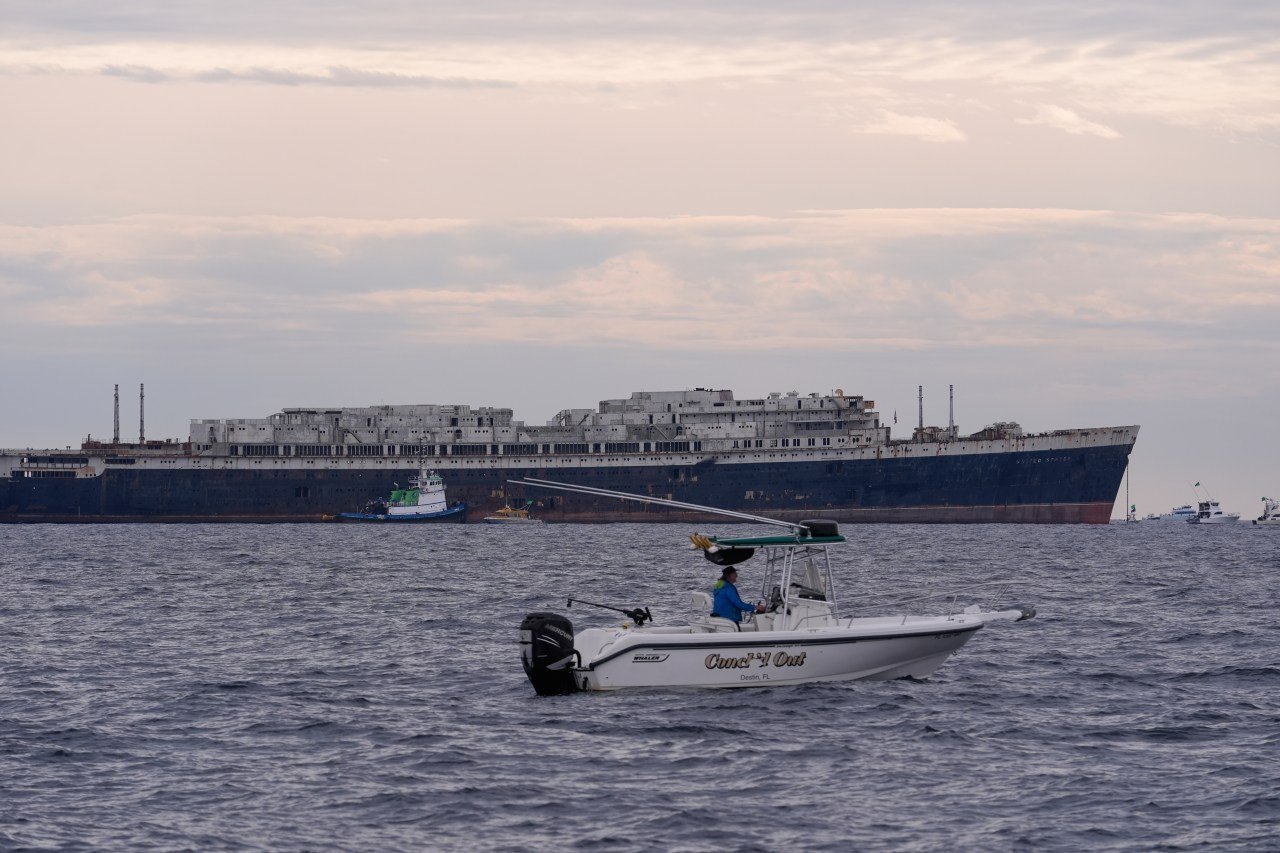
The SS United States, a celebrated ocean liner that once held the transatlantic speed record, was intentionally sunk on Wednesday in the Gulf of Mexico, beginning a new chapter as the world's largest artificial reef. The vessel, longer than the Titanic and with more than 800 crossings under its belt, took hours to go under, far longer than the projected one-hour timeline.
By nightfall, much of the ship remained visible in the murky waters off the Florida Panhandle. It was not until around 9 p.m. that the liner listed to one side and slipped beneath the surface. Coleen O'Malley, president of Coleen Marine, the contractor overseeing the sinking, said before the vessel disappeared, “She is an amazing lady who will not lay down without a fight. Much like the amazing nation she was named after.”
The deliberate scuttling, a $13.5 million project organized by Okaloosa County, is designed to attract divers and anglers while creating a habitat for tuna, marlin, and swordfish. Crews had filled 128 fuel and lubricant tanks with water to ensure the ship would settle upright on the ocean floor, a process that Nick Tomecek, a county spokesperson, admitted “took longer than we thought.” He added, “She's a big ship.”
A storied past
Launched in 1952, the SS United States was a technological marvel of its era, carrying Hollywood stars like Grace Kelly and Elizabeth Taylor, as well as Presidents Harry Truman, Dwight Eisenhower, and John F. Kennedy, and Britain's former King Edward VIII. A young Bill Clinton also sailed on it in 1968 en route to Oxford University. Passengers enjoyed lavish meals that included caviar, roast duckling, and smoked ox tongue.
To prepare the ship for its final voyage, workers removed its 65-foot smokestacks, which will anchor a planned museum. The sinking was conducted without explosives due to federal environmental and safety regulations, Tomecek explained. Instead, workers opened valves to flood the hull through pipes that once cooled the boilers, and they cut large holes in the decks and removed more than 400 portholes to speed the process.
The vessel now rests in about 180 feet of water, with its top deck 60 feet below the surface—shallow enough for novice divers to explore. It sits about 25 miles southwest of Destin, between Panama City and Pensacola, in an area already dotted with more than 500 artificial reefs. The previous largest such reef was the USS Oriskany, an aircraft carrier scuttled in 2006 off Pensacola, which is close enough that experienced divers could visit both wrecks in a single day, Tomecek noted.
Susan Gibbs, granddaughter of the ship's designer, called the vessel “the embodiment of this country's best” and said it “represents pride and resilience and strength and beauty.” The ship was decommissioned in 1969 and spent decades docked in Philadelphia before this final journey. Tim Mullane, a Navy veteran and chief operating officer of Coleen Marine, described the removed funnels as “works of art.” Gibbs added, “I'm just so happy that we are able to save parts of her.”