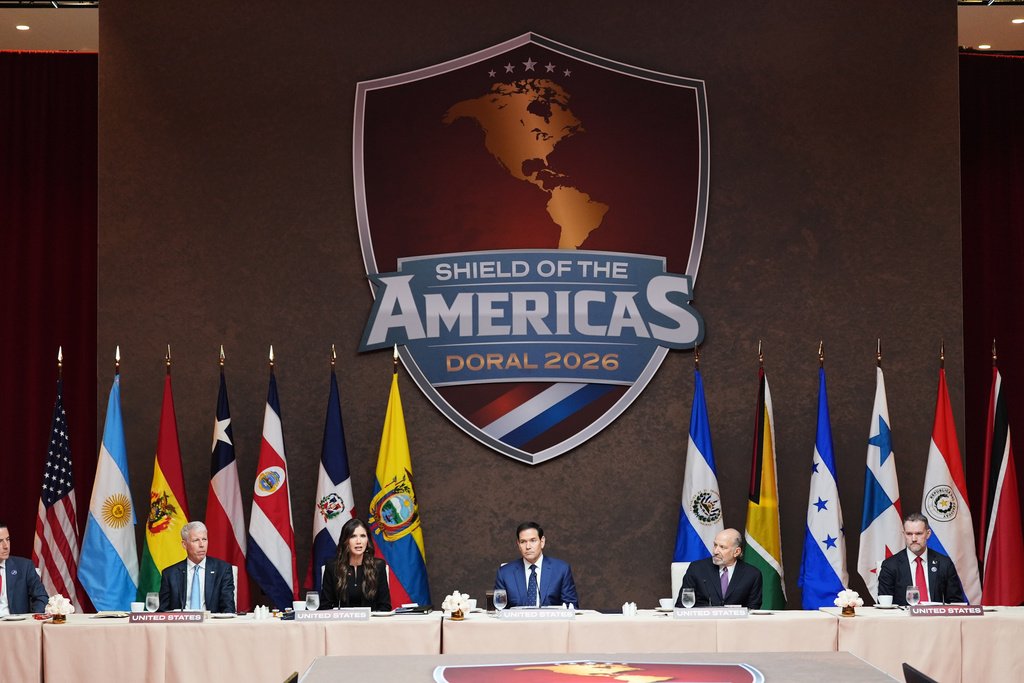
The Shield of the Americas Summit, held in March, signaled a decisive shift in U.S. foreign policy, declaring the Western Hemisphere a core strategic priority rather than a peripheral concern. This recalibration positions regional stability as fundamental to both American domestic security and global influence.
From Summit to Statecraft
The immediate test of this declared focus is now underway. Special Envoy Kristi Noem has embarked on a diplomatic tour through Honduras, Costa Rica, Guyana, Ecuador, and the Dominican Republic. Her mission: to translate the summit's broad consensus into concrete, bilateral security agreements aimed at dismantling transnational criminal networks. This operational phase follows the Florida gathering where thirteen nations agreed to enhance coordination against cartels, a threat that has consistently outpaced government responses.
Initial results are emerging. In Honduras, Noem and President Nasry Asfura committed to deepening joint efforts against organized crime, including enhanced support for Honduran police and military. In Costa Rica, discussions with President Rodrigo Chaves yielded a third-country agreement model, backed by U.S. funding and support from the International Organization for Migration. These steps begin the arduous work of building sustained momentum.
A Strategy of "Enlist and Expand"
The initiative's framework aligns with the 2025 National Security Strategy's core hemispheric concept: "enlist and expand." The goal is to enlist regional partners to control migration, halt drug flows, and bolster security, while expanding the coalition to counter hostile foreign influence. As Secretary of State Marco Rubio has emphasized, the administration explicitly links security to economic progress, arguing that "you can't have economic progress without security." This connection between security cooperation and economic competitiveness—encompassing trade, energy, and finance—forms the initiative's foundational logic.
The strategy echoes a 2024 Atlantic Council report, which argued that U.S. safety and competitiveness require treating the hemisphere as a modern partnership, not a side project. The Shield aims to build mechanisms that tie security directly to economic resilience, with cyber cooperation highlighted as a key area for embedding U.S. expertise.
Three Lines of Effort to Disrupt Cartels
For the Shield to meaningfully degrade cartel power, analysts point to three critical, interconnected lines of effort. First, targeting illicit finance must become the center of gravity, requiring robust anti-money laundering enforcement, rapid cross-border financial intelligence sharing, and joint investigations capable of unraveling complex shell companies.
Second, governments must treat technology as a shared operating system. Criminal networks leverage digital tools with speed and sophistication that often outmatch state responses. Closing this gap demands regional cyber response capabilities, baseline security standards for critical infrastructure, and secure information-sharing protocols that endure political transitions.
Third, the hemispheric trade system itself must be hardened. The push for near-shoring presents a geopolitical opportunity, but also a vulnerability if ports, customs, and logistics corridors remain porous to criminal penetration. A resilient Shield would integrate security cooperation with trade competitiveness through modernized customs, container targeting, secure logistics corridors, and transparent procurement processes.
The Costa Rican Warning
The situation in Costa Rica exemplifies the pervasive nature of the threat. Long considered a bastion of democratic stability, the country was designated by the U.S. Treasury in early 2026 as a "key global cocaine transshipment point." Criminal networks use its territory to store and move multi-ton shipments from Colombia to markets in the U.S. and Europe. This reality underscores that the battle is increasingly centered on ports, corruption risks, and supply chain penetration, affecting nations regardless of their traditional stability.
The ultimate challenge for the Shield initiative will be designing implementation mechanisms that are partner-driven, adaptable, and measurable. Success cannot be gauged by drug seizure statistics alone, but by tangible improvements in institutional integrity, financial transparency, and the security of critical trade infrastructure. As the administration confronts these complex challenges, its approach will be scrutinized alongside other policy debates, such as the ongoing discussions around modernizing American political institutions and the U.S. Army's adaptations to personnel shortages. The Shield's durability hinges on proving that this integrated approach can deliver security and prosperity where previous efforts have fallen short.