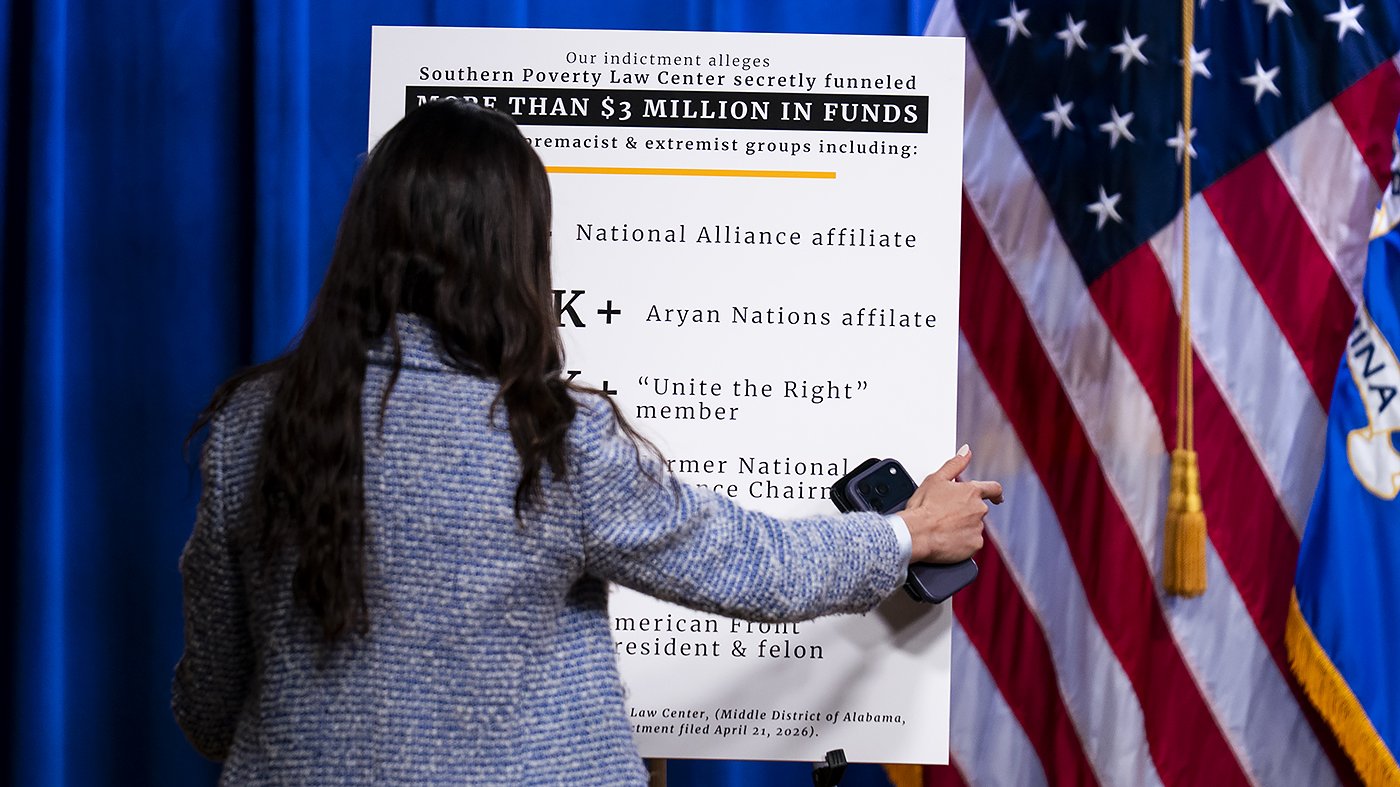
The Trump administration has opened a new front against its critics, filing a criminal fraud case against the Southern Poverty Law Center that legal observers and Democratic lawmakers say threatens the entire nonprofit sector. The SPLC pleaded not guilty Thursday to charges that it defrauded donors by funneling money to hate groups—an accusation the organization flatly denies.
The indictment alleges the SPLC used a now-defunct informant program to channel funds to groups like the Ku Klux Klan, betraying its decades-long mission of fighting extremism. But the SPLC argues the claim is unsupported even by the charging document itself and accuses prosecutors of misleading the grand jury that returned the indictment.
Representative Jamie Raskin of Maryland, the top Democrat on the House Judiciary Committee, framed the prosecution as part of a sustained assault on civil society that began with law firms and universities. “They’ve been murmuring for a long time about the coming assault on the not-for-profit community,” Raskin told The Hill. “This looks like a whole new frontier in attacking not-for-profit groups that the president considers an enemy or politically incorrect.”
The SPLC, founded in 1971, has long been a target of conservative ire for its “Hate Map” and other work cataloging extremist groups. That list has included organizations supportive of President Trump, such as Charlie Kirk’s Turning Point USA and the Proud Boys. The SPLC justified the inclusion by pointing to Kirk’s warnings about “great replacement” rhetoric, a debunked conspiracy theory that claims elites are replacing white populations with nonwhite immigrants.
Conservatives have pushed back fiercely. Representative Chip Roy of Texas argued at a December House Judiciary subcommittee hearing that the SPLC’s “partisan and profitable” operation unfairly brands mainstream figures as existential threats. “A mere difference in policy opinion may land you on SPLC’s hate map,” Roy said, adding that after Kirk was killed—the FBI later severed ties with the SPLC, with Director Kash Patel calling it a “partisan smear machine”—the group offered no retractions or accountability.
The core of the government’s case is that the SPLC misled donors about how their money was used. Yet the indictment cites only a single instance where funds from an informant reached other group members and provides no further details. In pleading not guilty, interim president Bryan Fair said, “The charges against the SPLC are provably wrong; they are based on inaccurate facts and a misapplication of law. There is no question that the information the SPLC shared with law enforcement saved lives.”
Democrats on Capitol Hill have rallied behind the SPLC. Representative Dan Goldman of New York, a former federal prosecutor, called the indictment “a complete abomination of our criminal justice system,” noting it fails to show any misrepresentation that influenced donor decisions. He described the case as “clearly a purely political attack on organizations that try to hold Donald Trump and the extreme right accountable.”
The SPLC is not alone in facing heightened scrutiny. The Justice Department has encouraged U.S. attorney offices to investigate George Soros’s Open Society Foundation, and the State Department has moved to revoke visas for leaders of nonprofits focused on online hate speech and disinformation. The pattern, critics warn, signals a broader campaign to chill dissent. For more on the administration's legal battles, see the recent court ruling blocking Trump's tariff and the Iran ceasefire talks that have also drawn executive attention.