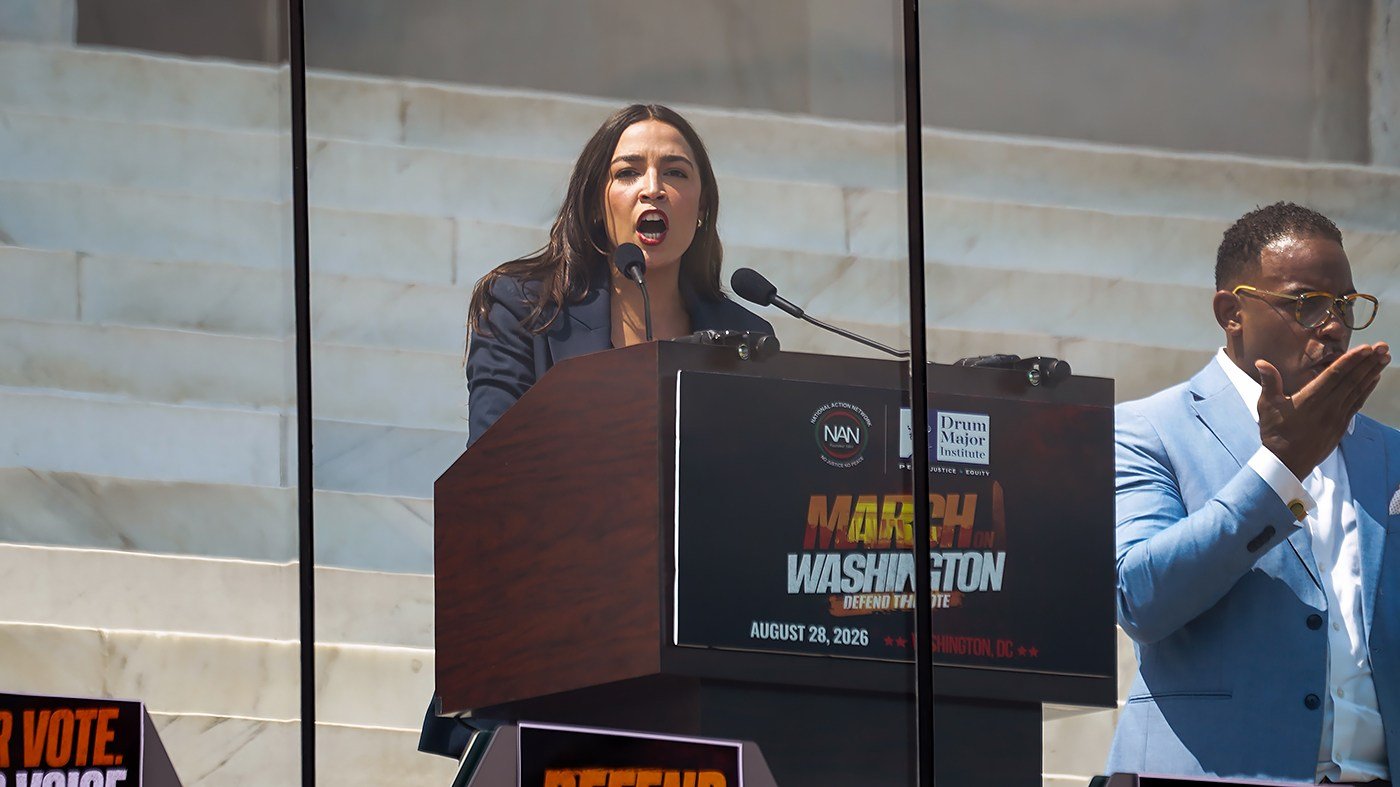
At this year's March on Washington, civil rights leader Rev. Al Sharpton drew a direct line between Rep. Alexandria Ocasio-Cortez (D-N.Y.) and the late Shirley Chisholm, the first Black woman elected to Congress and a pioneering presidential candidate. Introducing the New York congresswoman on Saturday, Sharpton, who served as Chisholm's youth director, said she possessed "the same fire and vigor as this beloved sister of mine."
Sharpton's remarks underscored Ocasio-Cortez's rising stature within the Democratic Party's progressive wing. He praised her as "a sister beloved who has stood up on these issues and spoke out on what needed to be said," a nod to her vocal advocacy on voting rights and economic justice.
The comparison carries weight as speculation grows about a potential Ocasio-Cortez presidential bid in 2028. Polls of Democratic primary voters often place her near the top, and her appearance at the march—following Vermont Sen. Bernie Sanders, the progressive standard-bearer who fell short in 2016 and 2020—reinforces her status as a leading voice on the left.
Ocasio-Cortez's trajectory mirrors Chisholm's in more ways than one. Both represented New York City in the House, and Chisholm's 1972 campaign broke barriers as the first Black candidate and first woman to seek a major party's presidential nomination. Sharpton's invocation of that legacy positions Ocasio-Cortez as the heir to that tradition.
The march, organized by Sharpton's National Action Network and other civil rights groups, focused on voting rights legislation, which remains a contentious issue. Recent court rulings have reopened the door to stricter mail-in voting rules, while Democratic-led states have challenged those restrictions. The Biden administration has also faced pressure to end a nationwide halt on such rules.
Ocasio-Cortez's prominence comes as progressives have scored key victories in this year's primaries, and her endorsement power has been felt, as when she boosted Sen. Ed Markey's reelection bid. Her ability to mobilize young voters and democratic socialists makes her a formidable force in any future national contest.
During her speech, Ocasio-Cortez echoed the march's themes, calling for expanded access to the ballot and warning against attempts to suppress the vote. Her rhetoric, paired with Sharpton's endorsement, signals that the left wing of the Democratic Party sees her as a unifying figure capable of carrying forward Chisholm's legacy.
Political analysts note that while Ocasio-Cortez has not formally declared any presidential intentions, her frequent national appearances and policy leadership have kept her in the spotlight. With the Democratic primary field likely to be crowded, her ability to harness grassroots energy could prove decisive.
For now, the March on Washington served as a platform for Sharpton to anoint Ocasio-Cortez as a standard-bearer for the party's progressive wing, a role that Chisholm once occupied. Whether she will follow that path to a presidential campaign remains to be seen, but the comparison has already ignited conversations about the future of Democratic leadership.