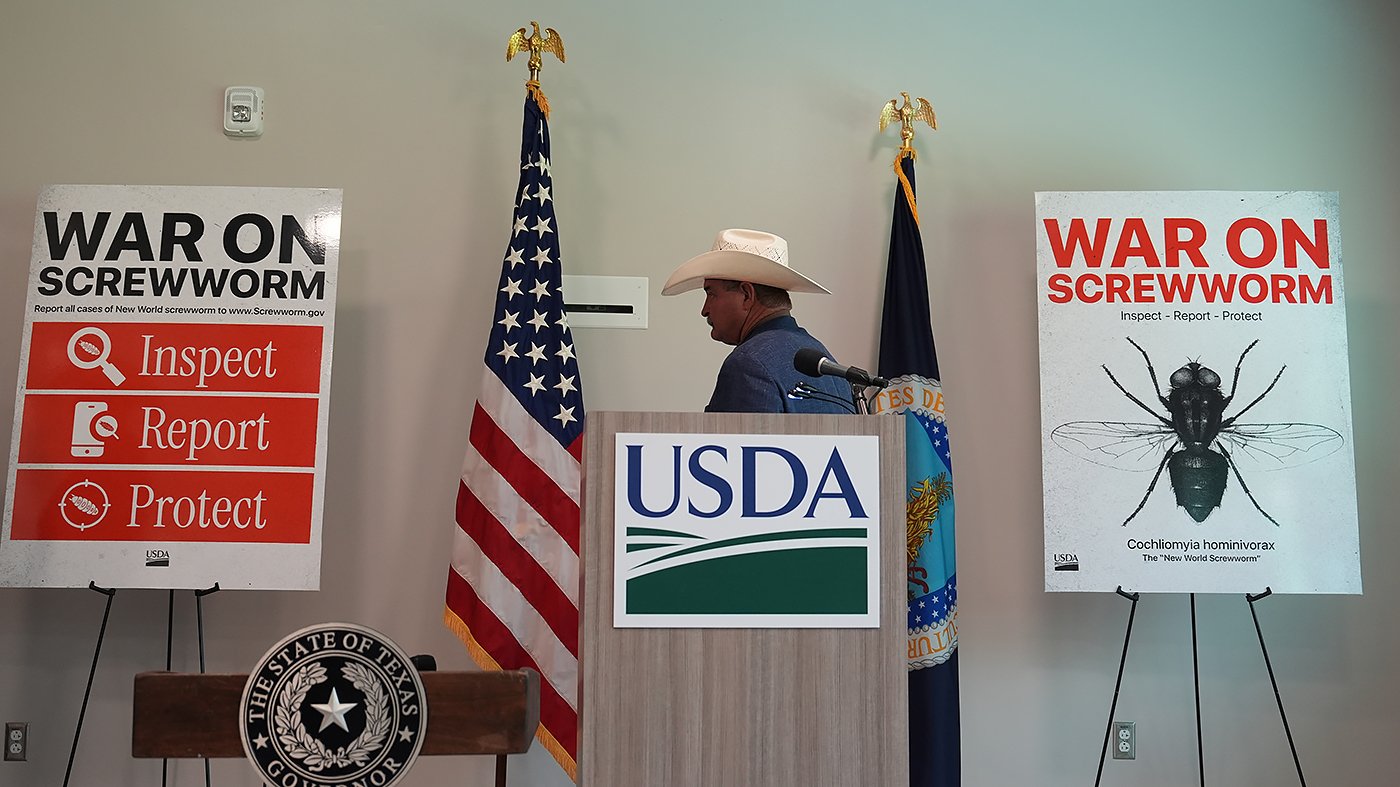
After decades of pushing the New World screwworm deep into South America, the United States is facing a resurgence of the parasitic fly, with nine confirmed cases in Texas and New Mexico. The outbreak is testing the government's ability to respond after significant staffing cuts at the Department of Agriculture (USDA) under President Trump.
USDA Secretary Brooke Rollins defended the administration's preparedness, stating, “These developments obviously represent a serious threat to our livestock and wildlife, but they haven’t caught us off guard. We have been tracking this pest for a long time, and we have fought before, and we will do so again.” She noted that over $1 billion has been invested to combat the screwworm, and the agency has fast-tracked animal drug authorizations and expanded surveillance with ranchers.

Rear Adm. Michael Schmoyer, who leads the USDA's New World Screwworm Directorate, said the agency has deployed thousands of traps across the U.S. and into Mexico. “Models suggested that it was going to be here last summer, so we had plenty of time to prepare,” he told reporters. “Consequently, we actually have a playbook on how to do this.”
However, the USDA has lost approximately 20,000 employees between January 2025 and January 2026, according to Office of Personnel Management data. The Animal Plant and Health Inspection Service (APHIS) saw a 25% reduction, losing more than 2,000 staff. A group of 11 Democratic senators, led by Jeff Merkley of Oregon, wrote to Rollins on June 9, arguing that “the reemergence of the New World screwworm in the U.S. highlights the urgent need to fully staff the USDA’s Services, which are on the frontlines of disease outbreak detection and rapid response.”
Rollins pushed back against criticism linking the cuts to the outbreak. “The idea that DOGE caused this could not be further from the truth,” she said, referring to the Department of Government Efficiency. “What we did was reallocate resources and prioritize what matters, ensuring taxpayer dollars are used effectively while leaning in aggressively on preparedness.” She added that the agency now has more than 100 full-time staff dedicated to the infestation, compared to just 10 during the Biden administration.
Experts say the primary strategy remains the same as in the 1950s: mass-producing sterile male screwworms and releasing them into affected areas. “We’re not talking mass dispersion of insecticides or pesticides that are going to decimate other species. The sterile insect technique is like a surgical blade. It’s beautiful,” said Lee Haines, an entomologist at the University of Notre Dame. But Haines noted that production is expensive and requires a rearing facility.
The Food and Drug Administration has issued three conditional approvals and 10 emergency use authorizations for animal drugs to treat infestations. Rajeev Modi, executive vice president at Elanco, said some of its fast-track products hit the market as early as October 2025, though two are only available through a USDA stockpile in Texas. He described coordination with FDA, USDA, and EPA as smooth.
Texas has been preparing for over a year, according to Sonja Swiger, a Texas A&M entomology professor. “While most of the United States is just now realizing that this problem has happened, here in Texas, we’ve been getting ready for over a year now,” she said. The outbreak, which includes cases in cattle and goats, is expected to grow, marking a comeback for a species once considered eradicated from the country.