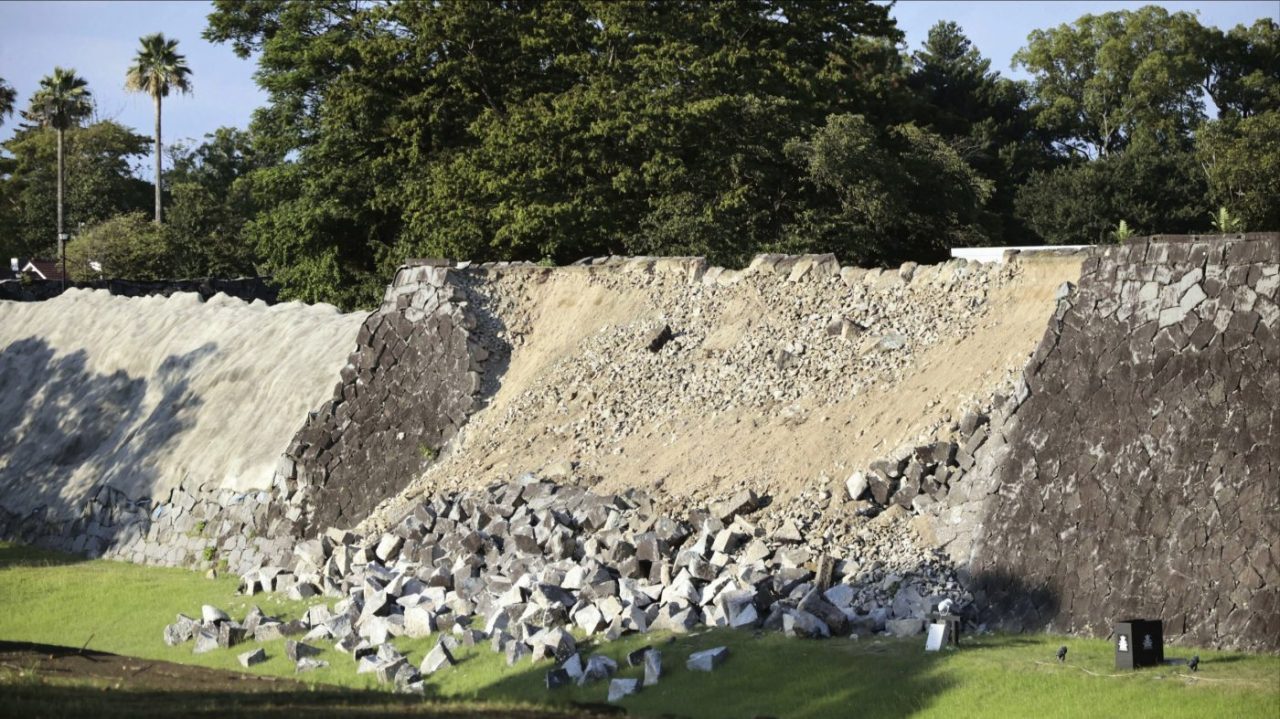
A powerful 7.1 magnitude earthquake struck Japan’s southern island of Kyushu late Tuesday afternoon, causing significant damage and leaving dozens of people injured or missing. The quake, centered near Kumamoto, collapsed part of a shopping center and toppled a massive chimney at a paper factory, according to local officials.
The Japan Meteorological Agency issued a tsunami advisory for the Ariake and Yatsushiro Seas along the western coasts of Kumamoto and three neighboring prefectures, but lifted it within two hours. Prime Minister Sanae Takaichi told reporters that damage to roads, bridges, and buildings, along with blackouts and fires, has been reported, though details remain unclear.

Collapse at Aeon Mall and Factory
In Kashima Town, the second floor of the Aeon Mall shopping center gave way, trapping an unknown number of people. The Kumamoto prefectural emergency response team confirmed that four individuals were rescued with injuries and taken to a hospital, while ten others remain unaccounted for. Search and rescue operations are ongoing as the full extent of the damage is assessed.
At the Nippon Paper Industries factory in Yatsushiro, a chimney collapsed and the building was damaged, trapping 11 people under debris. Two of them were later found without vital signs, and the condition of the other nine is unknown, the emergency team reported.
Evacuations and Infrastructure Impact
The Fire and Disaster Management Agency advised more than 260,000 people to evacuate, primarily in Kumamoto prefecture but also in neighboring Nagasaki prefecture. Major public facilities and infrastructure were not damaged, according to the agency, and the Nuclear Regulation Authority reported no abnormalities at three nearby nuclear power plants.
Transportation was severely disrupted. Shinkansen bullet trains and local trains across Kyushu were suspended for safety checks. The runway at Aso Kumamoto Airport was closed with no immediate prospect of reopening, according to the airport’s website. A train derailed at Yatsushiro station, and stone walls at Kumamoto Castle—a major tourist site still being repaired after the deadly 2016 quake—were damaged.
Business Operations Halted
The earthquake affected several major manufacturers in Kyushu. Toyota Motor Corp. suspended operations at three of its factories in the region due to safety concerns, with plans to reopen on Wednesday. Honda Motor Co. and Nippon Paper also halted operations, and Yamato Transport Co. stopped delivery services in and out of Kumamoto, as reported by the Nikkei business daily.
Japan’s Defense Ministry dispatched military aircraft to assess the situation. Local hospitals reported an influx of injured: about 40 people were treated at a hospital in Yatsushiro, and around 50 others were taken to a hospital in Kumamoto city.
Witness Accounts and Warnings
Hiroki Shimoda, an official at Mifune town hall, described the fear the quake triggered, noting it reminded him of the 2016 Kumamoto earthquake that killed at least 50 people. “The shaking reminded me of the Kumamoto quake (10 years ago) and I was frightened,” he said, adding that he saw roof tiles crash to the ground from nearby homes.
Shinji Kiyomoto of the Japan Meteorological Agency urged residents to remain cautious over the next two to three days for potential aftershocks. The affected area is about 900 kilometers (540 miles) southwest of Tokyo.