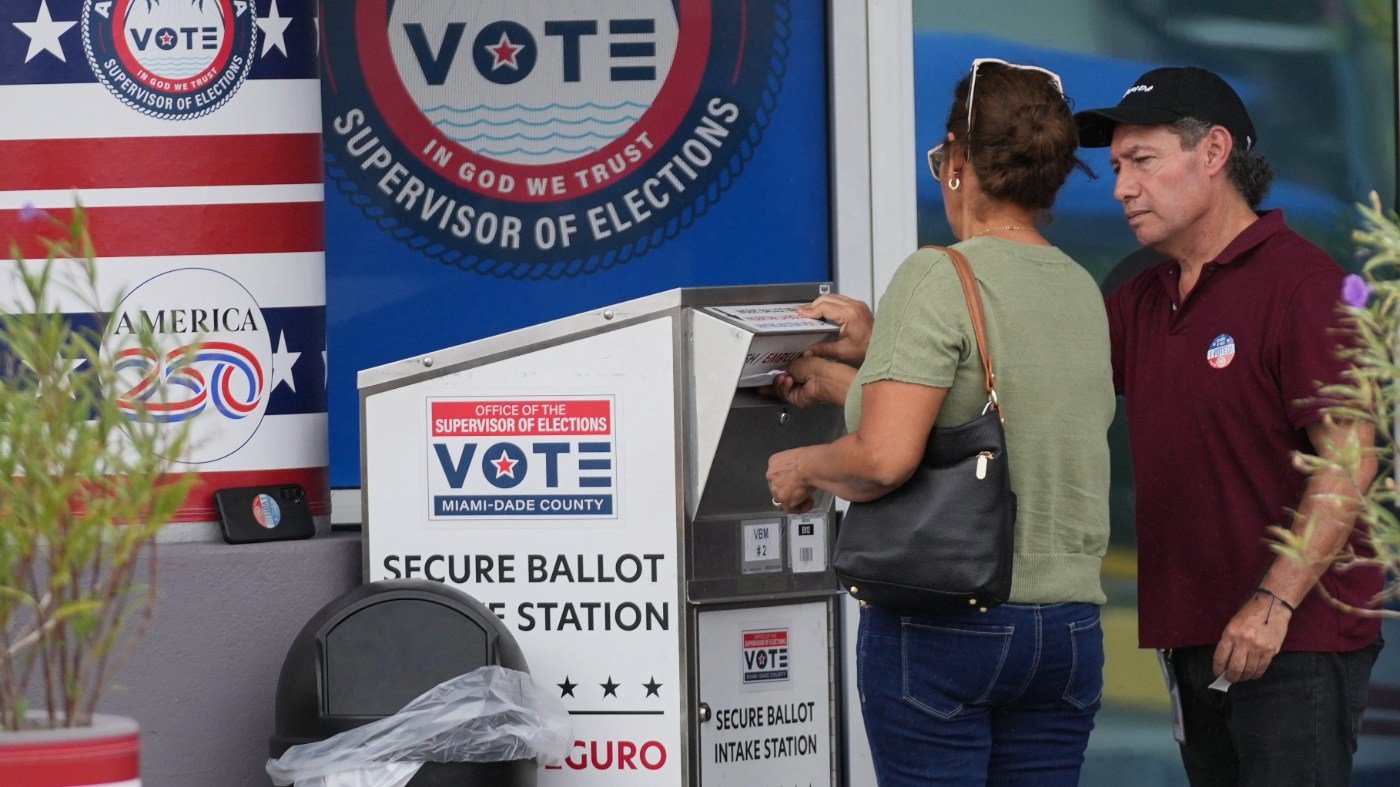
The Republican Party's refusal to fully embrace early voting proved to be a decisive factor in the 2026 midterm elections, according to a new analysis. Democrats leveraged early voting to build a sizable advantage that translated into a sweeping victory, flipping eight Republican Senate seats and more than 40 House seats, while also winning key governorships.
The data is stark: Democrats accounted for roughly 45 percent of early ballots cast, compared to just 30 percent for Republicans—a gap that closely mirrored the overall margin of victory. This pattern was particularly evident in Texas, where Democratic gubernatorial nominee Gina Hinojosa defeated incumbent Greg Abbott by nearly 1.7 million votes more than the previous Democratic nominee, Beto O'Rourke, had received in 2022. Hinojosa's total actually surpassed the number of votes Kamala Harris received in Texas during the 2024 presidential election, underscoring the power of a surge in early turnout.
The disparity is not merely a matter of preference; it has practical consequences. Early voting offers a significant economy of scale advantage. As the analysis notes, it is far more cost-effective to operate a single van over the entire early voting period, making repeated trips, than to hire ten vans for one day to move a hundred people. This efficiency allows parties to stretch their turnout budgets further, a lesson Republicans have been slow to learn.
Some Republicans have argued that the party should simply abolish early voting and return to a single Election Day. But as the analysis points out, that is a losing strategy. The party is currently in a leadership fight over how to respond to the midterm losses, and the debate over early voting is central to that struggle. The reality is that until Republicans win elections, they have little chance of changing the rules.
The analysis also highlights the weather risk of relying solely on Election Day voting. In Nevada, Republican Adam Laxalt lost a narrow Senate race to Democrat Catherine Cortez Masto in 2022, partly due to a snowstorm that depressed turnout. Studies show that each inch of snowfall reduces turnout by about half a percent, and each inch of rain by nearly one percent. For a party that depends on a single-day surge, such weather events can be catastrophic.
There is evidence that Republicans can adapt. In 2024, Donald Trump and the Republican National Committee actively encouraged early voting, narrowing the Democrats' early edge and contributing to an electoral victory. But in 2026, the party reverted to its old habits, and the result was a disaster.
The analysis concludes that Republicans must make early voting a core part of their turnout strategy. It is not just about convenience; it is about survival. As the author notes, "It will take many years and electoral cycles to dig out of the hole Republicans are now in. Best to get started today."