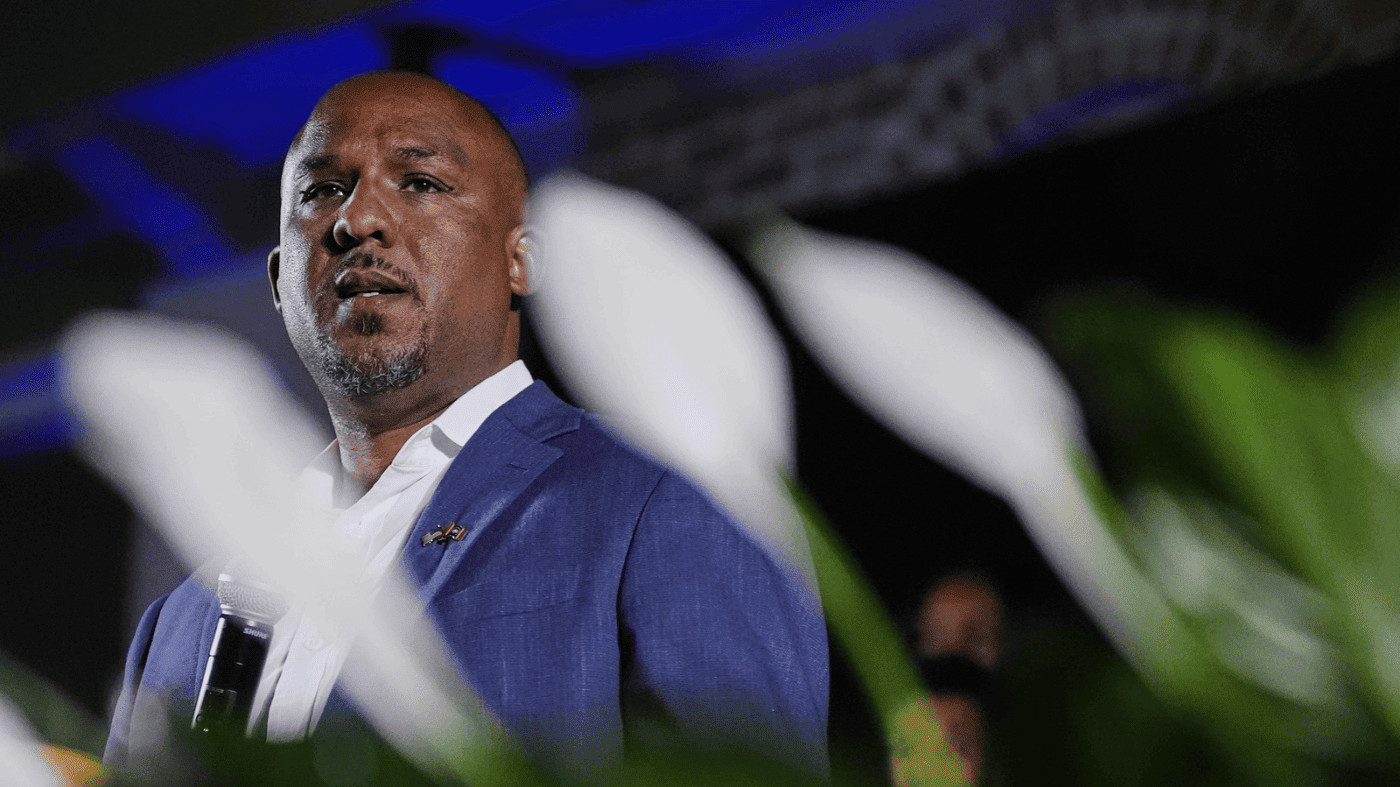
Sen.-elect Scott Colom (D-Miss.) on Sunday pressed the Democratic Party to redirect more money and organizational muscle toward Mississippi and the broader South, arguing that his upset victory last week should serve as a wake-up call for a party that has too often written off the region.
Speaking on NBC News's "Meet the Press," Colom acknowledged that his campaign operated with minimal financial backing compared to races in other states. "We didn't have a bunch of resources. There wasn't a bunch of campaign money spent to win Mississippi, compared to other states," he said. "But that meant we did it the Mississippi way, and I'm proud of that. What we need to do now, as a Democratic Party, is understand we can't continue to allow that lack of investment to occur."
Colom's victory over incumbent Republican Cindy Hyde-Smith—who had the backing of President Trump and was widely favored—was one of several surprising Democratic Senate wins in the 2026 midterms. The party also flipped seats in Iowa, Kansas, Maine, North Carolina, Ohio, South Carolina, and Texas, with Alaska still too close to call. That wave has reignited a debate over whether Democrats can compete in traditionally red territory.
The incoming senator, who will become Mississippi's first Black senator since Reconstruction, argued that the party must do more to show rural and Deep South voters that it cares about their concerns. "We need to put senators like myself in position where we can deliver for the rural South, where we can be leaders in ways that show the voters in rural America that we care about them, the voters in the Deep South that we want them to be successful," he said.
Colom's election marks a historic milestone: he is the first Black senator from Mississippi since Hiram Revels and Blanche Kelso Bruce, both Republicans elected in the 1870s. No Democrat has held that seat since 1982. His win, along with Democratic victories in Georgia and Texas, has fueled speculation that the party may finally be making inroads in the South.
Democratic strategist Fred Hicks, who works in Georgia and Florida, told The Hill that the South is "not just winnable; it also completely changes the calculus of the path of victory for the presidency if any Southern states are in play." He urged Democrats to "not cede anything in the South."
The party has already begun shifting resources. The Democratic Senatorial Campaign Committee expanded its battleground map this summer to include Florida, Georgia, and Texas, and the Democratic National Committee launched a Southern States Resource Hub in August. DNC Chair Ken Martin said at the time that "the puck is heading to the South."
Asked about the upcoming Senate leadership race, Colom said he has not yet decided between Senate Minority Leader Chuck Schumer (D-N.Y.) and Sen. Chris Van Hollen (D-Md.), who is challenging for the top post. "I've got to be honest with you. I don't know either one of them that well," he said. "So, I'm going to listen to what other people tell me about them and I'm going to figure out what are the things that people are doing well in leadership, what are the things they're not doing well, and find out how we can work together to achieve results."
Colom's call for greater investment is echoed by other Southern Democrats who won in 2026. Keisha Lance Bottoms, who will become Georgia's first Black woman governor, and Gina Hinojosa, who will be Texas's first Latina governor, have both emphasized the need for sustained party engagement. As the party prepares for the next Congress, the question is whether this year's wins are a one-off or the beginning of a durable Southern strategy.