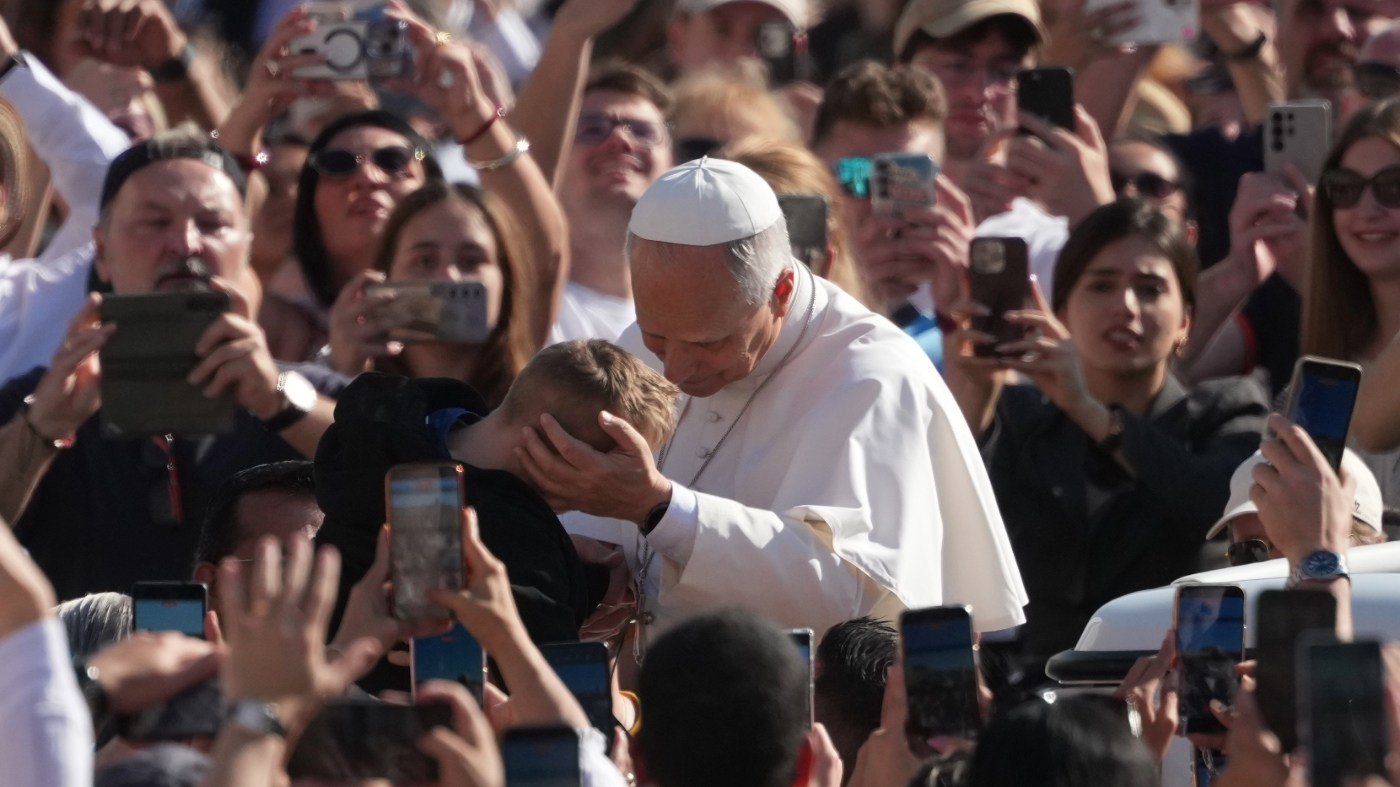
In September, Pope Leo XIV's visit to France was nothing short of a triumph. An estimated 300,000 people lined the streets of Paris as his popemobile made its way to the restored Notre Dame Cathedral, while another 600,000 attended an open-air Mass. A youth vigil drew 80,000, with spots filling within hours. The impact was immediate: this past Easter, the French Catholic Church recorded more than 21,000 adult baptisms—a historic high.
Similar momentum is building across the United States. Catholic dioceses are reporting unprecedented conversion numbers, with Los Angeles seeing a 139 percent increase, Phoenix a 23 percent jump, and New York a 36 percent rise. In Pope Leo's home archdiocese of Chicago, conversions surged 52 percent—the highest since 2013. Even smaller dioceses like Rapid City, S.D., and Fairbanks, Alaska, have seen notable upticks.
This surge, dubbed the "Leo effect," is particularly pronounced among adults aged 18 to 35. A spokesperson for the Diocese of Boise, Idaho, noted that many are drawn to the "transcendent beauty, clarity, and orthodoxy of the Catholic faith." Archbishop Mitchell Thomas Rozanski of St. Louis observed, "In our age of uncertainty, and in our age of great anxiety, [there] is a thirst and hunger for God and stability that faith brings to people's lives."
A survey of converts from 20 dioceses underscores these motivations: 84 percent cited a desire for deeper spirituality or a relationship with God, 77 percent sought growth in goodness and virtue, 72 percent wanted inner peace, and 56 percent craved a global, multi-generational church community. This wave coincides with Pope Leo's 2025 election, and nearly eight in ten U.S. Catholics approve of him, with 32 percent holding extremely favorable views.
The phenomenon reflects a broader societal shift. Harvard sociologist Robert Putnam's 1995 essay "Bowling Alone" highlighted America's decline in social capital—once a nation of joiners, now a nation of loners. Bowling leagues, which peaked at 12,000 alleys in the mid-1960s, had dwindled to just 3,154 by 2023. Young people are searching for meaning, as 22-year-old French convert Jonas Tauitou-Faron explained: "We are trying to search for meaning in the current world, and some of us are finding religion." Pope Leo echoed this, noting that in a secular society, young people "are obviously searching for something."
Conversion is not just about Sunday Mass; it builds community. Nineteen-year-old Jesse Araujo of Pahrump, Nevada, was drawn in by Catholic podcasts on YouTube. Amen-Ra Pryor, a 23-year-old Howard University student, found the Church's teachings on suffering helpful during his struggles with depression and isolation. Putnam's research in "Our Kids: The American Dream in Crisis" shows that church-involved youth "have better relations with their parents and other adults, have more friendships with high-performing peers, are more involved in sports and other extracurricular activities." Vibrant parishes like St. Joseph's in New York's West Village and St. Patrick's Old Cathedral in Nolita host post-Mass wine receptions where young people mingle.
This revival echoes Alexis de Tocqueville's 1831 observations about American democracy's need for religion as an antidote to individualism and materialism. He argued that faith fosters communitarian values essential to democratic life, and even if it doesn't save souls, "it is at least very conducive to their happiness and their greatness in this [world]."
Pope Leo, addressing converts in France, urged them to be "missionaries of the Gospel in this society." That missionary spirit is reinvigorating the Church and countering what former U.S. Surgeon General Vivek Murthy called "an epidemic of loneliness and isolation." As the Leo effect continues, it may reshape not only religious landscapes but also the social fabric of nations.