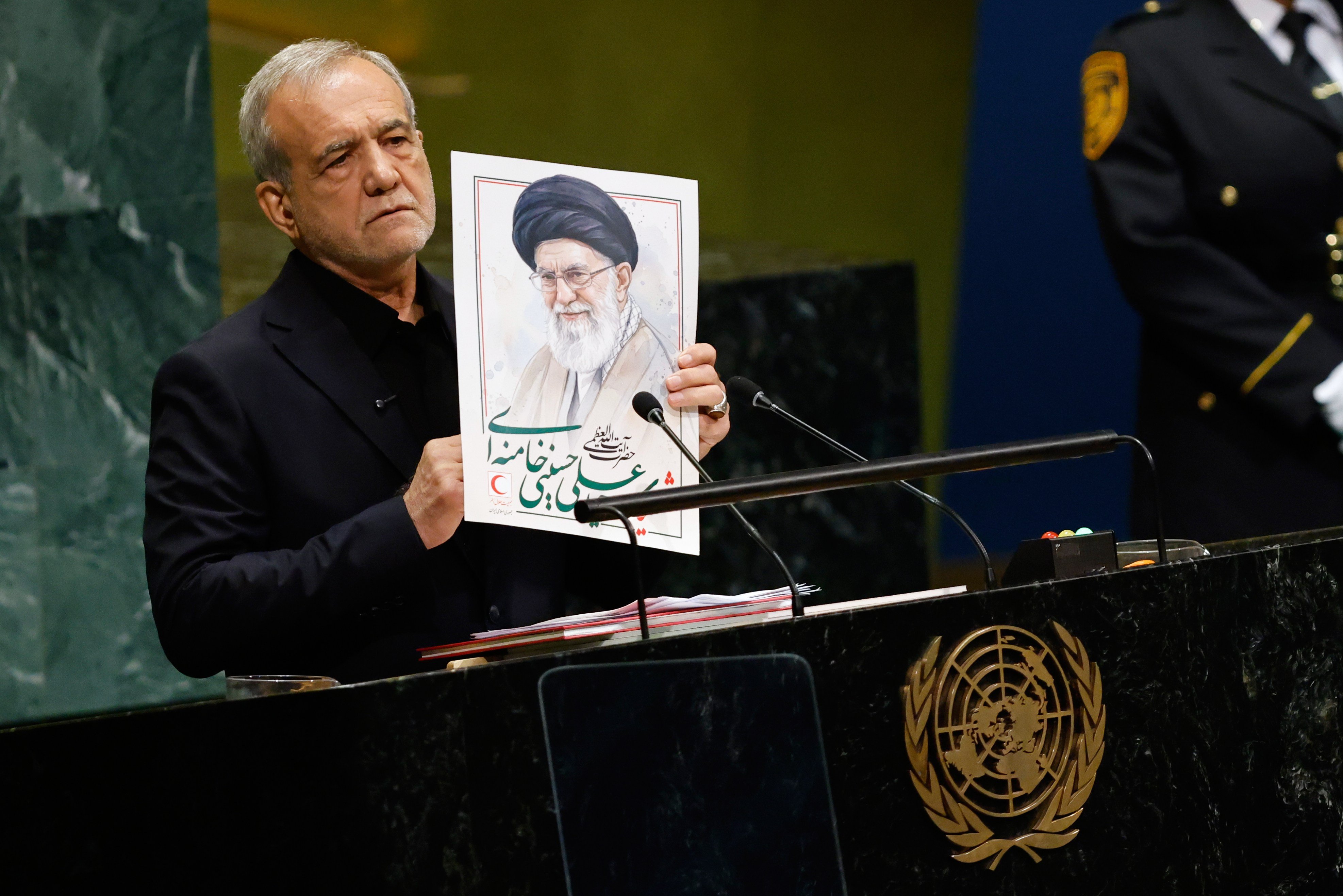
When Masoud Pezeshkian addressed the United Nations, he claimed to speak for Iran—but the Islamic Republic is not synonymous with the Iranian nation. The regime installed in 1979 has imposed its ideology on a civilization with millennia of history, and Pezeshkian's rhetoric followed a familiar pattern: victimhood, Palestine, resistance, and perpetual foreign hostility. What was missing was any mention of Iran itself.
Absent from his speech were the political prisoners, the protesters gunned down in the streets, the tortured and blinded detainees, and the families mourning children killed by state violence. Also missing were the millions crushed by inflation, poverty, censorship, and religious authoritarianism. Pezeshkian painted the regime as a victim while ignoring its brutality against its own people. He touted infrastructure, but Iran's most vital infrastructure is its population—a generation battered by repression and economic ruin.
This is the central contradiction of the Islamic Republic: a regime that has spent decades arming terrorist groups abroad presents itself at the UN as a peace advocate. It lectures on justice while branding all opposition as foreign agents. It speaks endlessly about Gaza and Palestine while concealing the bloodshed on Iranian streets. The world is expected to accept this as diplomacy.
For decades, Washington has fixated on the same narrow issues—nuclear enrichment, sanctions, negotiations, terrorism, and regional security. But this lens obscures the more consequential conflict inside Iran: the struggle between the Iranian people and the regime itself. Confusing Iran with the clerical state remains a fundamental analytical error.
The regime understands this distinction, which is why domestic dissent terrifies it. Its deepest fear is not international condemnation but a population that rejects its ideological foundations and separates national identity from the Islamic Republic. This explains the regime's panic during protests, its communications blackouts, and its insistence that dissent is a foreign conspiracy. The very idea of an alternative is a threat.
Crown Prince Reza Pahlavi has emerged as a vocal advocate for a secular, democratic transition beyond the Islamic Republic. Washington cannot choose Iran's next leader—that is for Iranians to decide. But American policymakers should recognize that Iranian politics extends beyond the clerical establishment. Ignoring pro-democracy forces does not make them disappear, and treating the regime as permanent is a strategic mistake.
President Trump should grasp this before launching another round of negotiations. Diplomacy is not inherently wrong; states do talk to adversaries. But negotiations that merely constrain a dangerous regime differ fundamentally from those that prolong its survival, replenish its resources, or grant it legitimacy. Past US administrations have hoped that sanctions, incentives, or factional politics would transform the Islamic Republic into a conventional state. Yet the architecture of power remains intact, even as reformists and hard-liners rotate in and out.
Pezeshkian's UN performance mattered because it revealed a political system desperate to convince the world it speaks for Iran. Beneath the denunciations of Israel and accusations against the US lay a regime facing a profound legitimacy crisis. Coercion can sustain a state, but it cannot erase political alienation.
The question for Washington is whether it is prepared for the possibility that the Islamic Republic will not endure. Preparing for that future means documenting human-rights abuses, maintaining Iranian access to information, engaging voices outside the ruling establishment, and planning with allies for a transition that preserves Iran's territorial integrity and prevents chaos or further authoritarianism. This is the conversation the US should be having, rather than perpetuating the illusion that the 1979 order is permanent.
Pezeshkian may return to the UN next year, or another regime representative may deliver the same tired slogans. But history does not guarantee regimes another speech. The US heard the Islamic Republic this week; the White House should finally hear the Iranian nation. The Islamic Republic is not Iran, and it is not immortal. Behind its missiles, intelligence apparatus, prisons, and propaganda stands an exhausted political order sustained by coercion, not consent. The world should begin preparing for the day after.