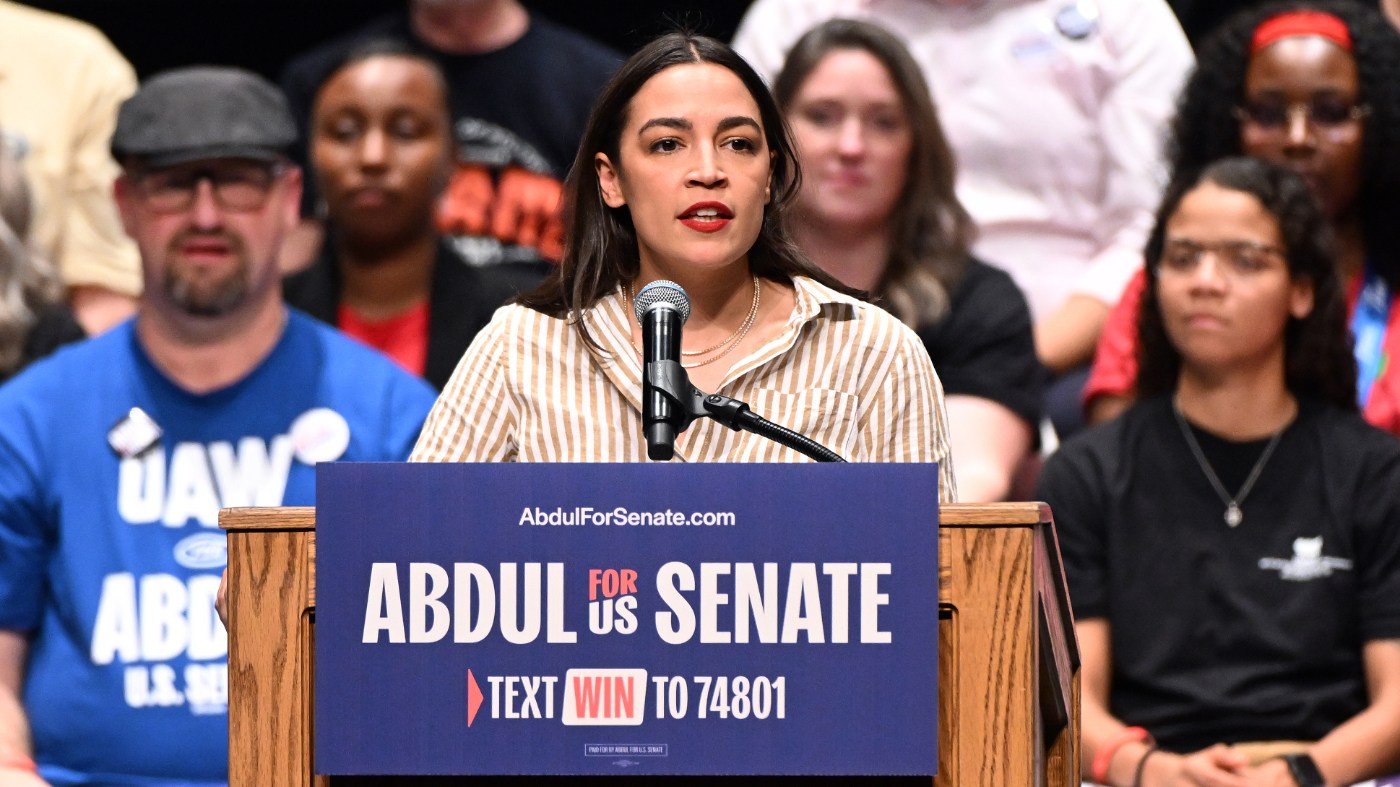
The conventional wisdom says President Trump has the most on the line in next week's midterms. A Democratic wave would bring investigations, possible impeachment, and relentless oversight that could define his final two years. But the stakes may be just as high for Rep. Alexandria Ocasio-Cortez (D-N.Y.) and the progressive movement she now embodies. Nowhere is that more evident than in Michigan, where Ocasio-Cortez has thrown her full weight behind Democratic Senate nominee Abdul El-Sayed.
Ocasio-Cortez has transferred $1 million from her campaign to support El-Sayed, lent him her national platform, and campaigned with him in Detroit and even in the Republican-leaning Upper Peninsula—territory that her political philosophy insists progressives must contest. In doing so, she has effectively tied her own political fortunes to his outcome.
Ocasio-Cortez is widely seen as positioning herself for a 2028 presidential run. She has hinted at higher ambitions, built a massive campaign war chest, and remains a top contender on prediction markets. Michigan offers a clear test: can a progressive win a statewide race in a genuine battleground that twice backed Trump? An El-Sayed victory would bolster her claim that progressives "can win anywhere." A loss, especially with Democrats leading the generic congressional ballot by 8 points and Trump's approval ratings weak, would seriously undermine her case.
Progressive activists celebrated El-Sayed's primary win as proof of concept, but a general election defeat would invite pointed questions. Moderates would argue that centrist Rep. Haley Stevens—who lost the primary by just one point—was polling even with Republican Mike Rogers, while El-Sayed trailed. "Stevens would have won" could become a Democratic refrain for years.
El-Sayed is a polarizing candidate. Republicans have hammered him over associations with controversial figures and alleged links to the Muslim Brotherhood, which he denies. Polls show voters are split on him and on the progressive project he represents. A Brookings Institution study found that progressives won only 18 percent of genuinely competitive Democratic primaries this cycle.
In Michigan, El-Sayed's average lead over Rogers is about 2 points—essentially a tie. By contrast, moderate Democrats Roy Cooper in North Carolina and Jon Ossoff in Georgia lead by roughly 10 and 9 points, respectively. Within Michigan, gubernatorial nominee Jocelyn Benson leads by nearly 6 points. El-Sayed is underperforming other Democrats, suggesting hesitation among voters to back a left-wing candidate.
That is the exact question Ocasio-Cortez could face nationally in 2028: Can enthusiasm among young, college-educated progressives translate into support from independents and working-class voters in battleground states? Trump and Republicans are leaning into this vulnerability, casting El-Sayed's "unapologetic progressivism" as proof that Democrats have shifted too far left. Their attacks have turned the race into a referendum on the movement's broader viability.
Michigan's importance extends far beyond 2026. If Democrats capture the Senate with El-Sayed's help, the party's 2028 conversation will tilt progressive—perhaps toward Ocasio-Cortez herself. An El-Sayed win would give her the credential she lacks: evidence that her politics can travel beyond deep-blue areas. But if he loses, she and her allies will face two years of charges that their movement cost Democrats a winnable seat and possibly the Senate majority. Either way, the Michigan result will echo into 2028.