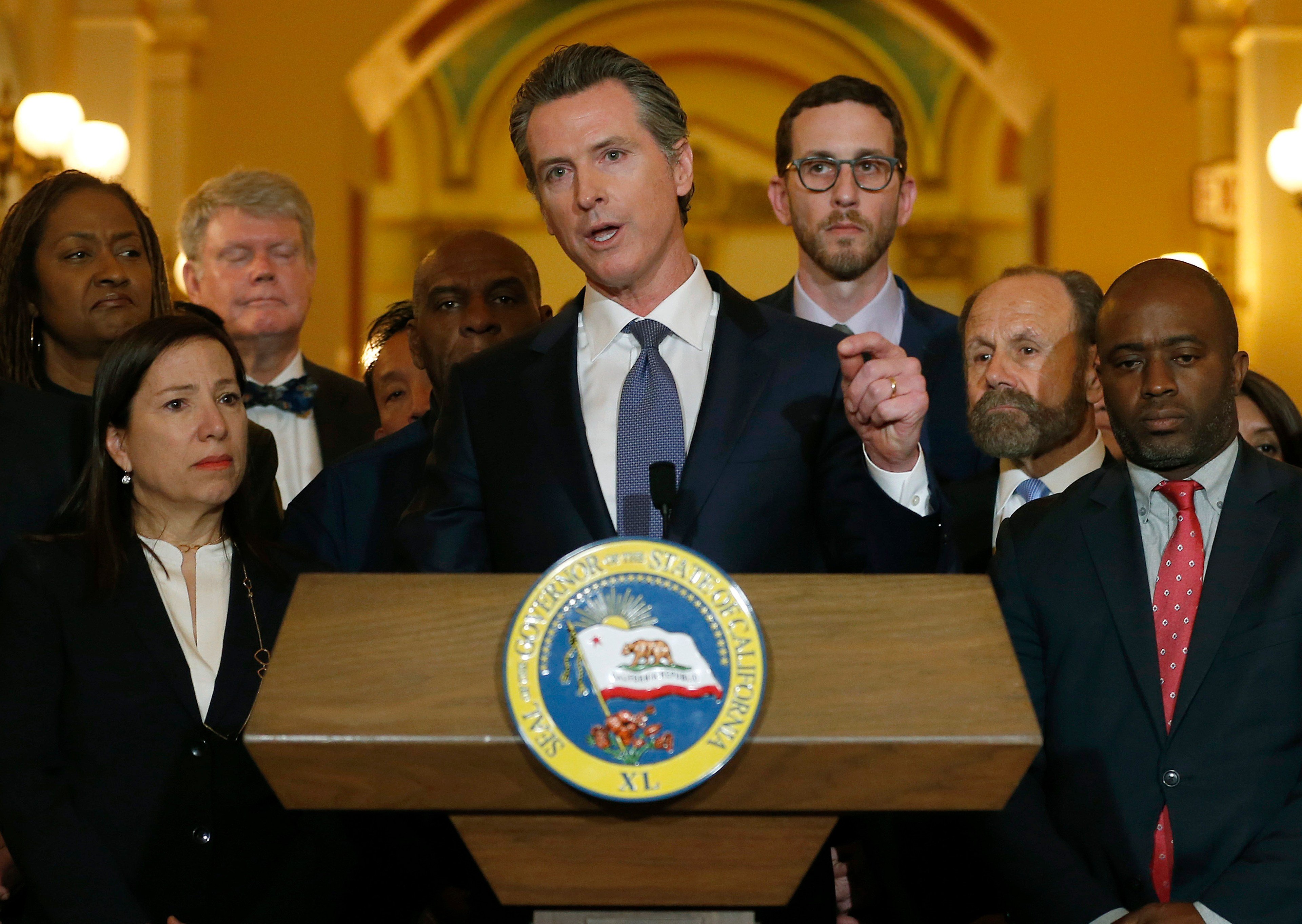
California Governor Gavin Newsom stands at a historic crossroads. He has the power to commute every death sentence in his state, a move that would spare the lives of 563 individuals currently on death row. Such an action would be unprecedented in American history, dwarfing any previous clemency effort aimed at those awaiting execution.
The sheer scale of this potential act is staggering. To put it in perspective, the combined death row populations of the 11 states that have abolished capital punishment over the last two decades—Colorado, Connecticut, Delaware, Illinois, Maryland, New Hampshire, New Jersey, New Mexico, New York, Virginia, and Washington—totaled just 69 people at the time of their respective bans. Even the Supreme Court's landmark 1972 ruling in Furman v. Georgia, which struck down existing death penalty laws, invalidated the sentences of 629 people. And while Illinois Governor George Ryan's 2003 clemency for 167 inmates was remarkable, and President Biden's recent commutation of 37 federal death sentences was significant, neither approaches the magnitude of what Newsom could do.

By issuing a universal commutation, Newsom would single-handedly reduce the nation's death row population by a quarter. This would be a lightning rod in the national debate over capital punishment, providing momentum for abolitionists and political cover for governors in other states to follow suit. It would also cement Newsom's position as a leading voice against the death penalty, a stance he has long championed, calling the system "a failure by all measures."
The Political Calculus
Newsom's hesitation, according to reports, stems from concern about how such a move might affect a potential presidential run. But the political evidence suggests those fears are largely unfounded. In the 2020 Democratic primary, nearly every candidate opposed the death penalty, and Joe Biden ran on that platform. While a slim majority of Americans still support capital punishment, there is widespread recognition of its flaws, including racial disparities and the risk of executing the innocent.
Looking at key swing states, a strong anti-death penalty record could be an asset. Michigan and Wisconsin, two of the seven most contested states, abolished the death penalty decades ago. Pennsylvania, another battleground, has a moratorium on executions and a popular Democratic governor, Josh Shapiro, who openly opposes capital punishment and has urged the legislature to abolish it. North Carolina, also in play, has effectively halted executions for two decades, and its former governor Roy Cooper—now a Senate candidate—commuted 15 death sentences. Nevada, too, hasn't executed anyone since 2006.
Even in states where the death penalty remains active, opposition hasn't proven politically fatal. In Georgia, Senator Raphael Warnock has called capital punishment "the final failsafe of white supremacy," yet he has won statewide elections. In Arizona, public support for the death penalty has been declining, as has the imposition of new death sentences.
All of this suggests that Newsom has ample room to act on his conscience. The late Pope Francis, who met with Newsom in 2024, dubbed him his "death penalty man," a sign of the moral weight of this issue. A mass commutation would not only be a historic act of justice but also a politically savvy one, solidifying his standing with the Democratic base without alienating key swing voters.
The legal path in California is complex—under state law, the governor can unilaterally grant clemency to inmates with a single conviction, but those with multiple felony convictions require approval from the State Supreme Court. However, even if the court balks, Newsom could still spare more lives than any other governor or president in history. The question now is whether he will seize this moment.