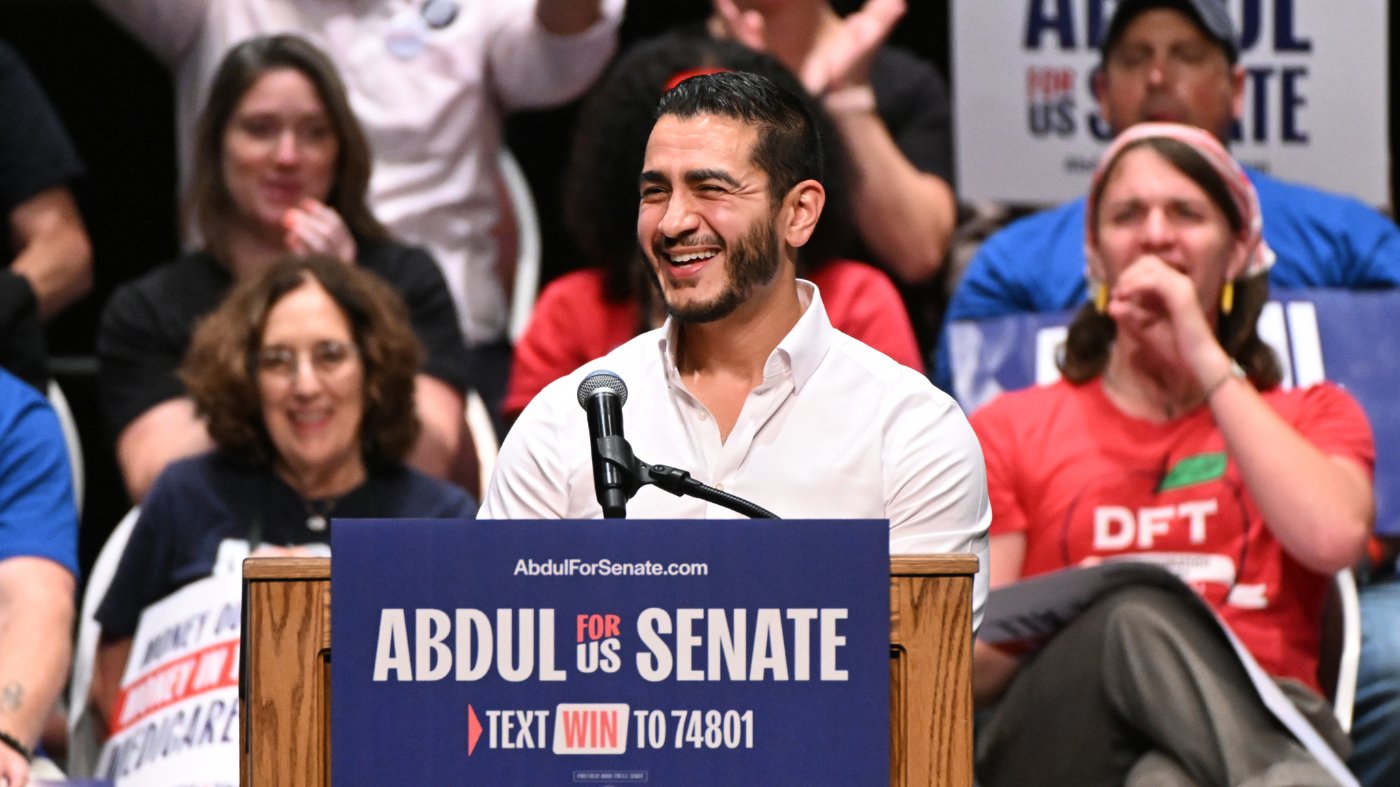
The most closely watched Democratic primary of the 2026 cycle reaches its climax Tuesday, as Michigan voters choose between centrist Rep. Haley Stevens and progressive Abdul El-Sayed to take on Republican Mike Rogers in the race for an open Senate seat. The contest has become one of the most expensive in the nation, with over $52 million spent—much of it in support of Stevens—and its outcome will reverberate well beyond the state.
Democrats view holding this seat as essential to their hopes of reclaiming the Senate majority, especially with Maine looking increasingly competitive. For Republicans, flipping Michigan would not only bolster their current majority but also offset potential losses in states like North Carolina or Ohio. The primary also serves as a high-stakes test of whether a democratic socialist-aligned progressive can win a statewide race in a purple state, or whether such candidates are limited to deep-blue House districts.

The two candidates offer starkly different visions. Stevens, a pragmatic centrist, has the backing of establishment Democrats, including Gov. Gretchen Whitmer and Sen. Gary Peters. El-Sayed, supported by progressive icons like Sens. Bernie Sanders and Elizabeth Warren, as well as Rep. Alexandria Ocasio-Cortez, is running on a sharply anti-Israel platform that also calls for abolishing ICE, raising taxes on the wealthy, and implementing Medicare for All.
Recent polling suggests El-Sayed has gained significant momentum in the final stretch. The latest RealClearPolitics average shows him with a double-digit lead, and an Emerson poll puts him ahead by 15 points (54% to 39%). Prediction markets have also swung dramatically, with Kalshi giving El-Sayed a 96% chance of victory, up 30 points since mid-July. A win would mark one of the most significant progressive victories in years—but it may come at a steep cost.
A poll released last week by the Michigan Education Association and Business Leaders for Michigan paints a troubling picture for Democrats. In a hypothetical general election, Stevens and Rogers are virtually tied at 46% to 45%. But Rogers leads El-Sayed by double digits, 49% to 39%. The divergence is most pronounced among two key voting blocs: independents and Black voters.
Among independents, Stevens and Rogers are effectively tied, while Rogers holds a 28-point lead over El-Sayed. With Black voters, Stevens' advantage over Rogers is 69 points—more than double El-Sayed's 37-point margin. The Emerson poll that showed El-Sayed leading the primary also found Stevens winning Black primary voters by a 58% to 38% margin. Mitchell Research similarly found Stevens' general election support among Black voters to be 17 points higher than El-Sayed's.
These numbers echo concerns raised during last week's debate, where El-Sayed repeatedly attacked Stevens over issues largely unrelated to Michigan—such as Israel, AIPAC, and corporate donations—while Stevens framed herself as a pragmatic lawmaker focused on delivering results for the state. The contrast feeds into perceptions of El-Sayed as a "celebrity candidate" who may be out of touch with local concerns.
Black leaders in Michigan have voiced particular unease, with many pointing to El-Sayed's support for the "uncommitted" movement in the 2024 presidential primary, which is widely seen as contributing to Kamala Harris' defeat in the state. As Rev. Dr. Wendell Anthony, president of the Detroit NAACP, put it: "Are you going to be more concerned about the West Bank than the West Side of Detroit?" Such doubts about El-Sayed's priorities could prove fatal in a general election.
Republicans, meanwhile, are watching closely. Rogers reportedly told supporters he would be "in good shape" if El-Sayed wins—a telling admission. The primary has crystallized two distinct Democratic coalitions: Stevens draws support from older, Black, and non-college-educated voters, while El-Sayed appeals to younger, white, college-educated progressives. This mirrors the pattern seen in New York City, where democratic socialist candidates have won with similar coalitions despite lacking support from the party's traditional base.
The question now is whether that model can succeed in a purple state like Michigan. The answer will have profound implications for the Democratic Party's future, as the fault lines exposed in this primary are likely to shape national strategy. With Democrats holding a narrow edge in midterm polling, a loss here could be the difference between majority and minority control. As internal divisions loom, the Michigan outcome will be a critical test of whether progressives can win the battle without losing the war.