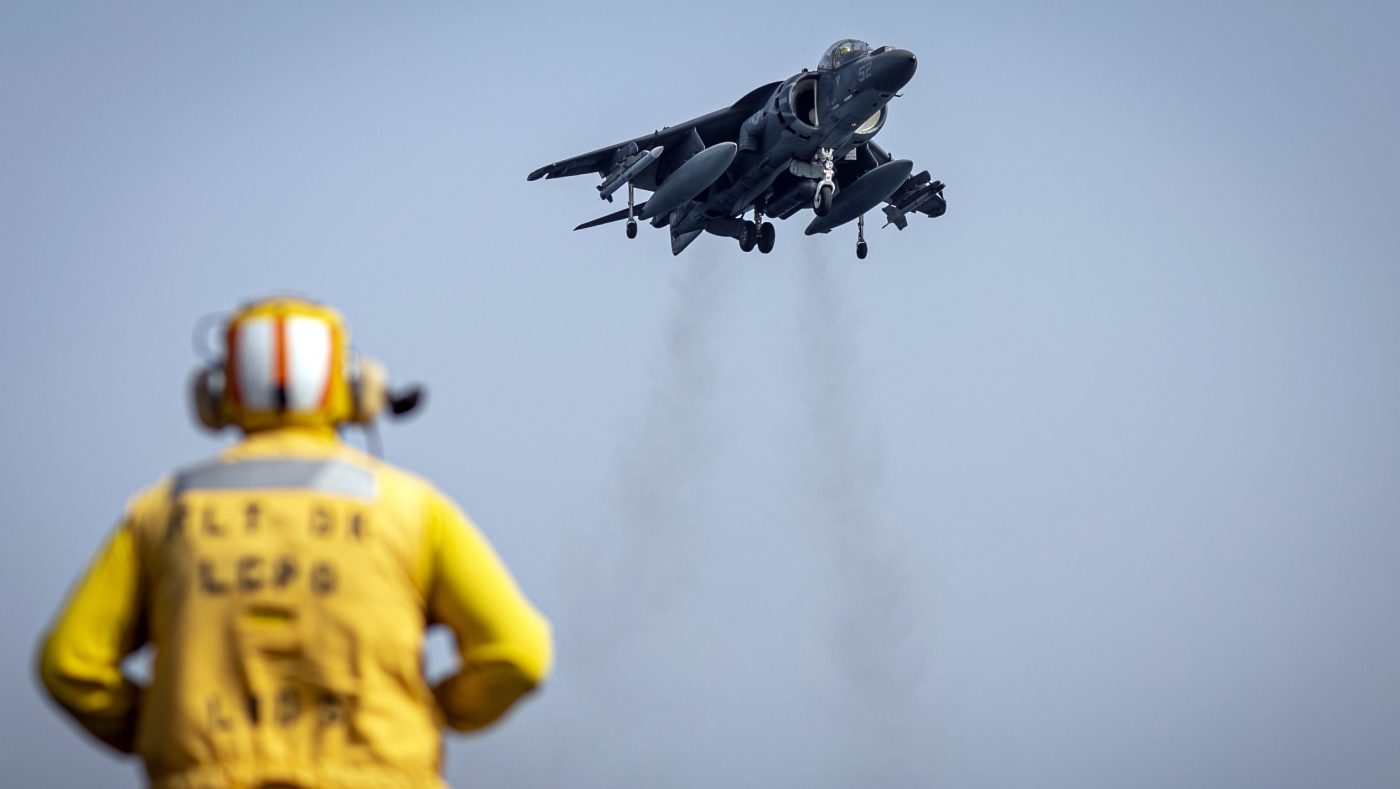
The U.S. Marine Corps officially retired the AV-8B Harrier II this week, closing a 55-year chapter for the vertical-landing fighter jet that could operate without a runway. A sundown ceremony at Marine Corps Air Station Cherry Point, North Carolina, drew more than 5,000 attendees, according to a service press release, as the last active-duty unit flew the aircraft one final time.
The Harrier, known for its ability to take off and land vertically using a single turbofan engine with four rotating nozzles, allowed Marines to deploy from Navy ships and makeshift landing zones close to combat zones. That capability made it a versatile asset in conflicts ranging from Operations Desert Shield and Desert Storm in the early 1990s to the 1999 NATO campaign in Yugoslavia, the wars in Iraq and Afghanistan, the 2011 Libya intervention, and the fight against the Islamic State in Iraq and Syria. More recently, Harriers were deployed during the 2023 Red Sea crisis against Iranian-backed Houthi forces and in the Caribbean Sea ahead of Venezuelan President Nicolas Maduro’s capture in January.

The aircraft flown at the ceremony belonged to Marine Attack Squadron 223, a unit that sent a detachment to the Caribbean last year as part of a U.S. military buildup in the region. Lt. Col. John B. Cumbie, the squadron’s commanding officer, said at the event, “As a platform that has continuously forward deployed across the globe, the Harrier will be remembered for its distinguished combat legacy, legendary Vertical/Short Take Off and Landing (V/STOL) capability, and the Marines and sailors that made the community special.”
At its peak, the Marine Corps operated roughly 280 Harriers, according to CNN. The service is now transitioning to the F-35B, a next-generation fighter that also features short takeoff and vertical landing capabilities. The shift mirrors broader modernization efforts across the military, though the Harrier will continue flying with NATO allies such as Italy and Spain.
The retirement comes amid other transitions in the defense landscape. For instance, the Pentagon is also adjusting to new threats, as highlighted by the Senate vote to raise the Capitol Police retirement age in response to a surge in security risks. Meanwhile, political shifts in Washington, like the Iowa Senate race following Senator Joni Ernst’s retirement, underscore the changing guard in both civilian and military spheres.
Marine Corps officials emphasized the Harrier’s legacy in the release, stating, “Time and again, the Harrier distinguished itself as a lethal, capable and versatile tactical air platform.” The aircraft’s ability to operate from austere environments made it a unique tool for expeditionary warfare, a niche now filled by the F-35B as the Corps continues to evolve its air combat capabilities.
The sundown ceremony marked a symbolic end to an era, but the Harrier’s influence will persist in the design and doctrine of future vertical-lift jets. For the Marines who flew and maintained it, the aircraft remains a testament to the ingenuity and adaptability required to project power from sea and shore.