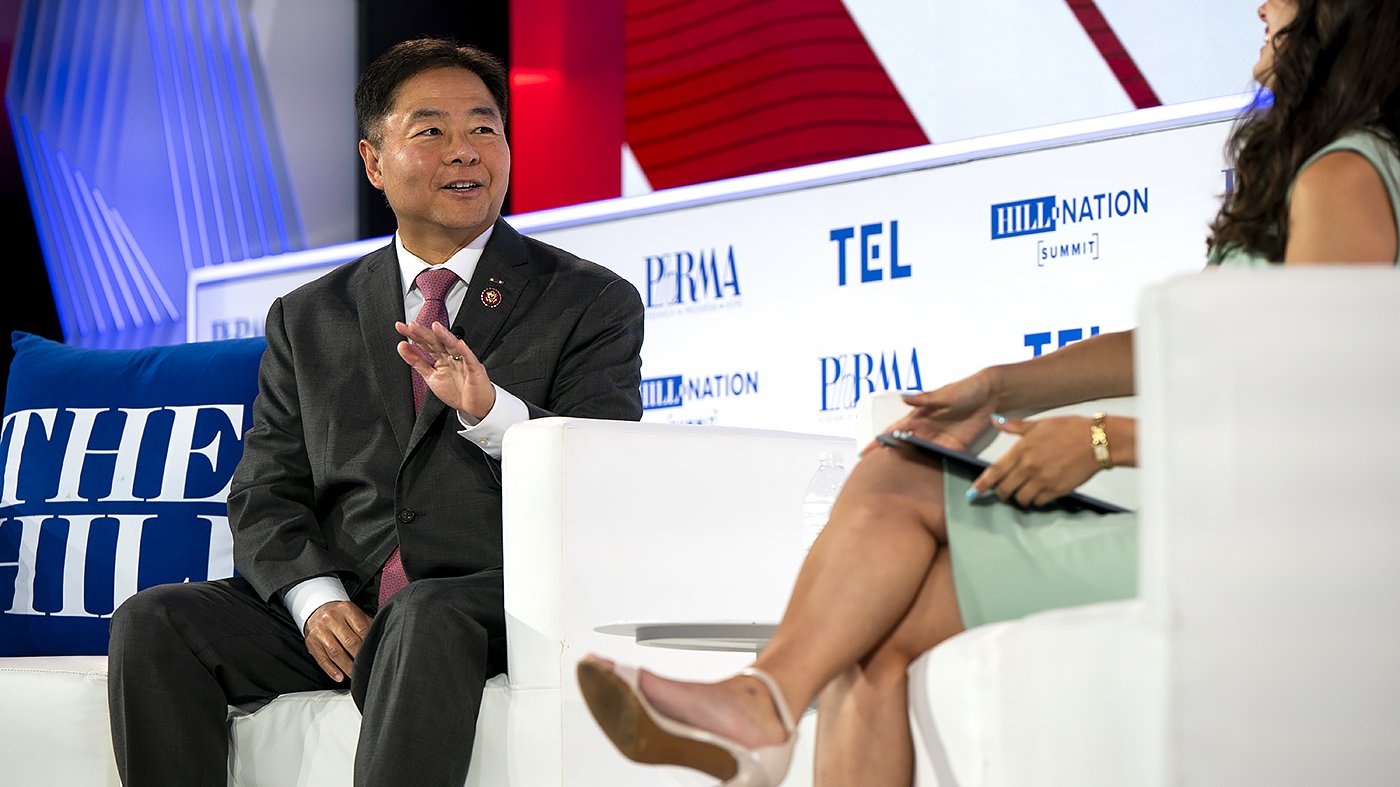
Rep. Ted Lieu (D-Calif.) took aim at House Republican leadership on Wednesday for failing to advance any legislation that would impose guardrails on artificial intelligence, even as the technology races ahead at a pace he called “freaky.”
“I am still freaked out by AI, and it’s actually accelerated much more quickly than I thought possible,” the fourth-ranking House Democrat said at The Hill’s second-annual Nation Summit, as reported by Miranda Nazzaro.
Lieu, a former Air Force officer and vocal tech policy advocate, argued that Congress must strike a balance between regulating AI and fostering innovation, especially in the context of the U.S. competition with China. But he made clear that his Republican colleagues are dropping the ball on the regulatory side.
“I cannot name a single law passed this term by House Republican leadership that has any guardrails on AI,” Lieu said, echoing a frustration he said is shared by many Americans. According to a recent Johns Hopkins University survey, nearly 80% of respondents want regulations on AI, particularly in sensitive fields like healthcare and therapy.
Lieu did acknowledge a bipartisan effort: Reps. Jay Obernolte (R-Calif.) and Lori Trahan (D-Mass.) introduced draft legislation last month proposing a national AI framework. He praised their willingness to tackle a “very difficult area,” but took issue with a key provision that would override state laws on AI model development for three years.
“If you’re going to have a ceiling on preemption, then it needs to have not only a very strong federal standard, but also take into account that AI’s moving so quickly and we don’t even know what AI’s going to look like in two or three years,” Lieu said, calling the approach “a little dangerous.” He argued for a federal floor rather than a ceiling, allowing states to experiment with stricter rules as the technology evolves.
The draft bill’s summary notes it “expressly does not preempt laws of general applicability, common law remedies, or laws regulating AI use or deployment,” but Lieu remains wary of any preemptive move that could lock in inadequate protections.
Lieu’s critique comes amid a broader debate on Capitol Hill about how to regulate AI without stifling innovation, a tension that has only grown as models like ChatGPT and Gemini rapidly improve. The California Democrat’s comments also highlight a partisan divide: while Democrats push for guardrails, many Republicans argue that too much regulation could cede ground to China.
Meanwhile, California has been a testing ground for tech policy, from EV rebates to housing battles, and Lieu’s stance reflects the state’s aggressive push for consumer protections. As AI continues to reshape industries, Lieu made clear that Congress’s inaction is eroding public trust.
“The American people, I think, are being fed up with what they see as a lack of action in Congress,” he said.