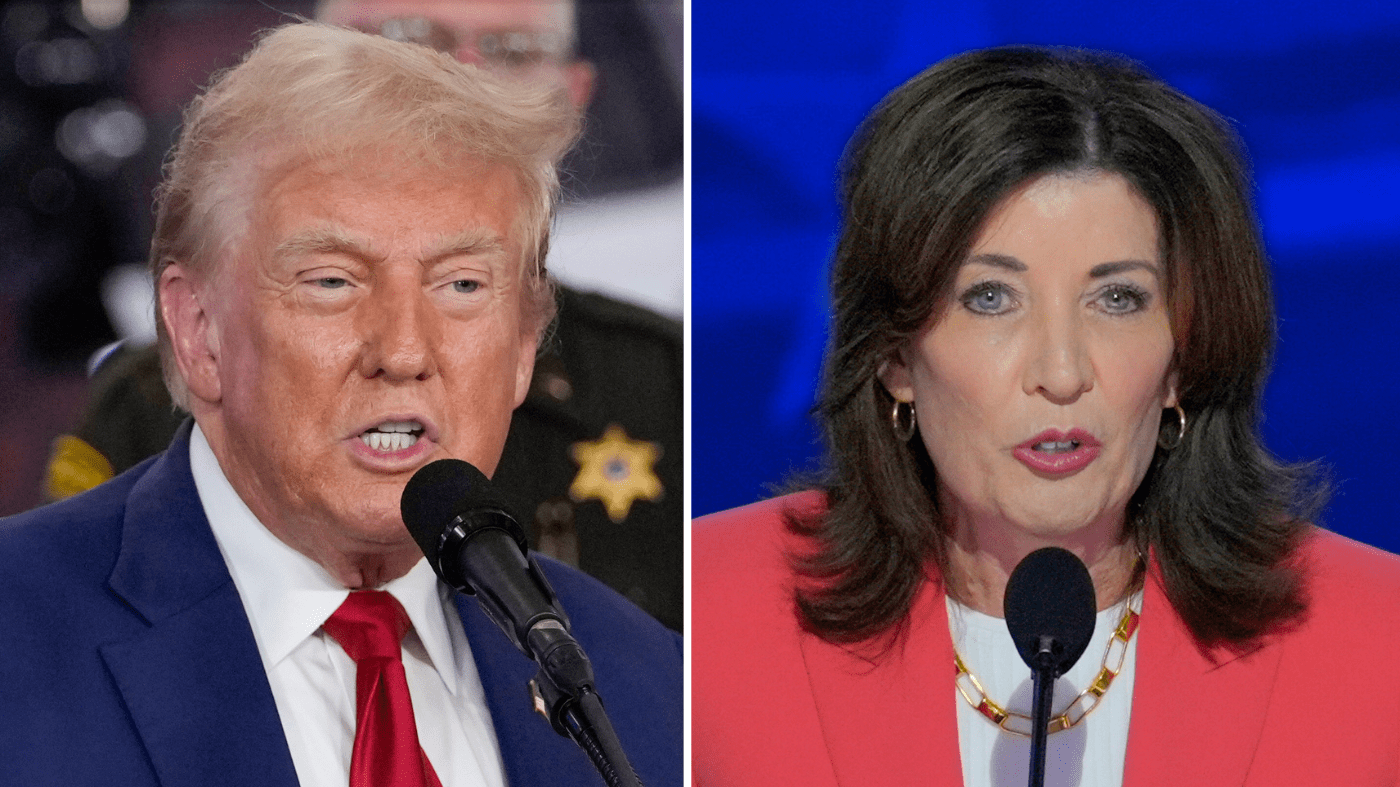
President Donald Trump launched a blistering attack on New York Governor Kathy Hochul on Wednesday, condemning her administration's unprecedented statewide halt on new hyperscale data centers as a “terrible decision” driven by political motives. In a series of posts on Truth Social, Trump accused the Democratic governor of prioritizing partisan interests over economic growth and technological competitiveness.
“Data Centers are tremendous WINS for the States and Communities that are lucky enough to get them. New York should change its Policy, IMMEDIATELY,” Trump wrote, framing the freeze as a gift to China and a blow to American innovation. He added, “The Radical Left Dumocrats must not be allowed to cause us to lose Data Centers, AI, and all of this incredible new Technology, to China, and other countries!”
The moratorium, the first of its kind in the nation, suspends state environmental permits for up to one year for data centers consuming 50 megawatts or more of power. Hochul's aides said the pause is intended to give regulators time to craft a framework that protects the environment, stabilizes the energy grid, and shields New Yorkers from rising electricity costs. The move follows a similar one-year moratorium passed by the state legislature last month, which targets facilities with a peak load exceeding 20 megawatts. It remains unclear whether Hochul will sign or veto that bill.
Trump’s critique highlights a growing partisan divide over the rapid expansion of data centers, which are critical for powering artificial intelligence systems. The Trump administration has prioritized boosting domestic AI infrastructure, and the president has repeatedly argued that data centers are “the biggest Driving Forces in the Future for Jobs.” He described them as “big, strong, bold, and Money Machines for the State in which they are built.”
Pointing to data center development in other states, Trump suggested that New York’s policy shift will push companies toward Republican-led states and “some Blue” ones that are more welcoming. He likened the tax revenue and job creation from such facilities to “liquid gold,” warning that Hochul’s freeze will undermine New York’s economic standing.
The president also emphasized that data centers must pay for their own water and power consumption, a stance gaining bipartisan support as voters grow concerned about strain on public infrastructure. This issue has been central to the White House’s push for a “Ratepayer Protection Pledge,” which major tech firms like Google, Microsoft, Meta, Oracle, xAI, OpenAI, and Amazon have already signed. The pledge commits them to building, bringing, or buying new power to support data centers without raising household electricity bills.
Democrats broadly agree that data center growth poses challenges, but they remain divided on solutions. A faction of antiestablishment Republicans has also backed similar initiatives, complicating the political landscape. The White House is reportedly planning to convene utility companies and data center developers to formalize a pledge ensuring that AI-driven demand for electricity does not lead to higher costs for consumers.
Hochul’s freeze has drawn sharp criticism from business groups and tech advocates, who argue it will stifle innovation and investment at a critical moment. With AI development surging, the battle over where to locate the massive facilities needed to train and run these systems is intensifying. New York’s decision could reshape the competitive dynamics among states vying for a slice of the growing data center market.