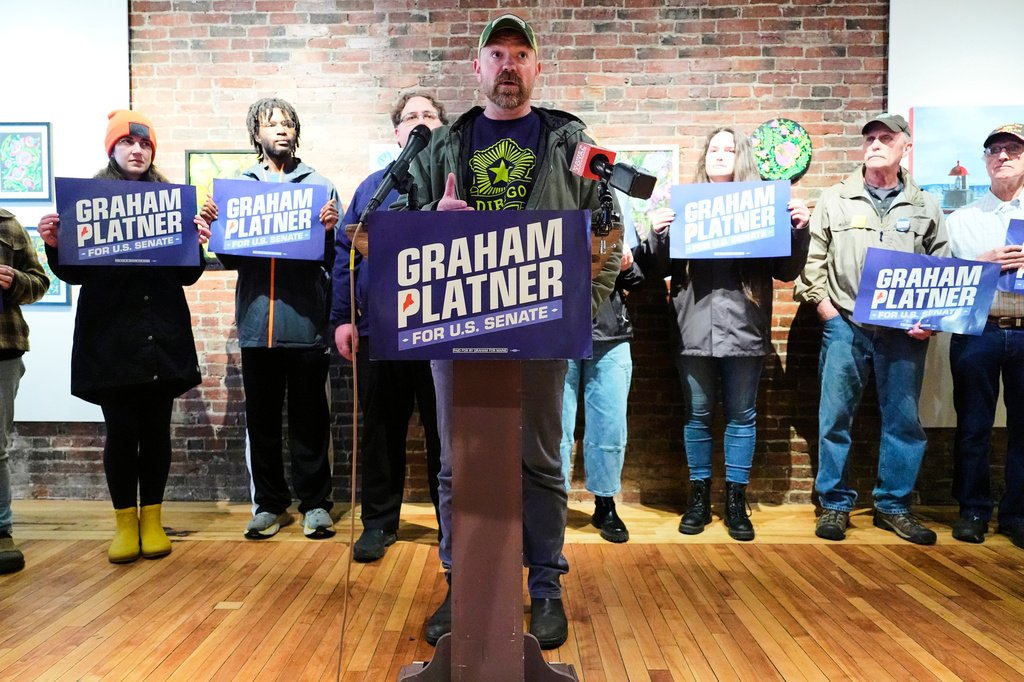
Frank Bruni, a New York Times opinion writer, has laid bare the raw calculus driving many liberals in the Trump era: fear and loathing of the president can justify supporting a candidate with a deeply troubling record. In a recent column, Bruni argues that Graham Platner, the Democratic challenger to Maine Senator Susan Collins, is far from ideal—but still the only responsible choice.
Bruni opens by acknowledging Platner's flaws: thin political experience, a history of using 'gay' as a slur, a Nazi tattoo he kept for nearly two decades, and a series of offensive social media posts. Among them: calling cops 'bastards,' using the word 'retarded,' saying war was 'the most enjoyable experience of my life,' questioning why black people don't tip, and dismissing rape concerns with crude victim-blaming. Platner has since apologized, attributing the posts to a dark period, but the record remains.

Yet Bruni writes that if he lived in Maine, he would vote for Platner. The reason: Platner is a Democrat running against a Republican, and Trump represents an 'extreme danger' to American democracy. Voting for Collins, he argues, 'would be irresponsible, nonsensical and perilous.'
This logic mirrors the rationale many Republicans used to back Trump over Kamala Harris, despite viewing him as narcissistic, vulgar, and dishonest. Trump himself warned that a Harris victory would mean 'the end of our country.' The symmetry is striking: each side sees the other as an existential threat, justifying support for deeply flawed candidates.
The dilemma raises a fundamental question: must voters always choose the lesser of two evils? Some argue no. They advocate casting a symbolic vote for a third-party candidate or staying home—as the author did during Trump's three campaigns. Such abstention, they contend, preserves principles without endorsing a candidate with a Nazi tattoo or a history of offensive rhetoric.
Another New York Times opinion writer, David French, who shares Bruni's disdain for Trump, poses a pointed question: 'If a person with an identical profile [as Platner] applied to be your manager at work, would you be comfortable hiring him? And if you’d have qualms putting such a man in charge of your team at work, why is it appropriate to put him in the U.S. Senate?'
For Bruni, the answer is clear: the stakes of a Trump presidency outweigh Platner's baggage. But for critics, that logic erodes standards and fuels the very polarization both sides decry. As voters weigh their choices, the Platner-Collins race in Maine has become a microcosm of the national political crisis—where fear, not hope, drives the ballot.